
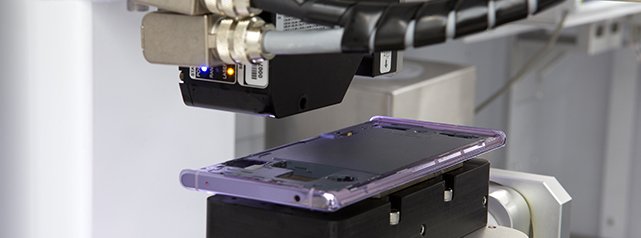
In precision manufacturing, adhesive dispensing requires more than simply applying glue.
Manufacturers need to control where the adhesive is applied, how much material is dispensed, and how consistently the process is repeated.
For flat or relatively simple surfaces, a 3-axis dispensing machine may be sufficient. However, applications involving curved edges, inclined surfaces, sidewalls, corners, or complex three-dimensional paths may require the dispensing tool to change its orientation during movement.
This is where a 5-axis vision dispensing machine can provide greater process flexibility.
By combining multi-axis motion control, rotary-axis positioning, machine vision, and automated adhesive dispensing, a 5-axis system can adapt the dispensing path and tool orientation to more complex product geometries.
What Is a 5-Axis Vision Dispensing Machine?
A conventional 3-axis dispensing machine primarily controls movement along the X, Y, and Z axes.
A 5-axis dispensing machine adds two rotary axes, commonly configured according to the machine architecture. These additional axes allow the dispensing tool or workpiece to change orientation while following the programmed dispensing path.
This additional motion flexibility is useful when adhesive must be applied to:
·Curved or inclined surfaces
·Sidewalls and corners
·Circular or annular paths
·Irregular contours
·Multi-angle surfaces
·Three-dimensional adhesive paths
A 5-axis system does not automatically make every dispensing process more accurate or faster. Its main advantage is greater motion flexibility when the product geometry and dispensing path require it.
When Do You Need a 5-Axis Dispensing Machine?
A 5-axis dispensing machine is generally worth considering when the dispensing tool needs to change orientation while following a complex or three-dimensional adhesive path.
A simple way to evaluate the requirement is:
·Flat or planar surface → 3-axis may be sufficient
·Simple curved path → 3-axis or rotary configuration may be sufficient, depending on geometry
·Multi-angle or inclined surface → additional rotary-axis flexibility may be beneficial
·Complex 3D path → 5-axis is often more suitable
The final machine configuration should be determined by the product geometry, dispensing path, required tool orientation, positioning requirements, production volume, adhesive characteristics, and process tolerances.
In other words, manufacturers do not necessarily need a 5-axis machine for every dispensing application. The objective is to select the simplest equipment configuration that can reliably meet the process requirements.
How Does Vision Dispensing Work?
Machine vision helps the dispensing system identify the actual position or features of a workpiece before the dispensing process.
Depending on the application, an industrial camera and image-processing system may identify:
·Reference marks
·Product edges
·Holes
·Contours
·Positioning features
·Other predefined visual characteristics
The control system can then calculate the difference between the programmed position and the detected position and apply the required compensation.
A typical vision-guided process is:
Vision recognition → Position calculation → Path compensation → Multi-axis movement → Adhesive dispensing
This approach is particularly useful when there are small variations between the fixture position and the actual product position.
However, machine vision should not be considered a standalone guarantee of dispensing accuracy. Actual positioning and dispensing performance depends on the complete system, including motion accuracy, vision resolution, calibration, fixture accuracy, dispensing valve, material properties, and process parameters.
What Are the Main Advantages of 5-Axis Dispensing?
Greater Flexibility for Complex 3D Paths
The primary advantage of five-axis motion is the ability to coordinate spatial movement with tool orientation.
When dispensing around curved edges, inclined surfaces, corners, or other complex geometries, the rotary axes can help maintain a more appropriate relationship between the dispensing nozzle and the workpiece.
Maintaining a suitable dispensing angle and working distance can help support consistent bead formation and reduce process issues such as uneven adhesive application or excessive material.
The actual result, however, depends on the machine structure, nozzle configuration, path planning, material properties, and process parameters.
Improved Positioning Adaptability
A vision system can compensate for certain variations in workpiece positioning.
Instead of assuming that every product is located at exactly the same programmed coordinate, the system can identify predefined features and adjust the dispensing path based on the detected position.
This can be particularly useful for products where fixture positioning or part placement has small variations.
More Consistent Automated Processing
Automated dispensing replaces repeated manual positioning and adhesive application with programmable process parameters.
Depending on the system configuration, the machine can repeatedly control:
·Dispensing path
·Dispensing speed
·Tool orientation
·Trigger position
·Material output conditions
·Motion sequence
This helps improve process repeatability and reduce variation caused by manual operation.
Five-axis systems must still be properly calibrated. Errors in the rotary axes, for example, can affect the final position and orientation of the dispensing tool.
3-Axis vs. 5-Axis Dispensing: Which One Should You Choose?
The choice between 3-axis and 5-axis dispensing should be based on the actual application rather than simply the number of axes.
A 3-axis dispensing machine is generally suitable when the dispensing path is primarily located on a flat or relatively simple surface and the dispensing tool does not need to change orientation significantly.
A 5-axis dispensing machine becomes more valuable when the application requires coordinated linear and rotary movement to follow curved, angled, or three-dimensional paths.
The key questions for equipment selection are:
·Is the dispensing surface flat, curved, angled, or three-dimensional?
·Does the nozzle need to change orientation during dispensing?
·Is the dispensing path circular, inclined, vertical, or multi-directional?
·How much positional variation exists between workpieces?
·Is machine vision required for position correction?
·What adhesive is being used?
·What bead size and dispensing consistency are required?
·What cycle time and production volume are expected?
·Is the product geometry likely to change between models?
The answers to these questions provide a more reliable basis for equipment selection than simply choosing a machine with more axes.
What Materials Can a 5-Axis Dispensing Machine Handle?
Depending on the dispensing valve and material delivery system, automated dispensing equipment may be configured for materials such as:
·Silicone
·Epoxy
·UV adhesives
·Structural adhesives
·Thermal interface materials
·Other industrial adhesives
Material compatibility should be evaluated according to viscosity, curing characteristics, flow behavior, component ratio, pot life, temperature requirements, and dispensing method.
The dispensing valve, pressure or pumping system, nozzle, and process parameters should also be selected according to the specific adhesive.
Therefore, the same five-axis motion platform may require different dispensing configurations for different materials or applications.
Typical Applications of 5-Axis Vision Dispensing
5-axis vision-guided dispensing can be considered for products where conventional dispensing equipment has difficulty maintaining the required dispensing path or tool orientation.
Typical application areas include:
·Consumer electronics
·Smartphone components
·Camera modules
·Smart wearables
·Automotive electronics
·Automotive components
·Medical devices
·Optical and precision components
·Curved housings
·Complex 3D-structured products
The specific equipment configuration depends on the product geometry and dispensing process. Five-axis dispensing is particularly relevant when the adhesive path involves multiple directions or when the dispensing tool must maintain a controlled orientation relative to the product surface.
How Does a 5-Axis Vision Dispensing Process Work?
A typical automated process can be organized into six stages.
Product Loading
The workpiece is positioned on the dispensing platform or a customized fixture.
Vision Recognition
The industrial camera identifies predefined product features and determines the actual workpiece position.
Position Compensation
The control system calculates the difference between the programmed position and the detected position and applies the required compensation.
Multi-Axis Movement
The X, Y, and Z axes control the spatial position while the rotary axes adjust the dispensing tool orientation according to the programmed path.
Adhesive Dispensing
The dispensing valve applies adhesive according to the programmed path, speed, trigger position, and material parameters.
Process Inspection
Depending on the system configuration, visual or 3D inspection can be integrated to evaluate the dispensing result or adhesive path.
The overall process can therefore be summarized as:
Product Loading → Vision Recognition → Position Compensation → 5-Axis Movement → Adhesive Dispensing → Inspection
Why Combine 5-Axis Motion with Machine Vision?
Five-axis motion and machine vision address different parts of the dispensing process.
Five-axis motion provides greater freedom to position and orient the dispensing tool.
Machine vision helps determine where the actual workpiece or predefined features are located.
Dispensing control manages how and when the adhesive is applied.
Combining these functions can provide a more adaptable solution for complex automated dispensing applications.
The value of a five-axis vision system therefore comes not simply from adding two rotary axes, but from coordinating:
5-Axis Motion + Machine Vision + Dispensing Control + Process Programming
ZiQi 5-Axis Vision Dispensing Solutions
Shenzhen ZiQi Technology Co., Ltd. develops automated dispensing solutions for precision manufacturing applications.
ZiQi's dispensing systems can be configured according to the product geometry, adhesive characteristics, dispensing path, positioning requirements, and production process.
Depending on the application, a dispensing system can integrate multi-axis motion, machine vision, rotary dispensing, programmable process control, customized fixtures, and other automation functions.
For applications involving curved surfaces, complex contours, multi-angle dispensing, visual positioning, or customized production requirements, a five-axis configuration can provide greater motion flexibility than conventional 3-axis equipment.
Before selecting the final machine configuration, ZiQi recommends evaluating the actual product sample, adhesive properties, dispensing path, required bead characteristics, positioning requirements, and production targets through process testing.
This application-based approach helps ensure that the selected dispensing system matches the actual manufacturing requirements rather than simply adding unnecessary machine functions.
Frequently Asked Questions
What is a 5-axis vision dispensing machine?
A 5-axis vision dispensing machine combines three linear axes, two rotary axes, machine vision, and an automated dispensing system. It can detect workpiece features and control the dispensing tool along more complex paths and orientations.
What is the difference between a 3-axis and 5-axis dispensing machine?
A 3-axis machine primarily controls X, Y, and Z movement. A 5-axis machine adds two rotary axes, providing additional freedom to change the dispensing tool or workpiece orientation while following the dispensing path.
Can a 5-axis dispensing machine dispense adhesive on curved surfaces?
Yes, provided that the machine's rotary-axis range, nozzle configuration, fixture, and motion path are suitable for the specific product geometry. Five-axis motion can provide the orientation flexibility needed for many curved and three-dimensional dispensing applications.
Can a 5-axis dispensing machine dispense on vertical or inclined surfaces?
It can be suitable for vertical or inclined surfaces when the machine has sufficient rotary-axis range and the dispensing tool, fixture, nozzle, and adhesive process are properly configured for the application.
Does every dispensing application require five axes?
No. Flat and relatively simple dispensing applications may only require three-axis motion. Five-axis equipment becomes more valuable when the dispensing process involves complex geometry, changing tool orientation, or multi-directional three-dimensional paths.
How do I choose between a 3-axis and 5-axis dispensing machine?
Start with the product geometry and dispensing path. Evaluate whether the nozzle needs to change orientation, whether vision-based positioning is required, the adhesive characteristics, required dispensing consistency, cycle time, and production volume. These factors provide a better basis for equipment selection than axis count alone.
Conclusion
A 5-axis vision dispensing machine combines multi-axis motion, machine vision, and automated adhesive dispensing for applications that require greater path and orientation flexibility.
Compared with conventional 3-axis dispensing, five-axis motion can provide greater flexibility for curved, angled, and three-dimensional adhesive paths, while machine vision can help compensate for workpiece-position variations.
For manufacturers working with complex product geometries, multi-angle dispensing requirements, or precision adhesive processes, a properly configured 5-axis vision-guided dispensing system can provide a flexible and repeatable automation solution.