
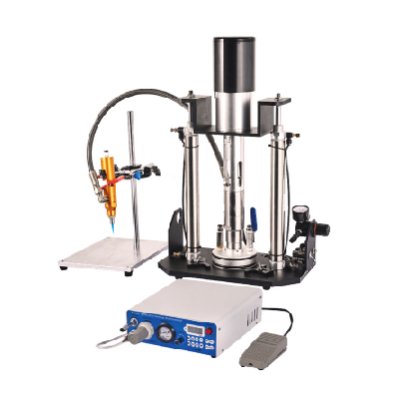
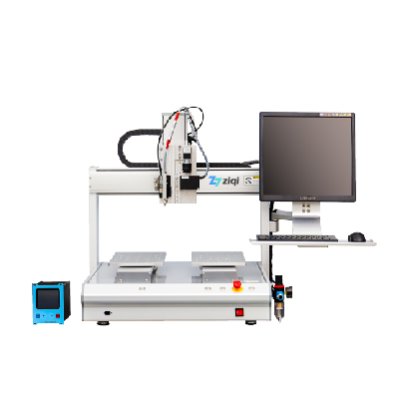
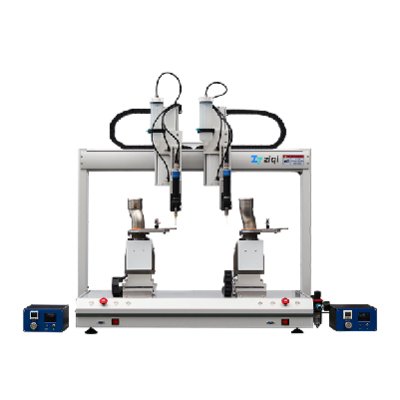
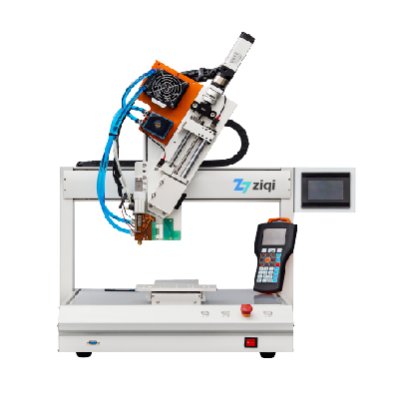
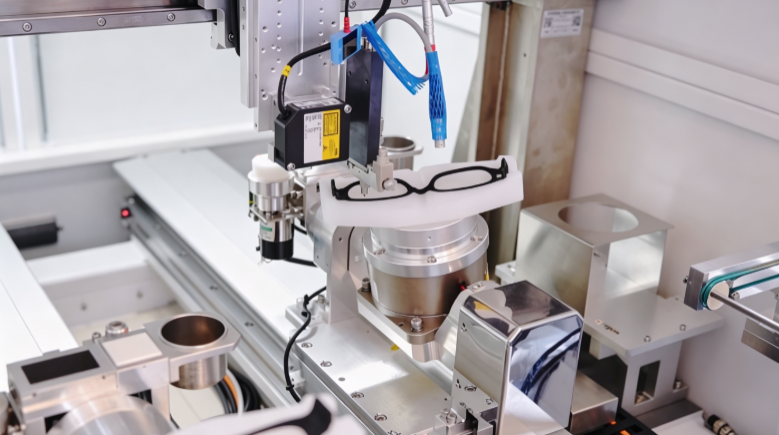
As AR glasses become smaller, lighter, and more highly integrated, adhesive dispensing is becoming more challenging. Curved frames, inclined surfaces, narrow bonding areas, and compact optical components can make conventional 3-axis dispensing difficult for certain applications.
So, when do AR glasses manufacturers need a 5-axis vision dispensing machine?
A 5-axis vision dispensing machine is particularly useful when adhesive must be applied along curved, inclined, recessed, or three-dimensional surfaces and the dispensing valve needs to change orientation during the dispensing process. By combining multi-axis motion, rotary-axis control, machine vision, and programmable dispensing parameters, the system can adapt the dispensing path to the actual position and geometry of the workpiece.
For flat surfaces and simple adhesive paths, however, a 3-axis dispensing machine may be sufficient. The right solution depends on the product geometry, adhesive, required bead size, positioning tolerance, cycle time, and production volume.
For manufacturers of AR glasses, optical modules, waveguide assemblies, and miniature structural components, the key question is therefore not simply “How many axes does the machine have?” but rather “Does the dispensing process require controlled nozzle orientation and flexible 3D motion?”
Quick Answer: When Do AR Glasses Need 5-Axis Dispensing?
AR glasses do not automatically require a 5-axis dispensing machine.
A 3-axis dispensing machine can be suitable when:
·The dispensing surface is mainly flat
·The adhesive path is simple
·The nozzle can remain perpendicular to the workpiece
·The product geometry does not require continuous angle adjustment
A 5-axis dispensing machine becomes more valuable when:
·The adhesive path follows a curved surface
·Surface angles change along the dispensing path
·The dispensing valve needs to change orientation
·Adhesive must be applied in narrow or recessed areas
·Multiple three-dimensional surfaces need to be processed
·Greater flexibility is required for different product geometries
In short, 5-axis dispensing is most valuable when both the position and orientation of the dispensing valve need to be controlled during the process.
Why Is Adhesive Dispensing Difficult for AR Glasses?
AR glasses are not simply smaller versions of conventional electronic products. Their compact structures may integrate optical components, sensors, electronic modules, and mechanical parts within a limited space.
This creates several challenges for automated adhesive dispensing.
Complex 3D Geometry
AR glasses may contain:
·Curved optical components
·Waveguide components
·Irregularly shaped frames
·Inclined surfaces
·Narrow grooves
·Miniature optical and electronic modules
Adhesive may need to follow a curved or non-horizontal path rather than a simple straight line on a flat surface.
A conventional 3-axis dispensing machine controls X, Y, and Z linear movement and can handle many flat or relatively simple applications. However, when the surface angle changes, simply moving the nozzle in XYZ may not be enough to maintain the required nozzle-to-surface relationship.
A 5-axis dispensing system adds two rotary axes to the three linear axes. Depending on the machine architecture, these rotary axes may control the dispensing head, the workpiece, or a combination of both.
This additional rotational freedom allows the dispensing system to maintain the required orientation while following more complex dispensing paths.
Precision Adhesive Application
Adhesives may be used in AR glasses manufacturing for:
·Bonding
·Component fixation
·Structural sealing
·Protection
·Assembly of optical and mechanical components
Incorrect adhesive placement or inconsistent bead formation can potentially result in:
·Poor bonding
·Insufficient sealing
·Excess adhesive
·Optical contamination
·Component misalignment
·Inconsistent product quality
For optical assemblies in particular, controlling where and how adhesive is deposited is important because excessive or misplaced adhesive may interfere with adjacent components or surfaces.
A vision-guided dispensing system can identify the actual position of the workpiece and compensate for positioning deviations before or during dispensing.
However, dispensing accuracy is not determined by the machine's motion axes alone. Actual results depend on the motion platform, vision system, calibration, dispensing valve, adhesive properties, workpiece tolerances, nozzle, and process conditions.
Therefore, machine accuracy and dispensing performance should be validated through application testing rather than relying on a single nominal specification.
3-Axis vs. 5-Axis Dispensing for AR Glasses
One of the most important equipment-selection questions is:
Is a 3-axis dispensing machine enough, or does the AR glasses application require 5-axis motion?
The answer depends primarily on the geometry of the dispensing surface and the required nozzle orientation.
When Is 3-Axis Dispensing Enough?
A 3-axis machine can be an effective solution when:
·The dispensing surface is primarily flat
·The adhesive path is simple
·The nozzle can remain at a fixed orientation
·Product positioning is sufficiently controlled
·Complex 3D motion is not required
For these applications, choosing 5-axis equipment may add unnecessary mechanical complexity and cost.
When Should Manufacturers Consider 5-Axis Dispensing?
5-axis motion becomes more valuable when:
·The adhesive path follows a curved surface
·The workpiece contains different surface angles
·The dispensing valve must change orientation during dispensing
·Adhesive must be applied inside narrow or recessed areas
·Several surfaces need to be processed in one cycle
·Product geometry varies significantly between models
Therefore, 5-axis does not automatically mean better. The correct machine should be selected according to the actual dispensing process.
How Does a 5-Axis Vision Dispensing Machine Work?
A typical 5-axis vision dispensing system combines three major technologies:
·5-axis motion control
·Machine vision positioning
·Precision dispensing and process control
·5-Axis Motion Control
The system coordinates X, Y, and Z linear movement with two additional rotary axes to control the position and orientation of the dispensing system.
Instead of simply moving the nozzle from point A to point B, the machine can coordinate its linear and rotary movements along a programmed path.
This can be useful for:
·Curved frames
·Inclined surfaces
·Circular paths
·Irregular adhesive grooves
·Three-dimensional bonding areas
Depending on the machine design, the rotary axes may be assigned to the dispensing head or workpiece. The exact kinematic configuration should therefore be matched to the required dispensing path.
Machine Vision Positioning
Machine vision provides information about the actual position of the workpiece.
Before dispensing, the vision system may identify:
·Product edges
·Reference marks
·Component boundaries
·Positioning features
·Defined dispensing areas
The system can then compare the detected position with the programmed coordinates and compensate for positioning deviations.
For transparent, translucent, or reflective optical components, lighting configuration, camera selection, calibration, and image-processing methods are particularly important.
Suitable illumination can improve image contrast and help maintain positioning stability, but the appropriate vision configuration should be determined through application testing.
Precision Dispensing and Process Control
Motion control alone does not determine dispensing quality.
Depending on the adhesive and application, important process parameters may include:
·Dispensing speed
·Adhesive pressure
·Adhesive temperature
·Dispensing volume
·Valve opening time
·Nozzle height
·Nozzle angle
·Path trajectory
The dispensing system may use different technologies depending on adhesive viscosity, required bead size, and production requirements, such as:
·Syringe or pressure dispensing
A programmable control system allows these parameters to be managed more consistently across production batches.
For automated production lines, process data can also be integrated with production-management or MES systems where required.
Key Applications of 5-Axis Dispensing in AR Glasses Manufacturing
Optical Module Bonding
Miniaturized optical modules often require controlled adhesive application within limited spaces.
A 5-axis dispensing system can follow defined adhesive paths around optical and structural
components while adjusting the dispensing orientation according to the application geometry.
Potential applications include:
·Optical component bonding
·Module fixation
·Structural sealing
·Protective adhesive application
The adhesive and dispensing method should be selected according to the optical material, curing process, bond-line requirements, and environmental conditions.
Adhesive Dispensing for Waveguide Assembly
Waveguide technology is used in many AR optical architectures.
During waveguide assembly, adhesive may be required in precisely defined bonding areas while adjacent optical surfaces must be protected from unwanted adhesive.
A vision-guided dispensing system can detect positioning features and guide the dispensing path according to the actual workpiece position.
For transparent or highly reflective components, vision calibration and lighting design are important factors in achieving reliable positioning.
The specific adhesive process depends on the waveguide material, optical structure, bonding requirements, and curing method.
Curved Frame Adhesive Dispensing
AR glasses frames may contain curved edges, narrow grooves, and irregular bonding surfaces.
For these applications, maintaining a suitable nozzle orientation can be difficult with conventional 3-axis motion alone.
The rotary axes of a 5-axis system provide additional freedom to adjust the dispensing orientation along the programmed path.
This can help support:
·Curved-path dispensing
·Corner transitions
·Narrow-area accessibility
·More consistent bead formation
·Improved process repeatability
The actual dispensing result still depends on the adhesive, nozzle, dispensing parameters, surface geometry, and machine configuration.
Adhesive Application Around Optical Components
Some AR glasses assembly processes require adhesive to be applied around optical components or their supporting structures.
In these cases, the dispensing path may need to pass through compact areas while maintaining a controlled distance and orientation between the nozzle and the workpiece.
A vision-guided 5-axis system can provide greater flexibility for these complex paths, particularly when component positioning varies between cycle.
How to Choose a 5-Axis Vision Dispensing Machine for AR Glasses?
Equipment selection should start with the actual dispensing application rather than simply choosing the machine with the highest number of axes.
Before selecting a system, consider the following factors.
What Is the Shape of the Dispensing Surface?
Determine whether the adhesive path is:
·Flat
·Inclined
·Curved
·Recessed
·Three-dimensional
The more complex the surface geometry, the more valuable multi-axis motion can become.
Does the Nozzle Need to Change Orientation?
This is one of the most important questions.
If the nozzle needs to remain perpendicular or maintain a specific angle relative to a changing surface, rotary-axis control may be required.
If the nozzle can remain at a fixed orientation, a 3-axis solution may be sufficient.
What Adhesive Is Being Dispensed?
Adhesive properties strongly influence the dispensing system.
Consider:
·Viscosity
·Curing method
·Temperature sensitivity
·Required dispensing volume
·One-component or two-component formulation
·Required bead width
·Pot life for two-component adhesives
The adhesive should be tested with the dispensing valve and material-delivery system before final equipment selection.
What Bead Size and Dispensing Volume Are Required?
Required bead width and adhesive volume affect the selection of:
·Nozzle diameter
·Dispensing speed
·Pressure and flow control
A small optical bonding application may require a very different dispensing system from structural frame sealing.
Is Machine Vision Required?
Vision positioning can be particularly useful when:
·Product positioning varies between cycles
·Component alignment tolerances are tight
·Adhesive paths are difficult to locate mechanically
·Multiple product models need to be processed
·Optical or mechanical reference features can be detected reliably
·However, vision is not automatically required for every application.
What Is the Required Cycle Time?
For mass production, the dispensing solution should balance:
Accuracy + repeatability + dispensing speed + loading/unloading efficiency
A machine with excellent motion accuracy is not necessarily the best production solution if its overall cycle time cannot meet the manufacturing target.
How Many Product Models Need to Be Supported?
AR glasses manufacturers may need to produce different frame designs, optical configurations, or product variants.
A programmable vision dispensing system can provide greater flexibility for product changeovers when the mechanical configuration, fixtures, dispensing process, and software architecture are designed accordingly.
The number of models that one machine can support should therefore be evaluated through actual production requirements and application testing.
Why Combine Machine Vision with 5-Axis Dispensing?
The value of a 5-axis dispensing machine does not come from additional motion axes alone.
The larger advantage comes from combining:
Multi-axis motion + machine vision + precision dispensing + digital process control
Each technology performs a different function:
Machine vision determines where the workpiece or dispensing feature is located.
·Motion control determines how the dispensing system reaches the programmed position.
·Rotary axes provide additional freedom to control the dispensing orientation.
·The dispensing system controls adhesive flow and deposition.
·Process control manages parameters and repeatability.
Together, these technologies provide a more flexible solution for complex adhesive applications in AR glasses manufacturing.
Why Choose ZiQi for AR Glasses Dispensing?
For AR glasses and other miniature optical-electronic products, dispensing requirements can vary significantly from one application to another.
ZiQi develops automated dispensing equipment and customized automation solutions for precision manufacturing applications.
Its dispensing solutions can be configured around factors such as:
·Product geometry
·Adhesive characteristics
·Dispensing path
·Required bead size
·Vision positioning requirements
·Production cycle time
·Product changeover requirements
Depending on the application, a dispensing system can be configured with different dispensing technologies, machine-vision systems, motion-control architectures, and material-delivery systems.
For complex AR glasses applications, the equipment should be evaluated using the actual workpiece, adhesive, dispensing path, and required production parameters.
Application testing is therefore an important step before finalizing the machine configuration.
Frequently Asked Questions
What is a 5-axis vision dispensing machine?
A 5-axis vision dispensing machine is an automated dispensing system that combines multi-axis motion, rotary-axis control, and machine vision to apply adhesive along complex paths and surfaces with controlled positioning and nozzle orientation.
Why is 5-axis dispensing suitable for AR glasses?
AR glasses often contain curved frames, inclined surfaces, narrow grooves, optical components, and compact structures. A 5-axis system provides greater flexibility for dispensing on these complex geometries than conventional 3-axis motion.
What is the difference between 3-axis and 5-axis dispensing?
A 3-axis system primarily controls X, Y, and Z movement. A 5-axis system adds rotary-axis movement, allowing the dispensing valve to change orientation while following a dispensing path. This makes 5-axis equipment better suited to many curved and three-dimensional applications.
Does a 5-axis dispensing machine require machine vision?
Not every application requires vision. However, machine vision is useful when product positioning varies, alignment tolerances are tight, or the dispensing path needs to be located automatically.
Can a 5-axis dispensing machine dispense on curved surfaces?
Yes. The combination of linear and rotary motion allows the dispensing valve to adjust its orientation while following a curved trajectory, making the system suitable for many curved-surface dispensing applications.
How accurate is a 5-axis vision dispensing machine?
Accuracy depends on the complete system, including the motion platform, vision system, calibration, dispensing valve, adhesive, workpiece tolerance, and production conditions. The required accuracy should therefore be verified through application testing rather than relying on a single nominal specification.
Conclusion: Choosing the Right Dispensing System for AR Glasses
As AR glasses move toward smaller dimensions, more complex structures, and higher levels of integration, adhesive dispensing becomes increasingly demanding.
A 5-axis vision dispensing machine can provide significant advantages when adhesive must be applied along curved, inclined, recessed, or three-dimensional surfaces and the dispensing orientation needs to change during the process.
However, 5-axis is not automatically the best choice for every application.
The correct dispensing solution should be selected according to:
Product geometry + adhesive properties + dispensing path + bead requirements + nozzle orientation + vision requirements + accuracy + cycle time + production volume
For manufacturers developing AR glasses, optical modules, waveguide assemblies, and other precision products, a vision-guided 5-axis dispensing system can provide a flexible foundation for automated adhesive application.
The most reliable approach is to evaluate the actual product and adhesive through application testing and then configure the machine around the proven dispensing process.