
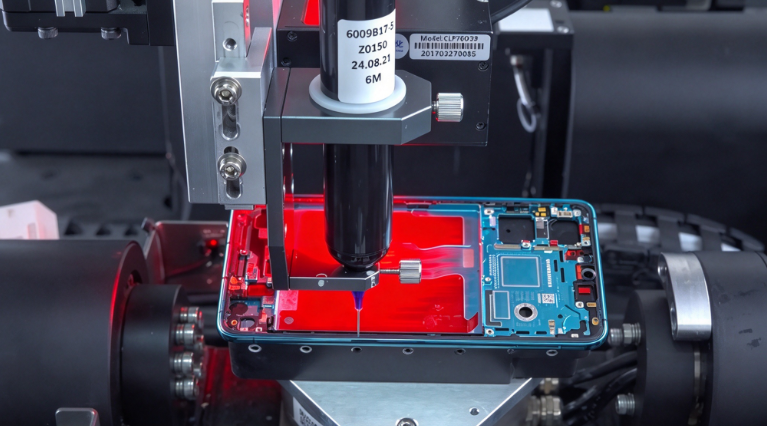
Can adhesive be applied around a smartphone screen frame without manually flipping and repositioning the workpiece?
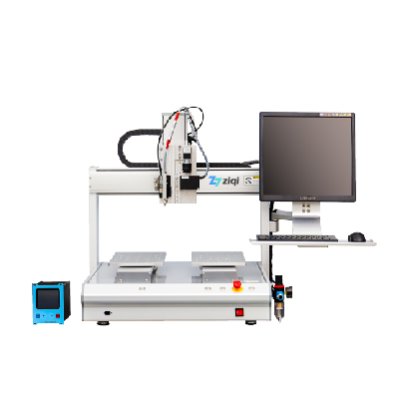
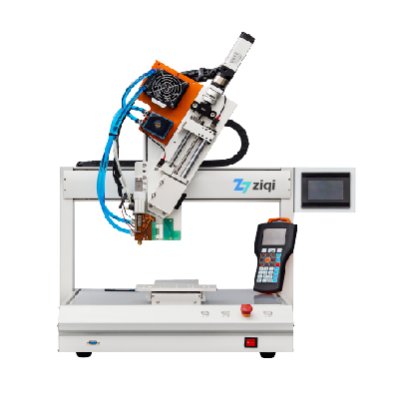
For suitable screen-frame geometries, a 5-axis vision dispensing machine can complete the required adhesive path in a single workpiece setup. By combining multi-axis motion, vision positioning, and an appropriate dispensing valve, the system can follow complex frame contours while compensating for workpiece-position deviations.
This approach can reduce manual repositioning, improve dispensing-path consistency, and support automated adhesive application for smartphone displays and other 3C electronic components.
The key is not simply using more axes. The dispensing system must match the screen geometry, adhesive properties, bead requirements, positioning tolerance, and production cycle time.
Why Is Smartphone Screen Frame Dispensing Challenging?
Modern smartphone screen frames are becoming thinner, more compact, and more complex.
Adhesive may need to be applied along narrow sealing areas that include straight sections, corners, angled sections, or other changes in path direction.
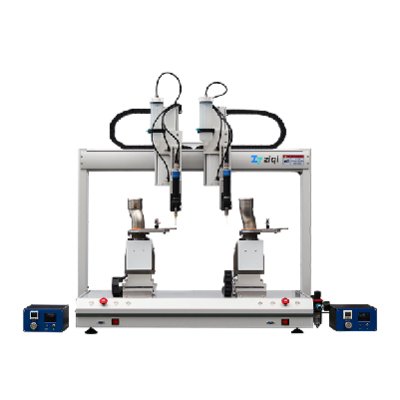
With a conventional 3-axis dispensing system, the dispensing valve generally maintains a fixed orientation while moving along the programmed X, Y, and Z axes. Simple planar paths can be processed efficiently, but applications that require changes in valve orientation or more complex approach directions may require additional motion capability.
Depending on the product design, repeated handling can introduce several challenges:
·Manual flipping or repositioning of the workpiece
·Position deviations between processing sections
·Inconsistent adhesive bead alignment
·Adhesive overflow or insufficient coverage
·Additional handling of sensitive display components
·Longer cycle times
·Increased operator involvement
For high-volume display assembly, reducing unnecessary handling can help create a more stable and repeatable dispensing process.
How Does 5-Axis Motion Enable One-Setup Dispensing?
A 5-axis dispensing machine adds rotational motion to conventional linear motion, allowing the dispensing valve to change its orientation while following the programmed path.
For suitable smartphone screen-frame applications, this can allow the valve to approach different sections of the frame from the required direction without manually rotating the workpiece.
Instead of:
Dispense → Flip → Reposition → Dispense
the process can be organized as:
Load → Vision Positioning → Path Compensation → 5-Axis Dispensing → Unload
The main advantage is not simply the additional axes themselves. The benefit comes from using the available motion to maintain an appropriate valve orientation relative to the dispensing path.
This can be particularly useful when the application includes:
·Changes in dispensing direction
·Angled or curved frame sections
·Non-planar dispensing requirements
·Restricted approach directions
·Complex sealing contours
·Applications where repeated workpiece repositioning is undesirable
A 5-axis configuration is not required for every smartphone screen application. For simple, flat dispensing paths, a conventional 3-axis system may provide sufficient motion capability.
How Does Vision Positioning Improve Dispensing Accuracy?
Even when a workpiece is correctly loaded, its actual position may vary slightly from the programmed position because of loading tolerances, fixture variation, or product-to-product differences.
For narrow adhesive paths, even small positional deviations can affect bead placement.
A vision dispensing system can identify reference features on the workpiece and calculate the difference between the actual position and the programmed coordinates.
The basic process is:
Vision Detection → Position Calculation → Path Compensation → Dispensing
The controller can then adjust the dispensing path according to the detected deviation.
For smartphone screen frames, vision positioning can help maintain more consistent adhesive placement along narrow sealing areas and complex contours.
Vision systems can also support multiple dispensing recipes for different screen models. When changing products, operators can select the corresponding program instead of manually redefining the dispensing path.
The actual achievable accuracy depends on the camera system, optics, fixture stability, machine mechanics, product tolerance, and application requirements. Vision positioning should therefore be evaluated together with the complete dispensing system rather than as an independent accuracy specification.
When Is Non-Contact Jet Dispensing Useful?
The motion system determines how the dispensing valve moves. The dispensing valve itself determines how the adhesive is deposited.
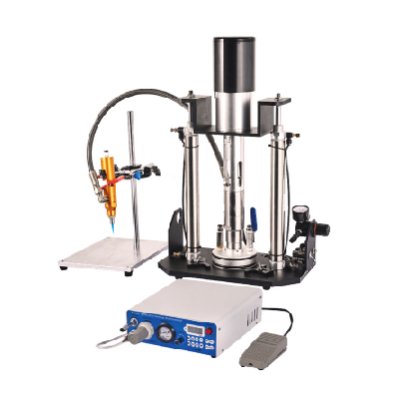
For applications where the nozzle should minimize physical contact with the workpiece, a piezoelectric non-contact jetting valve can be considered.
Unlike contact dispensing, a jetting valve ejects controlled amounts of adhesive through the nozzle without requiring the nozzle to travel directly along the workpiece surface.
This can be useful for applications requiring:
·Fine adhesive deposits
·High dispensing frequency
·Controlled adhesive volume
·Narrow dispensing paths
·Reduced nozzle-to-surface contact
·High-speed adhesive application
However, piezoelectric jetting is not suitable for every adhesive or every application. Dispensing performance depends on factors such as:
·Adhesive viscosity
·Adhesive rheology
·Curing characteristics
·Nozzle configuration
·Jetting frequency
·Adhesive volume
·Required bead or dot dimensions
·Material temperature
·Dispensing speed
For this reason, adhesive and sample testing should be performed before selecting the final valve configuration.
How Do 5-Axis Motion, Vision and Jet Dispensing Work Together?
These technologies solve different parts of the dispensing process.
5-axis motion provides additional flexibility for valve movement and orientation.
Vision positioning detects workpiece-position variation and supports automatic path compensation.
The dispensing valve controls how adhesive is deposited onto the product.
When these functions are integrated into one system, the production process can follow a workflow such as:
Workpiece Loading
The smartphone screen or frame is placed on the machine platform or production line.
Vision Detection
The camera identifies predefined reference features and determines the actual workpiece position.
Automatic Position Compensation
The control system calculates the detected deviation and adjusts the programmed dispensing path.
5-Axis Motion
The dispensing valve follows the required frame contour while adjusting its orientation according to the programmed motion path.
Adhesive Dispensing
The selected dispensing valve applies the adhesive along the required sealing path.
For applications requiring non-contact dispensing, a suitable piezoelectric jetting valve can be integrated into the system.
Process Completion
After dispensing, the workpiece can proceed to the next assembly or curing process without manual repositioning between dispensing sections.
This workflow can reduce unnecessary handling while maintaining a consistent relationship between the workpiece, dispensing path, and valve position.
When Should You Consider a 5-Axis Smartphone Screen Dispensing Machine?
A 5-axis dispensing system may be worth considering when the application includes several of the following conditions:
·The dispensing path requires changes in valve orientation
·The frame contains complex or multi-directional contours
·The workpiece is difficult to flip repeatedly
·Narrow sealing areas require accurate adhesive placement
·Product-position variation needs to be compensated automatically
·Multiple screen models must be processed
·Manual repositioning affects production consistency
·The production line requires automated dispensing
·Non-contact adhesive application is preferred
For simple, flat dispensing paths, a 3-axis system may be sufficient.
The appropriate configuration should be determined based on the actual application rather than the number of axes alone.
Important selection factors include:
Product geometry + adhesive properties + bead dimensions + dispensing speed + positioning tolerance + valve type + cycle time + automation requirements
What Should Be Considered Before Selecting a Screen Dispensing Machine?
Before selecting a dispensing system, manufacturers should evaluate the complete dispensing process.
Product Geometry
Determine whether the adhesive path is planar, curved, angled, or requires changes in valve orientation.
Adhesive Characteristics
Evaluate viscosity, rheology, curing method, temperature sensitivity, and required dispensing volume.
Bead Requirements
Define the required bead width, height, continuity, tolerance, and adhesive coverage.
Positioning Accuracy
Consider product tolerances, fixture repeatability, camera resolution, and the required dispensing tolerance.
Valve Technology
Depending on the adhesive and application, the system may use a contact dispensing valve, jetting valve, screw valve, pressure-driven valve, or another suitable configuration.
Production Requirements
Cycle time, product changeover, automation level, and integration with upstream and downstream equipment should also be considered.
Sample testing is recommended before final equipment selection so that the machine, valve, adhesive, and dispensing parameters can be evaluated as one process.
Benefits of One-Setup Dispensing for Smartphone Screen Frames
When the application is suitable for 5-axis dispensing, keeping the workpiece in one consistent position can simplify the overall process.
Potential benefits include:
·Reduced manual flipping and repositioning
·More consistent dispensing coordinates
·Improved adhesive-path alignment
·Fewer handling operations
·Easier integration with automated production lines
·Improved process repeatability
·Flexible processing of complex dispensing paths
The actual improvement in cycle time, accuracy, and production efficiency depends on the product geometry, adhesive, machine configuration, dispensing valve, and operating conditions.
Frequently Asked Questions
Can a 5-axis dispensing machine dispense around a smartphone screen without flipping it?
For suitable screen-frame geometries, a 5-axis system can complete the required dispensing path in a single workpiece setup, reducing the need for manual flipping and repositioning. The actual feasibility depends on the frame geometry, valve orientation, fixture design, and dispensing requirements.
Why is vision positioning important for smartphone screen dispensing?
Vision positioning identifies the actual workpiece location and allows the dispensing path to be compensated for detected positional deviations. This can be particularly useful when adhesive must be applied accurately along narrow sealing areas.
What is non-contact jet dispensing?
Non-contact jet dispensing ejects adhesive through a dispensing nozzle without requiring the nozzle to physically contact the workpiece surface. Piezoelectric jetting valves can be used for applications requiring controlled, high-frequency adhesive deposition.
Is a 5-axis machine always necessary for smartphone screen dispensing?
No. Simple flat dispensing paths can often be processed with 3-axis equipment. A 5-axis configuration becomes more useful when the application requires additional valve orientation, complex approach directions, or other motion capabilities that exceed a fixed-orientation dispensing process.
What should be considered when selecting a smartphone screen dispensing machine?
Key factors include product geometry, adhesive viscosity and rheology, required bead dimensions, dispensing speed, positioning tolerance, valve technology, cycle time, product changeover requirements, and automation level. Sample testing is recommended before final equipment selection.
Conclusion
Smartphone screen-frame adhesive dispensing requires more than simply moving a dispensing valve along a programmed path. As sealing areas become narrower and product geometries become more complex, manufacturers need to coordinate motion, positioning, and adhesive control within the same process.
A 5-axis vision dispensing machine can provide additional motion flexibility for suitable complex frame geometries, while vision positioning can compensate for workpiece-position deviations.
Depending on the adhesive and application requirements, a non-contact piezoelectric jetting valve can also be integrated for controlled adhesive deposition.
The goal is not to select the machine with the most axes, but to select a dispensing configuration that matches the actual product and process requirements.
For manufacturers developing smartphone screen-frame sealing or other precision adhesive applications, ZiQi can evaluate customer samples and application requirements to develop and validate a customized dispensing solution.