
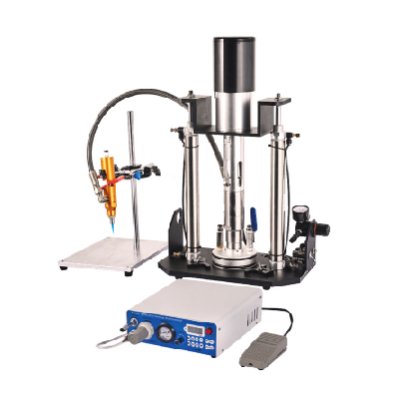
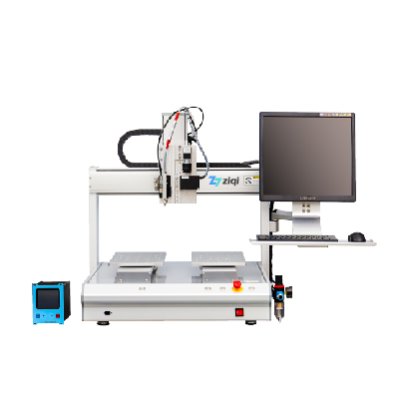
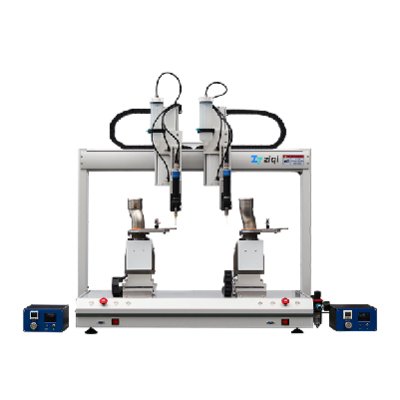
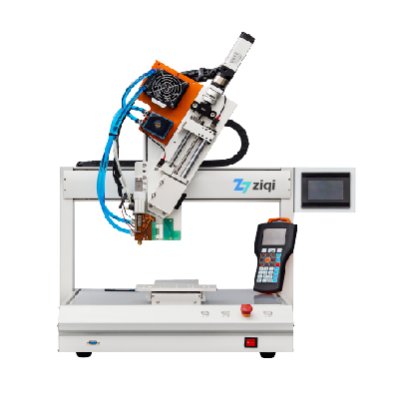
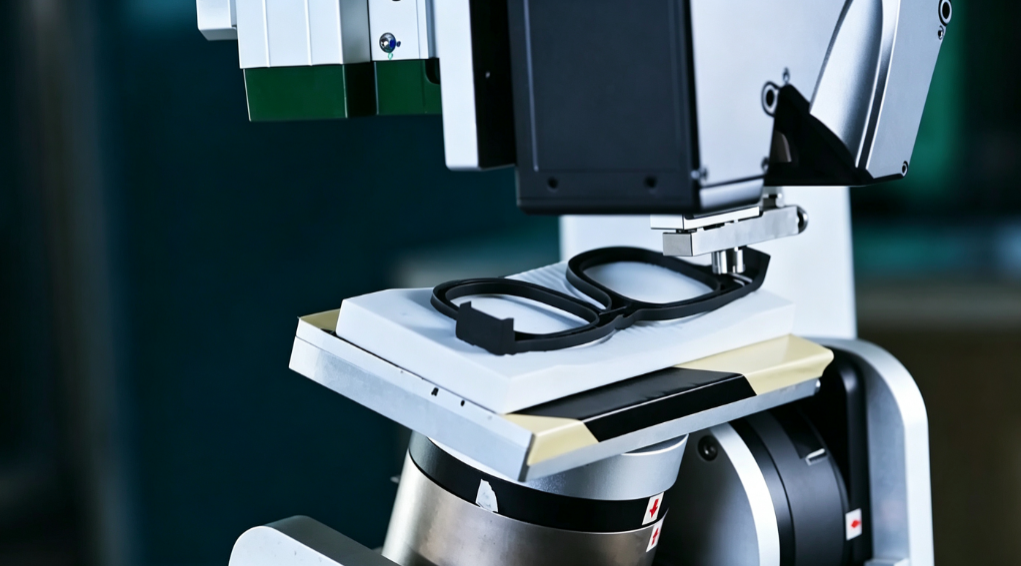
As AR/VR glasses, AI smart glasses, and other wearable devices become smaller and more integrated, adhesive dispensing is becoming increasingly demanding. Smart glasses may contain curved frames, narrow bonding grooves, inclined surfaces, lens holders, and other complex geometries that are difficult to process consistently with conventional 3-axis dispensing.
A 5-axis vision dispensing machine is a suitable choice when adhesive must be applied along curved, inclined, recessed, or multi-angle surfaces. By combining XYZ motion with two rotational axes and vision-guided positioning, the dispensing valve can follow complex 3D paths while maintaining a more suitable dispensing orientation.
However, not every smart glasses application requires five-axis dispensing. The right choice depends on the product geometry, adhesive, dispensing path, accuracy requirements, and production volume.
When Do Smart Glasses Need 5-Axis Dispensing?
Smart glasses typically have compact structures and limited bonding space. Adhesive may need to be applied along frame edges, narrow grooves, curved surfaces, sidewalls, or other difficult-to-reach areas.
A conventional 3-axis system can handle many flat or relatively simple dispensing paths. However, when the dispensing surface changes angle continuously, additional workpiece positioning or manual re-clamping may be required.
Typical challenges include:
·Uneven adhesive beads on curved surfaces
·Glue overflow or insufficient adhesive
·Broken or inconsistent glue lines
·Difficulty reaching narrow or recessed areas
·Repeated fixture adjustment
·Positioning deviations between products
·Limited access to angled or side surfaces
For these applications, the key challenge is not simply moving the dispensing valve to the correct X, Y, and Z position. The valve may also need to change its orientation while following the dispensing path.
How Does 5-Axis Dispensing Work?
A typical five-axis system combines X, Y, and Z linear movement with two rotational axes. The exact configuration can vary by machine design, but the purpose is similar: provide additional freedom to control the dispensing direction.
During dispensing, the system can coordinate these axes to follow curved or irregular paths. This allows the dispensing valve to approach a surface from a more appropriate angle instead of relying only on linear XYZ movement.
For smart glasses, this can support applications such as:
·Curved frame dispensing
·Lens holder bonding
·Narrow groove dispensing
·Sidewall adhesive application
·Multi-angle bonding
·Complex 3D adhesive paths
Industry dispensing systems commonly use five-axis synchronized motion for curved frames, wearable products, and AR/VR applications. Some systems also combine vision or 3D laser guidance to identify product geometry and guide the dispensing trajectory.
Why Is Vision Positioning Important?
Five-axis motion solves the problem of how the dispensing valve moves, while vision positioning helps solve the problem of where the actual product is located.
In production, the workpiece may have small positioning deviations after loading. A vision system can use cameras to identify reference points, product edges, or other features and then compensate for these deviations before dispensing.
For smart glasses, vision positioning can help identify:
·Frame reference points
·Product orientation
·Lens or housing positions
·Bonding grooves
·Product edges
·Positioning deviations
This can reduce dependence on extremely precise manual placement and improve process consistency.
Advanced dispensing systems may also combine vision with 3D laser measurement or trajectory guidance when the product geometry is highly curved or irregular.
What Smart Glasses Applications Can Use 5-Axis Dispensing?
A 5-axis vision dispensing system can be considered for smart glasses applications where adhesive paths are not limited to a simple flat plane.
Typical applications include:
Smart Glasses Frame Bonding
Adhesive can be dispensed along curved or narrow frame structures for component bonding and sealing.
Lens Holder and Optical Component Assembly
Five-axis motion can help access angled or spatially constrained bonding areas around lens holders and optical components.
Curved-Surface Adhesive Dispensing
The dispensing valve can change orientation while following a curved path, helping maintain a more consistent dispensing relationship with the workpiece surface.
Narrow Groove Dispensing
For narrow adhesive channels, accurate positioning and controlled material output are important to avoid overflow and incomplete bonding.
The exact dispensing process still depends on the adhesive, substrate, bead size, and product design. A machine should therefore be configured based on the actual application rather than the product name alone.
How to Choose the Right 5-Axis Vision Dispensing Machine?
Choosing a five-axis machine should start with the dispensing process rather than simply selecting the highest machine specification.
Product Geometry
Check whether the product contains:
·Curved surfaces
·Inclined surfaces
·Narrow grooves
·Sidewalls
·Recessed bonding areas
·Complex 3D paths
The more complex the geometry, the more valuable coordinated multi-axis motion becomes.
Dispensing Accuracy and Repeatability
Define the required adhesive bead width, position tolerance, dispensing volume, and repeatability.
For precision wearable products, these parameters should be evaluated together with the adhesive and dispensing valve rather than considered independently.
Adhesive and Dispensing Valve
The adhesive determines the required dispensing technology.
Depending on viscosity, curing method, flow characteristics, bead size, and dispensing volume, different systems may be considered, including pneumatic valves, screw/auger valves, or jetting valves.
The valve and material feeding system should be matched to the adhesive instead of selecting the valve solely according to the machine model.
Vision Requirements
Determine whether the application needs:
·Basic vision positioning
·Mark-point recognition
·Edge recognition
·Position compensation
·3D trajectory guidance
·Dispensing inspection
For products with variable positioning or complex contours, vision-guided compensation can provide additional process flexibility.
What Can ZiQi Provide for Smart Glasses Dispensing?
ZiQi Technology develops customized dispensing solutions based on the actual product and adhesive process.
For smart glasses and other wearable products, a 5-axis vision dispensing system can be configured according to:
·Product geometry
·Dispensing path
·Adhesive characteristics
·Required bead size
··Positioning accuracy
·Vision requirements
·Production volume
·Automation requirements
The solution can combine 5-axis motion control, vision positioning, dispensing valve selection, adhesive feeding, and customized fixtures to create a dispensing process suited to the specific product.
A typical engineering process can include:
Product evaluation → adhesive dispensing test → dispensing path development → vision positioning → fixture design → machine configuration → process validation
This approach helps determine whether a 5-axis system is actually necessary and which configuration is appropriate for the application.
For AR/VR glasses, AI smart glasses, and other wearable products, ZiQi can develop dispensing solutions for curved frames, narrow grooves, lens holders, and other precision bonding applications.
Is a 5-Axis Vision Dispensing Machine Right for Your Smart Glasses?
A 5-axis vision dispensing machine is generally worth considering when your smart glasses product has curved or irregular bonding surfaces, multi-angle adhesive paths, narrow grooves, or complex 3D structures.
If the adhesive path is simple and mainly located on flat surfaces, a 3-axis dispensing machine may provide a more practical and cost-effective solution.
The key is to select the machine according to the product geometry + adhesive + dispensing path + accuracy + production requirements, rather than choosing five-axis technology simply because it offers more motion axes.
FAQ
Is a 5-axis dispensing machine better than a 3-axis machine for smart glasses?
Not always. A 5-axis machine is better suited to curved, inclined, multi-angle, and complex 3D dispensing paths. A 3-axis system may be sufficient for simple flat-surface applications.
Can a 5-axis dispensing machine dispense adhesive on curved smart glasses frames?
Yes. Coordinated linear and rotational movement allows the dispensing valve to follow curved or inclined surfaces from different orientations.
Why is vision positioning used in smart glasses dispensing?
Vision positioning identifies the actual position and orientation of the workpiece and can compensate for placement deviations before dispensing, helping maintain consistent adhesive positioning.
What adhesives can be used with a 5-axis dispensing machine?
The suitable dispensing system depends on adhesive viscosity, curing method, dispensing volume, and required bead size. Applications may use silicone, epoxy, UV-curable adhesives, and other industrial bonding materials.
Can ZiQi customize a 5-axis dispensing machine?
Yes. The machine configuration can be developed according to the product structure, adhesive, dispensing path, vision requirements, accuracy, and production process.
Conclusion
For smart glasses with curved frames, narrow grooves, inclined surfaces, and complex bonding structures, 5-axis vision dispensing provides greater motion flexibility than conventional 3-axis dispensing.
By combining multi-axis motion, vision-guided positioning, and an application-matched dispensing system, manufacturers can automate complex adhesive paths while improving dispensing consistency and production flexibility.
The right solution, however, is not determined by the number of axes alone. Product geometry, adhesive behavior, dispensing accuracy, vision requirements, and production volume should all be evaluated before selecting the equipment configuration.
For manufacturers developing AR/VR glasses, AI smart glasses, and other precision wearable products, ZiQi Technology can develop customized dispensing solutions based on the actual application and production requirements.