
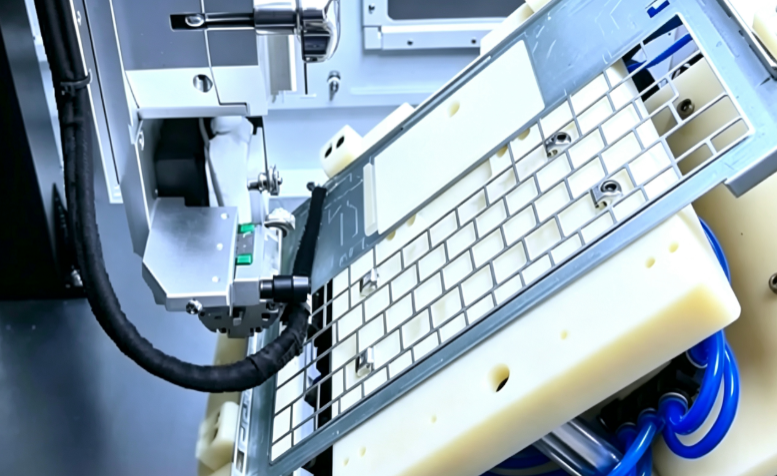
As laptop housings become thinner, lighter, and more structurally complex, achieving a consistent adhesive bead is becoming more challenging for manufacturers. Curved edges, recessed bonding channels, angled surfaces, narrow corners, and small positioning variations can all affect adhesive placement and bonding quality.
So, how can manufacturers achieve uniform adhesive dispensing on irregular laptop housings?
The answer is not simply to increase machine accuracy. A reliable dispensing process typically requires a combination of stable adhesive delivery, accurate workpiece positioning, controlled nozzle movement, automatic calibration, and adhesive inspection.
For complex laptop housing applications, a vision-guided multi-axis dispensing system can provide greater flexibility by compensating for positioning deviations and maintaining a suitable nozzle orientation along the dispensing path.
Why Is Adhesive Dispensing on Laptop Housings Difficult?
Laptop housings may contain flat areas as well as curved edges, stepped structures, recessed channels, and angled surfaces.
These changes in geometry can make it difficult to maintain a consistent nozzle-to-surface relationship.
Common dispensing problems include:
·Uneven adhesive bead width
·Broken or interrupted adhesive lines
·Excess adhesive or insufficient adhesive
·Adhesive position deviation
·Inconsistent bonding coverage
·Increased manual adjustment and rework
Another challenge is workpiece positioning variation. Even with a fixture, small differences in loading position can occur between production cycles. If the machine relies only on fixed coordinates, these deviations may cause the adhesive path to move away from the intended bonding area.
A vision-guided system can recognize product edges, reference marks, or other geometric features and compensate for the detected position deviation before dispensing.
What Dispensing Machine Is Suitable for Laptop Housings?
The required machine configuration depends on the actual housing geometry and adhesive path. A higher number of axes is not automatically better for every application.
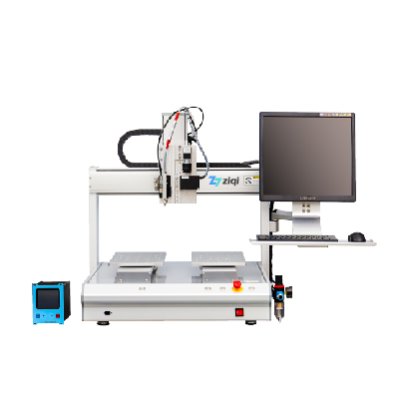
3-Axis Dispensing
A 3-axis system can be suitable for:
·Flat bonding surfaces
·Straight adhesive lines
·Simple 2D dispensing paths
·Products with stable positioning
If the nozzle can remain in a fixed orientation throughout the dispensing process, three-axis motion may be sufficient.
4-Axis Dispensing
A rotary axis can provide additional flexibility when the adhesive path includes:
·Curved edges
·Corner transitions
·Rotating surfaces
·Certain angled sections
The rotary axis allows the dispensing head or workpiece to change orientation during the process.
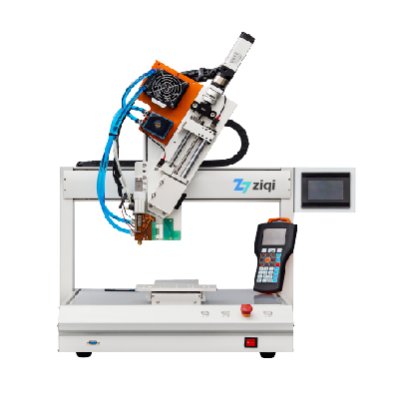
5-Axis Dispensing
For more complex three-dimensional paths, a five-axis dispensing system can coordinate linear and rotary movement to provide greater control over nozzle orientation.
It can be useful for applications involving:
·Curved and angled surfaces
·Sidewalls
·Multi-surface bonding paths
·Complex three-dimensional adhesive routes
A 5-axis dispensing machine is not necessary for every laptop housing. The appropriate configuration should be selected according to the product geometry, adhesive path, nozzle orientation requirements, and production process.
How Does Vision-Guided Dispensing Improve Positioning?
Vision positioning is particularly useful when product placement cannot be maintained within the required tolerance by fixtures alone.
Before dispensing, the camera can identify reference features such as:
·Product edges
·Fiducial marks
·Holes or openings
·Geometric features
·Housing contours
The system can then calculate the deviation between the actual workpiece position and the programmed reference position and apply the corresponding coordinate compensation.
This allows the dispensing path to follow the actual product position rather than relying entirely on fixed coordinates.
How Can Automatic Needle Calibration Reduce Setup Work?
The relationship between the dispensing needle, camera coordinate system, fixture, and workpiece may change after needle replacement, fixture adjustment, or machine setup.
Automatic or vision-assisted needle calibration can identify the needle position and calculate the required offset. This can reduce repetitive manual calibration work and improve setup consistency.
However, the exact calibration method and achievable accuracy depend on the machine architecture, vision system, fixture, and dispensing configuration.
How Can Adhesive Inspection Improve Quality Control?
Automated dispensing does not by itself guarantee that every adhesive bead is acceptable.
Depending on the equipment configuration, an inline vision system can inspect the dispensing result for issues such as:
·Missing adhesive
·Broken adhesive lines
·Position deviation
·Abnormal bead width
·Adhesive overflow
·Incomplete coverage
2D vision can be used for presence, position, or width-related inspection, while 3D inspection can provide additional information about bead height or profile when required.
This creates a more integrated production process:
Vision Positioning → Dispensing → Adhesive Inspection → Quality Handling
Potential defects can be identified earlier, reducing the risk of defective products continuing to downstream assembly processes.
What Causes Uneven Adhesive Beads?
Machine positioning accuracy is only one part of the dispensing process. Final adhesive consistency can also be affected by:
·Adhesive viscosity
·Material pressure stability
·Pump or valve characteristics
·Nozzle condition
·Dispensing speed
·Nozzle-to-surface distance
·Adhesive temperature
·Product surface condition
·Fixture tolerance
·Dispensing path design
Therefore, selecting a dispensing machine should not be based only on specifications such as positioning accuracy or the number of axes.
The dispensing system and adhesive process need to be evaluated together.
How ZiQi Supports Laptop Housing Dispensing Projects?
Shenzhen ZiQi Technology Co., Ltd. specializes in automated dispensing and industrial automation solutions for precision manufacturing applications.
For laptop housing adhesive dispensing, ZiQi can evaluate the application according to the actual product geometry, adhesive characteristics, dispensing path, production volume, positioning requirements, and inspection needs.
Rather than selecting a machine based only on the number of axes, the dispensing solution should be validated against the actual product and process requirements.
The key to uniform adhesive dispensing is not simply adding more machine axes. It is matching motion control, adhesive delivery, vision positioning, calibration, and inspection to the actual application.
For irregular laptop housings, a vision-guided multi-axis dispensing solution can provide the flexibility needed for complex dispensing paths while helping manufacturers improve process consistency and reduce manual adjustment.
Frequently Asked Questions
What type of dispensing machine is suitable for laptop housing adhesive dispensing?
A vision-guided automatic adhesive dispensing machine is suitable for laptop housings when product positioning varies or the housing contains irregular dispensing paths. For curved, angled, or multi-surface applications, a rotary-axis or multi-axis configuration may provide additional flexibility.
Can a vision dispensing machine compensate for product positioning errors?
Yes. Depending on the vision configuration, the system can identify reference marks, edges, or product features and calculate the position deviation before dispensing. The machine can then compensate the dispensing coordinates accordingly.
Does automatic needle calibration improve production efficiency?
It can reduce manual setup and calibration work, particularly when products, fixtures, or dispensing needles are changed. The actual improvement depends on the machine configuration and production process.
Can adhesive dispensing be inspected automatically?
Yes. Vision-based dispensing systems can be configured with adhesive inspection functions to identify issues such as missing adhesive, broken lines, position deviation, or abnormal bead characteristics.
Is a 3-axis dispensing machine enough for laptop housings?
It depends on the product geometry. A 3-axis system may be sufficient for flat or relatively simple dispensing paths. If the application includes curved surfaces, sidewalls, angled sections, or complex three-dimensional paths, a rotary-axis or multi-axis configuration may provide better process flexibility.
Conclusion
How can manufacturers achieve uniform adhesive dispensing on irregular laptop housings?
The key is to combine accurate positioning, stable adhesive delivery, flexible motion control, automatic calibration, and reliable inspection rather than relying on dispensing motion alone.
For complex laptop housing applications, a solution combining:
Vision Positioning
→ Automatic Needle Calibration
→ Servo-Driven Dispensing
→ Rotary-Axis Motion
→ Real-Time Adhesive Inspection
can help manufacturers improve dispensing consistency, reduce manual adjustment, adapt to irregular housing geometries, and strengthen production quality control.
For companies looking to automate laptop housing adhesive dispensing, the most suitable machine configuration should be determined by the actual housing geometry, adhesive properties, dispensing path, accuracy requirements, and production volume.
ZiQi can evaluate the application based on product samples and process requirements and develop a customized automated dispensing solution for laptop housing assembly.