
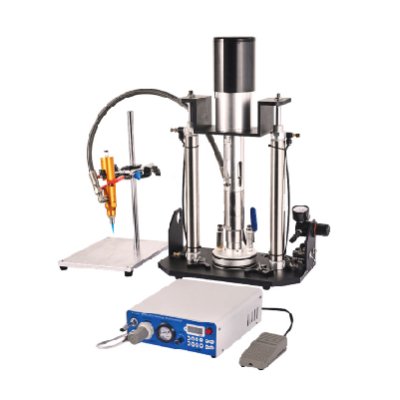
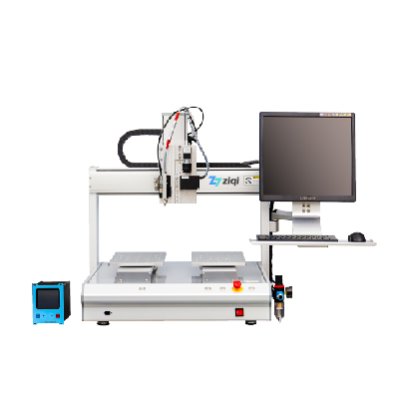
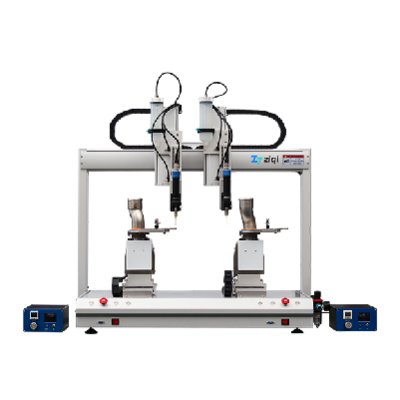
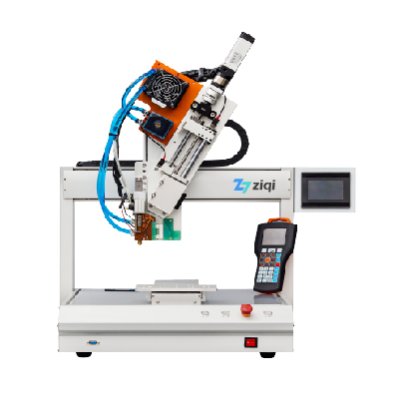
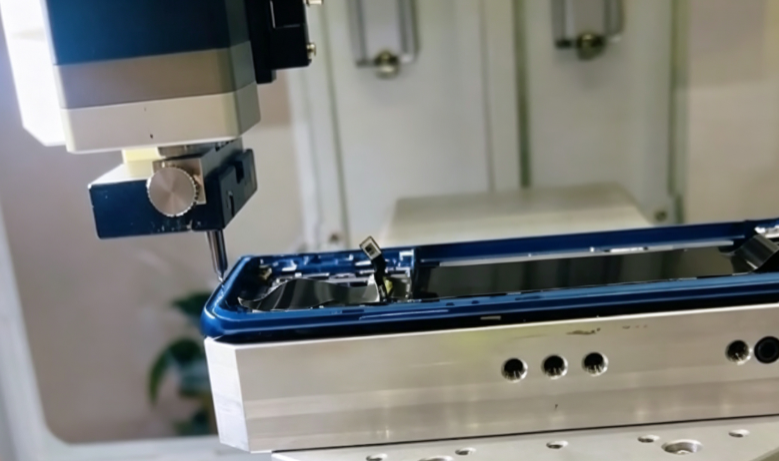
As smartphone displays evolve toward ultra-narrow bezels and increasingly compact structures, adhesive application on screen brackets and display modules requires greater positioning accuracy and process consistency. Narrow bonding areas, curved edges, and complex contours make it challenging to apply adhesive accurately while avoiding overflow or incomplete coverage.
Traditional dispensing methods often rely on fixed positioning fixtures and pre-programmed dispensing paths. When workpiece placement varies or product geometries become more complex, these methods may require repeated manual adjustments to maintain consistent dispensing results.
A vision dispensing machine addresses these challenges by combining industrial vision positioning, automatic position compensation, motion control, and precision adhesive dispensing. By identifying the actual position of a workpiece and adjusting the programmed dispensing path accordingly, the machine helps improve adhesive application consistency on narrow and irregular bonding areas.
For smartphone screen bracket manufacturing, vision dispensing provides a flexible solution for precision adhesive application, particularly when product positioning variations and complex edge geometries affect conventional dispensing processes.
Common Challenges in Smartphone Screen Bracket Dispensing
Smartphone screen brackets often feature narrow bonding surfaces, rounded corners, and relatively complex edge structures. These characteristics place specific demands on dispensing accuracy, adhesive volume control, and production consistency.
Positioning Deviations and Adhesive Overflow
Screen brackets and metal support components may experience dimensional variations during manufacturing processes such as injection molding and stamping. In addition, workpieces may not always be positioned identically in the dispensing fixture.
When a dispensing machine follows a fixed programmed path without compensating for these deviations, the adhesive may be applied outside the intended bonding area or fail to cover certain sections.
This can lead to adhesive overflow, incomplete coverage, and inconsistent bonding results.
Narrow Bonding Areas and Complex Edge Geometries
As display structures become more compact, the available bonding area around screen brackets becomes increasingly limited.
Rounded corners, curved edges, and irregular contours make it more difficult to maintain a consistent dispensing path. For applications involving sidewalls or angled surfaces, the dispensing head orientation may also need to be adjusted.
These factors increase the requirements for positioning control, motion coordination, and adhesive application consistency.
Adhesive Volume and Dispensing Consistency
Applying too much adhesive may cause overflow into surrounding areas, while insufficient adhesive may result in incomplete bonding coverage.
Maintaining a consistent adhesive line requires appropriate control of dispensing pressure, valve operation, nozzle size, movement speed, and adhesive properties.
For narrow-edge applications, coordinating adhesive output with the dispensing path is particularly important.
Frequent Product Model Changes
Different smartphone models may have different screen bracket dimensions, edge structures, and adhesive application paths.
When manufacturers switch between product models, they may need to adjust fixtures, update dispensing programs, and recalibrate positioning references.
A flexible dispensing system with vision-based positioning and multiple stored dispensing programs can help simplify changeovers and support multi-model production.
How Does a Vision Dispensing Machine Work?
A vision dispensing machine combines an industrial camera, image recognition software, a motion control system, and a dispensing unit to perform automated adhesive application.
Unlike conventional systems that depend entirely on fixed positioning references, a vision system can identify actual workpiece positions and compensate for certain placement deviations before dispensing.
A typical operating process includes the following steps.
Image Acquisition and Workpiece Recognition
An industrial camera captures images of the workpiece under suitable lighting conditions.
According to the application requirements, the vision system identifies predefined reference features, edges, or contours on the smartphone screen bracket.
These recognition results provide positioning information for the dispensing process.
Automatic Position Compensation
After identifying the workpiece position, the vision system compares the detected reference position with the programmed reference coordinates.
The system calculates the corresponding positioning offset and sends the compensation information to the motion control system.
The machine then adjusts the programmed dispensing coordinates to accommodate workpiece placement deviations.
This helps reduce positioning-related dispensing errors and improves the consistency of adhesive application.
Dispensing Path Execution
Once positioning compensation is completed, the motion control system executes the corrected dispensing path.
For applications involving straight edges, rounded corners, or irregular contours, the dispensing program can be configured according to the workpiece geometry.
Depending on the vision system and software configuration, the machine can use recognized positioning features or contour information to adjust the dispensing path.
Precision Adhesive Application
During dispensing, the motion system coordinates with the dispensing valve or other adhesive delivery mechanisms.
The adhesive output is controlled according to the programmed process parameters, helping maintain consistent adhesive application along the designated bonding area.
For applications requiring additional quality control, a separate inspection system can also be integrated to evaluate the dispensing result.
Key Technologies for Precision Smartphone Screen Bracket Dispensing
In addition to visual positioning, several machine technologies contribute to consistent adhesive application on narrow and complex bonding areas.
Industrial Vision Positioning and Path Compensation
The vision positioning system is one of the key technologies of a vision dispensing machine.
By identifying actual workpiece positions rather than relying entirely on fixed mechanical references, the system can compensate for placement deviations before dispensing.
Depending on the application, vision recognition can be configured to identify positioning marks, product edges, or other relevant features.
The main advantages include:
·Reduced dependence on precise manual workpiece alignment.
·Compensation for certain positioning deviations.
·More consistent dispensing path alignment.
·Greater flexibility when handling different workpiece geometries.
The actual positioning capability depends on camera resolution, lighting conditions, recognition algorithms, calibration, and machine configuration.
Three-Axis and Five-Axis Motion Control
The required motion structure depends on the geometry of the smartphone screen bracket and the dispensing path.
Three-Axis Dispensing
A three-axis dispensing machine uses X, Y, and Z linear movement to position the dispensing head and control its dispensing trajectory.
It is suitable for many applications involving flat surfaces, conventional adhesive paths, and workpieces that do not require changes in dispensing head orientation.
When combined with vision positioning, a three-axis system can compensate for workpiece placement deviations and perform precision dispensing along the corrected path.
Five-Axis Dispensing
For applications involving angled surfaces, sidewalls, or complex three-dimensional contours, a five-axis dispensing structure provides additional motion flexibility.
By combining XYZ linear movement with two rotary axes, the machine can adjust the dispensing head orientation according to the programmed dispensing requirements.
This helps maintain a suitable dispensing angle when working on different surfaces and complex geometries.
Five-axis motion is not necessary for every smartphone screen bracket application. The appropriate configuration should be selected according to the workpiece structure, adhesive path, and required dispensing orientation.
Precision Dispensing and Adhesive Volume Control
Accurate positioning alone is not sufficient to achieve consistent adhesive application. The dispensing system must also deliver an appropriate amount of adhesive along the programmed path.
Depending on the adhesive properties and process requirements, the machine can be configured with a suitable dispensing valve or adhesive delivery system.
Important process parameters include:
·Adhesive viscosity and flow characteristics.
·Dispensing pressure and valve operating conditions.
·Needle or nozzle size.
·Dispensing speed.
·Adhesive temperature, when temperature control is required.
By coordinating adhesive output with machine movement, the system helps maintain more consistent adhesive lines along straight sections and curved corners.
The dispensing configuration should be selected and tested according to the actual adhesive and workpiece requirements.
Key Benefits of Vision Dispensing for Smartphone Screen Brackets
More Consistent Adhesive Application
Vision-based positioning and automatic path compensation help reduce dispensing deviations caused by inconsistent workpiece placement.
When combined with appropriate motion control and adhesive output settings, the machine helps reduce the risk of adhesive overflow, missed dispensing areas, and inconsistent adhesive lines.
This supports more stable bonding processes and helps reduce material waste caused by positioning-related dispensing defects.
Reduced Manual Alignment and Adjustment
Traditional dispensing processes may require operators to position workpieces carefully and make repeated adjustments when alignment deviations occur.
With vision positioning, the machine can automatically recognize workpiece reference features and compensate for certain placement differences.
This reduces manual alignment requirements and supports more consistent automated production.
Flexible Multi-Model Production
Different smartphone screen bracket models may require different dispensing paths and process parameters.
A dispensing machine can store multiple product programs for different workpiece configurations. When combined with vision positioning, the system can accommodate certain placement variations without relying entirely on fixed mechanical alignment.
This makes vision dispensing suitable for manufacturers handling multiple product models and frequent production changeovers.
Support for Production Monitoring
Depending on the machine configuration and control system, additional data acquisition functions can be integrated to record important production parameters.
These may include positioning information, dispensing speed, adhesive temperature, and production cycle information.
Such data can support process monitoring, production analysis, and quality management.
Applications Beyond Smartphone Screen Bracket Dispensing
Although vision dispensing is particularly suitable for precision adhesive application on smartphone screen brackets, the same positioning and path compensation technologies can also be applied to other electronic assembly processes.
Typical applications include:
Foldable Smartphone Displays
Precision adhesive application for inner display brackets, support structures, and complex display assemblies.
Tablet Display Modules
Adhesive dispensing along display edges, support frames, and narrow bonding areas.
AR/VR Headsets
Precision adhesive application for display bezels, optical module housings, and other electronic components with complex geometries.
Smartwatch Displays
Micro-dispensing applications involving compact display structures and narrow bonding areas.
Other 3C Electronic Components
Vision-guided adhesive application for electronic products with irregular contours, positioning variations, or demanding dispensing requirements.
The machine configuration, vision system, dispensing valve, and motion structure can be selected according to the actual workpiece and adhesive application.
How to Select a Vision Dispensing Machine for Smartphone Screen Brackets
Choosing a suitable vision dispensing machine requires more than considering the machine's positioning capabilities.
Manufacturers should also evaluate the workpiece structure, adhesive properties, dispensing path, and production requirements.
Important factors include:
·Workpiece Geometry: Determine whether the bonding area is flat, curved, angled, or involves sidewalls and complex contours.
·Adhesive Properties: Evaluate adhesive viscosity, flow characteristics, curing requirements, and temperature sensitivity.
·Dispensing Path: Identify whether the adhesive needs to be applied along straight lines, rounded corners, irregular contours, or multiple surfaces.
·Positioning Requirements: Determine whether the application requires reference feature recognition, edge identification, or automatic position compensation.
·Motion Structure: Select a three-axis or five-axis configuration according to the required dispensing trajectory and dispensing head orientation.
·Production Requirements: Consider production volume, cycle time, product changeover frequency, fixture design, and the need for automated loading or inspection.
For applications with different product structures or adhesive requirements, equipment configuration and dispensing parameters should be evaluated through actual workpiece testing before final selection.
Frequently Asked Questions About Vision Dispensing Machines
What is a vision dispensing machine?
A vision dispensing machine is an automated dispensing system that integrates an industrial camera, image recognition software, motion control, and a dispensing unit.
It identifies workpiece positions or reference features and adjusts the programmed dispensing coordinates to compensate for positioning deviations before applying adhesive.
How does vision positioning improve dispensing accuracy?
Vision positioning allows the machine to identify the actual workpiece position rather than relying entirely on fixed fixture coordinates.
The system calculates positioning offsets and adjusts the dispensing path accordingly, helping reduce errors caused by workpiece placement variations.
The actual positioning accuracy depends on the vision system, calibration, machine structure, and application conditions.
Does smartphone screen bracket dispensing require a five-axis machine?
Not necessarily.
A three-axis vision-guided dispensing machine may be sufficient for applications involving flat bonding surfaces and conventional dispensing paths.
A five-axis dispensing machine is more suitable when the application involves angled surfaces, sidewalls, or complex three-dimensional dispensing trajectories that require changes in dispensing head orientation.
Conclusion
As smartphone displays become thinner and their structural designs increasingly compact, adhesive application on screen brackets requires more precise positioning and consistent dispensing processes.
A vision dispensing machine combines industrial vision recognition, automatic position compensation, motion control, and precision adhesive dispensing to address common challenges in narrow-edge applications.
By identifying actual workpiece positions and adjusting programmed dispensing paths, the machine helps reduce positioning-related dispensing deviations and improve adhesive application consistency.
For smartphone screen bracket manufacturing and other precision 3C electronic assembly applications, Shenzhen Ziqi Technology provides automated dispensing equipment solutions that can be configured according to workpiece geometry, adhesive properties, and production requirements.
Selecting the appropriate vision system, motion structure, and dispensing configuration helps manufacturers establish a more flexible and reliable automated adhesive application process.