

Medical catheters are commonly manufactured from polymers such as silicone, polyurethane (PU), polyethylene (PE), polypropylene (PP), and polyvinyl chloride (PVC). These materials provide the flexibility, chemical resistance, and mechanical properties required for many medical applications. However, their relatively low surface energy can make them difficult to wet, coat, bond, or print.
So, how can manufacturers improve the surface wettability and coating adhesion of medical catheters without changing the bulk properties of the polymer?
Plasma surface treatment provides a controlled method for modifying the outermost surface of polymer materials. By activating the surface, plasma treatment can increase surface energy, improve wettability, and promote interaction between the polymer and subsequently applied coatings, adhesives, or other functional materials.
For medical catheter manufacturing, plasma treatment can therefore serve as a surface activation and cleaning process before hydrophilic coating, adhesive bonding, printing, or other downstream processes.
Why Do Medical Catheters Need Plasma Surface Treatment?
The surface properties of a catheter directly affect the performance of subsequent manufacturing processes.
Many commonly used medical polymers are naturally hydrophobic. Their relatively low surface energy may result in:
·Poor wetting of water-based or hydrophilic coatings
·Uneven coating coverage
·Weak coating adhesion
·Poor adhesive bonding
·Difficult printing or marking
·Inconsistent surface performance
These challenges are particularly important for catheters requiring hydrophilic or low-friction surfaces.
Plasma treatment can modify the surface chemistry and wettability of the polymer without requiring the bulk material to be replaced. This makes plasma surface activation useful when the existing polymer provides the required mechanical and functional properties but its surface characteristics are not suitable for the next manufacturing step.
The actual treatment effect depends on the polymer material, plasma chemistry, process parameters, surface geometry, and the time between plasma treatment and the following process.
How Does Plasma Improve Medical Catheter Hydrophilicity?
Plasma can improve catheter wettability primarily by increasing surface energy and modifying the surface chemistry of the polymer.
When a polymer catheter is exposed to plasma, energetic and reactive species interact with the outermost surface layer.
Depending on the plasma gas and process conditions, these interactions can modify chemical bonds, generate reactive sites, and alter surface characteristics.
The basic process can be understood in three stages:
Plasma Activates the Polymer Surface
During plasma treatment, ions, electrons, radicals, and excited species interact with the polymer surface.
These interactions can modify chemical bonds and create more reactive sites on the surface. The result is a surface that can interact more effectively with liquids, coatings, or adhesives.
Surface activation is particularly useful before:
·Hydrophilic coating
·Medical-device coating
·Adhesive bonding
·Printing and marking
·Surface functionalization
·Other polymer coating processes
Plasma Can Introduce Polar Functional Groups
Depending on the plasma chemistry and process conditions, plasma treatment can introduce or increase polar, oxygen-containing, or other functional groups on the polymer surface.
These changes can increase the interaction between the polymer surface and subsequently applied liquids, coatings, or adhesives.
For oxygen-containing plasma processes, for example, changes in surface chemistry may increase the polar character of the polymer surface and improve wettability.
However, the exact chemical changes depend on the polymer and plasma process. Therefore, manufacturers should validate the treatment rather than assume that the same plasma recipe will work for every catheter material.
Surface Energy and Wettability Increase
One of the most important effects of plasma activation is improved surface wettability.
A treated polymer surface can become easier for a liquid coating to spread across. This can be particularly beneficial when applying a water-based or hydrophilic coating to a catheter.
Water contact angle is commonly used to evaluate surface wettability.
In general, a lower water contact angle indicates better wetting.
However, contact angle should not be treated as the only measure of process success. The final evaluation should also consider coating adhesion, durability, surface stability, and the actual requirements of the medical-device application.
Plasma Treatment vs. Hydrophilic Coating: What Is the Difference?
Plasma treatment and hydrophilic coating are related but fundamentally different processes.
Plasma treatment primarily modifies or activates the existing polymer surface, while a hydrophilic coating adds a functional layer to the surface.
A typical manufacturing process may therefore be:
Polymer Catheter → Plasma Cleaning / Activation → Hydrophilic Coating → Curing or Stabilization → Performance Testing
Plasma treatment can improve the initial surface condition and promote coating wetting and adhesion. The hydrophilic coating, rather than the plasma activation itself, generally provides the intended long-term surface functionality.
Depending on the catheter design and manufacturing process, plasma may be used as:
·A surface cleaning process
·A surface activation process
·A pretreatment before hydrophilic coating
·A pretreatment before adhesive bonding
·Part of a surface functionalization process
This distinction is important because plasma activation should not automatically be described as a permanent hydrophilic treatment.
What Can Plasma Treatment Do for Medical Catheter Manufacturing?
Plasma surface treatment can be used at different stages of polymer catheter production.
Hydrophilic Coating Pretreatment
Before applying a hydrophilic coating, plasma activation can improve polymer surface wettability and create a more suitable surface for coating deposition.
This can help improve coating coverage and promote adhesion when the plasma process is properly matched to the catheter material and coating system.
Adhesive Bonding
Low surface energy can limit adhesive wetting on polymer components.
Plasma activation can increase surface energy and modify surface chemistry, potentially improving interaction between the catheter material and adhesive.
The final bonding performance depends on the specific polymer, adhesive, plasma process, and bonding conditions.
Medical Tube Surface Activation
Medical tubes, guide tubes, catheter components, and other polymer parts can be plasma-treated before:
·Coating
·Bonding
·Printing
·Marking
·Functionalization
For tubular components, treatment uniformity can be particularly important because the surface is curved rather than flat.
Surface Cleaning
Plasma can also provide dry surface cleaning for suitable materials and contaminants.
Reactive plasma species can interact with certain organic residues and surface contaminants, helping prepare the polymer for subsequent manufacturing processes.
However, plasma cleaning should be considered part of a validated cleaning process. It should not automatically be assumed to replace every conventional cleaning method used in medical-device manufacturing.
Can Plasma Treat Silicone Catheters?
Yes. Silicone can be considered for plasma surface activation, but the treatment process must be developed for the specific silicone formulation and application.
Silicone is widely used in medical-device applications but can present surface-treatment challenges because of its surface characteristics and chemical structure.
The appropriate plasma process depends on factors such as:
·Silicone formulation
·Catheter geometry
·Treatment area
·Plasma chemistry
·Plasma power
·Treatment time
·Treatment distance
·Downstream coating or bonding process
Because silicone surfaces can undergo changes after treatment, the interval between plasma treatment and the following coating or bonding process should also be considered during process development.
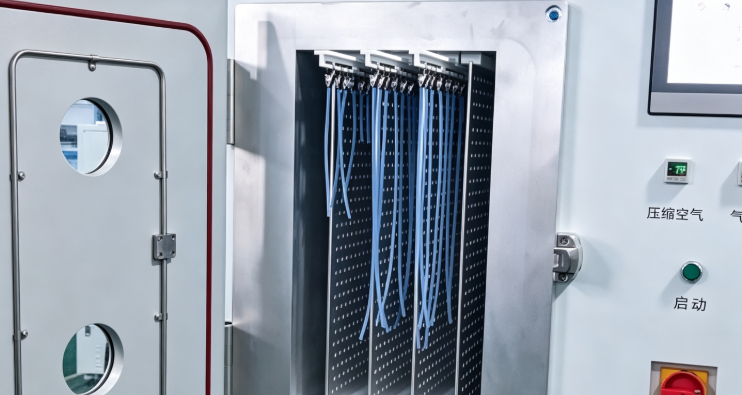
Vacuum Plasma Cleaning for Medical Catheter Surface Treatment
For medical-device manufacturing, vacuum plasma cleaning machines provide a controlled plasma environment inside a vacuum chamber.
Unlike atmospheric plasma systems, vacuum plasma treatment is performed after evacuating the treatment chamber and introducing the selected process gas under controlled pressure.
A typical vacuum plasma process includes:
Loading → Vacuum Pumping → Process Gas Introduction → Plasma Treatment → Venting → Unloading
The controlled chamber environment allows manufacturers to develop repeatable surface cleaning and activation processes for suitable polymer components.
Why Use a Vacuum Plasma Cleaning Machine?
A vacuum plasma cleaning machine can provide several process advantages for suitable medical-device applications:
Controlled Treatment Environment
The vacuum chamber provides a controlled processing environment in which pressure, process gas, plasma power, and treatment time can be defined as part of the process recipe.
Dry Surface Treatment
Plasma cleaning and activation can be performed without conventional liquid cleaning agents, making it a useful dry pretreatment technology for suitable applications.
Surface-Level Modification
Plasma primarily interacts with the outermost surface region, allowing manufacturers to modify surface properties while retaining the bulk characteristics of the polymer.
Controlled Surface Activation
By adjusting process parameters and plasma chemistry, manufacturers can develop a treatment process suited to the specific polymer and downstream coating or bonding requirement.
Batch Processing
Vacuum plasma systems can be configured for batch processing of suitable catheter components, tubes, and other medical-device parts, depending on chamber size and production requirements.
Process Automation
Vacuum plasma cleaning machines can be integrated with automated production workflows and controlled through programmable process recipes.
Special Considerations for Tubular and Catheter Structures
Medical catheters are different from flat polymer samples because they often have cylindrical, curved, thin-wall, or small-diameter geometries.
Treatment uniformity may therefore require additional process development.
For example, manufacturers may need to consider:
·Catheter diameter
·Wall thickness
·Surface curvature
·Component orientation
·Chamber loading
·Treatment area
·Outer-surface requirements
·Inner-lumen requirements
Outer-surface plasma treatment and inner-lumen treatment should not automatically be considered equivalent processes.
If the target area is the inside of a catheter or tube, the plasma process and chamber configuration must be specifically evaluated to determine whether the required internal surface can receive adequate and uniform treatment.
How Should Medical Catheter Plasma Treatment Be Evaluated?
Visual inspection alone is not sufficient to determine whether plasma treatment has achieved the required surface performance.
Depending on the application, manufacturers may evaluate several characteristics.
Water Contact Angle
Water contact angle is commonly used to characterize changes in surface wettability.
A lower contact angle generally indicates improved wetting.
However, the target value should be defined according to the actual coating or bonding process rather than treated as a universal specification.
Surface Energy
Surface-energy measurements can help characterize whether the polymer surface has been sufficiently activated for the intended downstream process.
Coating Adhesion
If plasma is used before hydrophilic coating, the adhesion and durability of the resulting coating should be evaluated.
The ultimate goal is not simply to achieve a lower contact angle, but to obtain the required coating performance.
Surface Cleanliness
When plasma cleaning is part of the manufacturing process, appropriate cleanliness testing should be defined according to the specific application and quality requirements.
Long-Term Surface Stability
Plasma-induced surface properties can change over time.
This phenomenon is commonly associated with hydrophobic recovery or surface ageing.
Therefore, manufacturers should evaluate the time between plasma treatment and the next manufacturing step and establish an appropriate process window.
Typical Vacuum Plasma Treatment Process for Medical Catheters
A simplified process can be structured as follows:
Pre-Cleaning and Loading
Catheter components are prepared and loaded into the vacuum plasma chamber according to the process requirements.
Vacuum Pumping
The chamber is evacuated to the required process pressure.
Process Gas Introduction
The selected plasma gas is introduced under controlled conditions.
Plasma Cleaning and Surface Activation
Plasma is generated inside the chamber to interact with the catheter surface.
Depending on the process, the treatment can help remove suitable surface contaminants and activate the polymer surface.
Surface Characterization
Representative samples can be evaluated using contact-angle measurement, surface-energy testing, adhesion testing, or other application-specific methods.
Hydrophilic Coating or Bonding
The downstream coating, adhesive, or other functional material is applied within the validated process window.
Curing and Quality Inspection
The coating or bonding process is completed, followed by the required performance and quality inspections.
This workflow can be adapted according to catheter material, geometry, production volume, surface-treatment requirements, and downstream coating or bonding processes.
Frequently Asked Questions
Can plasma treatment make a medical catheter hydrophilic?
Plasma treatment can significantly improve the wettability of many polymer surfaces by increasing surface energy and modifying surface chemistry. However, plasma activation alone should not automatically be considered a permanent hydrophilic treatment. For long-term hydrophilic performance, a dedicated coating or other surface-functionalization process may be required.
Can plasma improve hydrophilic coating adhesion?
Yes. Plasma activation can increase polymer surface energy and modify surface chemistry, which can improve coating wetting and adhesion when the treatment is properly optimized for the polymer and coating system.
Can plasma treatment be used on silicone catheters?
Yes. Silicone can be considered for plasma surface activation. However, the treatment parameters should be developed specifically for the silicone formulation, catheter geometry, plasma chemistry, and intended downstream process.
What is the difference between plasma cleaning and plasma activation?
Plasma cleaning primarily focuses on interacting with and removing or modifying suitable surface contaminants, while plasma activation focuses on modifying surface characteristics such as surface energy and chemical reactivity. The two effects can occur within the same plasma process, depending on the material and process conditions.
How long does plasma activation last?
There is no universal time period applicable to every polymer or medical catheter. Surface properties can evolve after treatment, so manufacturers should determine the appropriate treatment-to-coating or treatment-to-bonding interval through application-specific testing.
Can vacuum plasma be used for medical catheter production?
For suitable materials and applications, vacuum plasma can be used for controlled surface cleaning and activation of polymer medical-device components. The appropriate chamber configuration, plasma chemistry, process parameters, and loading method should be validated for the specific catheter design.
Vacuum Plasma Cleaning Machine for Medical Device Manufacturing
For manufacturers requiring controlled polymer surface preparation, a vacuum plasma cleaning machine can provide a programmable environment for plasma cleaning and surface activation.
ZiQi develops plasma surface treatment equipment for polymer and medical-device applications.
Vacuum plasma systems can be configured according to different materials, component geometries, chamber requirements, treatment processes, and production needs.
Depending on the application, a vacuum plasma cleaning system can be designed around parameters such as:
·Vacuum chamber configuration
·Plasma power control
·Process gas control
·Vacuum pressure control
·Treatment time
·Programmable process recipes
·Batch processing requirements
·Customized loading solutions
·Automated production integration
The actual equipment configuration should be determined through application testing and process validation.
Conclusion
Plasma surface treatment provides a controlled method for modifying the surface properties of polymer-based medical catheters.
By activating the outermost polymer surface, plasma can increase surface energy and wettability, improve interaction with subsequent coatings or adhesives, and provide a dry surface-treatment option for suitable medical-device manufacturing processes.
For catheter applications involving hydrophilic coating, polymer surface activation, coating adhesion, adhesive bonding, and surface cleaning, vacuum plasma treatment can be developed as part of a controlled manufacturing process.
The key is to view plasma not simply as a cleaning method, but as a surface-engineering process that must be optimized and validated for the specific medical device, material, geometry, and downstream application.
ZiQi provides vacuum plasma cleaning machines and customized plasma surface treatment solutions for polymer and medical-device applications. Contact ZiQi to discuss your catheter material, component geometry, treatment requirements, and production process.