
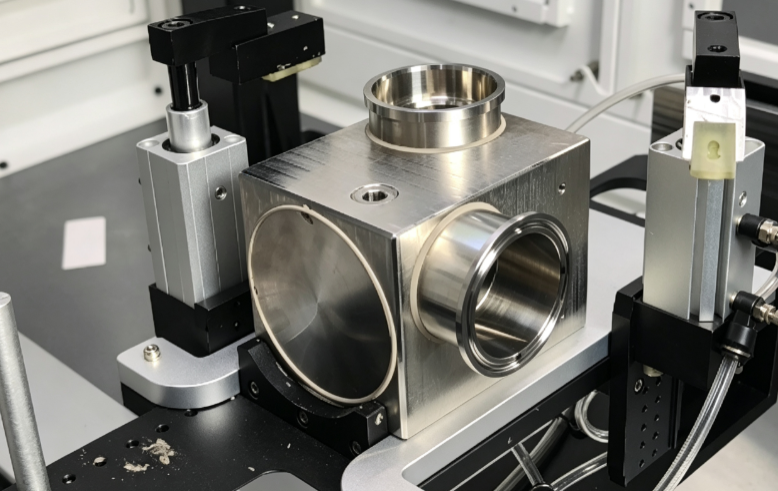
As AI computing, data centers, and high-performance computing systems continue to advance, liquid cooling technology is becoming increasingly important for thermal management. The growing demand for high-performance cooling solutions is also driving higher manufacturing requirements for liquid cooling components.
Liquid cooling manifolds, which distribute coolant throughout a cooling system, may incorporate complex structures and multiple brazed joint locations. Depending on the product design, brazing paste may need to be applied to several surfaces of the same manifold before vacuum brazing.
For workpieces with relatively simple structures, traditional single-side dispensing methods may be sufficient. However, when brazing paste must be applied to the front, side, and bottom surfaces, manufacturers face additional challenges in workpiece positioning, vision recognition, and dispensing path control.
This has created a need for more flexible automated dispensing solutions that can accommodate different surface orientations while maintaining consistent brazing paste application.
A rotary vision brazing paste dispensing machine provides an integrated approach by combining automatic workpiece rotation, moving-camera vision recognition, and programmable dispensing control.
Why Are Multi-Side Brazing Paste Applications Creating New Equipment Requirements?
In conventional liquid cooling manifold manufacturing, brazing paste application may be concentrated on one primary surface. For workpieces with relatively simple structures, a conventional single-side dispensing machine can often meet the application requirements.
However, some liquid cooling manifold designs require brazing paste to be applied to multiple surfaces, including the front, side, and bottom.
Each surface may have different brazing joint locations, structural features, and dispensing path requirements. This makes it more difficult to maintain consistent application quality through manual repositioning or conventional single-side dispensing methods.
Manufacturers may encounter several challenges:
·Maintaining accurate positioning across different workpiece orientations.
·Identifying dispensing locations on different surfaces.
·Controlling dispensing paths for different geometries.
·Maintaining consistent brazing paste quantity and application position.
·Reducing repeated manual handling and repositioning.
The transition from single-side to multi-side application is therefore more than an increase in the number of dispensing operations. It requires coordinated control of workpiece rotation, local vision recognition, and dispensing movements.
What Is Multi-Side Brazing Paste Dispensing?
Multi-side brazing paste dispensing is an automated application process in which brazing paste is deposited onto multiple designated surfaces of a workpiece before brazing.
For liquid cooling manifolds, this may involve applying brazing paste to the front, side, and bottom surfaces of the same component.
By integrating automatic rotary positioning with vision recognition and programmable dispensing paths, the machine can process different surface orientations without requiring operators to repeatedly reposition the workpiece manually.
A moving-camera vision system further supports this process by capturing local images near each dispensing location, identifying the target features, and correcting the dispensing coordinates before paste application.
This approach is particularly useful for manifold designs with multiple brazing joints, different surface geometries, and relatively demanding positioning requirements.
Three Key Challenges in Multi-Side Brazing Paste Application
Applying Brazing Paste to Multiple Surfaces
When brazing paste needs to be applied to the front, side, and bottom surfaces of a liquid cooling manifold, manual workpiece repositioning can become a major limitation.
Operators may need to turn or reposition the workpiece several times to complete the application process on each surface. Every manual operation introduces the possibility of alignment deviations, which may affect the accuracy of subsequent dispensing operations.
For precision liquid cooling components, positioning deviations can cause brazing paste to be deposited outside the intended joint locations.
An automated rotary dispensing system helps address this challenge by rotating the workpiece according to a programmed sequence. After completing the dispensing operation on one surface, the rotary mechanism changes the workpiece orientation to expose the next target surface.
This reduces repeated manual handling and provides a more consistent positioning reference for each dispensing operation.
Maintaining Positioning Accuracy Across Different Surfaces
Dispensing paths on different manifold surfaces are often different.
The front surface may require straight-line application, while the side surface may involve L-shaped transitions. The bottom surface may contain curved paths or more complex geometries around valve seats and other structural features.
When the workpiece rotates, the original dispensing coordinates may no longer correspond to the new workpiece orientation. Relying only on the previous positioning reference may therefore introduce alignment errors.
A moving-camera vision system helps address this challenge.
In this configuration, the camera is installed near the dispensing head and moves together with it. As the dispensing head approaches a target dispensing location, the camera captures a local image of the corresponding workpiece area.
The vision system identifies the relevant features and determines the actual dispensing position. The motion control system then uses the recognition results to compensate for positioning deviations and update the dispensing coordinates.
After the workpiece rotates to the next surface, the camera moves with the dispensing head to the corresponding target area and performs another local image recognition operation.
This process allows the machine to identify dispensing locations separately on the front, side, and bottom surfaces, rather than relying on a single image reference for the entire workpiece.
By combining local vision recognition, coordinate correction, and automatic rotary positioning, the machine helps improve dispensing position consistency across different workpiece orientations.
Maintaining Consistent Brazing Paste Application
Consistent brazing paste application is important for achieving reliable vacuum brazing results.
Variations in paste quantity, application position, or dispensing path can affect the distribution of brazing filler material at the joint locations. Insufficient or excessive paste application may lead to inconsistent filler material distribution and potentially affect joint formation.
When multiple surfaces are involved, maintaining consistency becomes more challenging because each surface may require different dispensing paths and process parameters.
A suitable automated dispensing machine should therefore support independent programming for the front, side, and bottom surfaces while maintaining coordinated control of the overall application process.
In vacuum brazing applications, the brazing paste must also be compatible with the furnace heating cycle and vacuum conditions. Its binder formulation, application quantity, and deposit location can influence binder removal and filler metal flow during heating.
For this reason, dispensing accuracy should be considered together with the brazing material characteristics, joint design, and subsequent vacuum brazing process requirements.
How Does a Rotary Vision Brazing Paste Dispensing Machine Work?
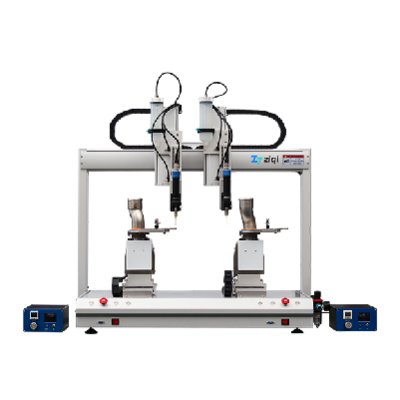
A practical solution for multi-side brazing paste application is a floor-standing rotary vision dispensing machine.
Its core operating principle is to combine automatic workpiece rotation with a moving-camera vision system and programmable dispensing control.
Unlike a conventional fixed-camera configuration, the camera is installed near the dispensing head and moves together with it. This allows the system to capture local images close to the actual dispensing locations.
The workpiece is automatically rotated to expose the front, side, and bottom surfaces in sequence. The vision system then identifies the target dispensing locations on each surface and helps correct the dispensing coordinates before application.
A typical operating process involves the following steps:
Workpiece Loading and Positioning
The liquid cooling manifold is loaded and secured in the rotary fixture to establish a stable positioning reference for the dispensing process.
Local Vision Recognition
The dispensing head moves toward the target area. The camera, installed near the dispensing head, moves with it and captures a local image near the dispensing position.
The vision system identifies the target features and determines the corresponding dispensing location.
Dispensing Position Correction
Based on the recognition results, the system compensates for workpiece positioning deviations and updates the dispensing coordinates to support accurate paste application.
Automatic Workpiece Rotation
After completing the programmed dispensing path on the current surface, the rotary mechanism automatically changes the workpiece orientation to expose the next surface.
Re-Recognition and Multi-Side Dispensing
The camera moves with the dispensing head to the next target area and performs another local image recognition operation. The machine then executes the corresponding dispensing path according to the programmed settings for that surface.
This sequence is repeated until the designated brazing paste application operations on the front, side, and bottom surfaces are completed.
By integrating these operations, the machine reduces repeated manual handling and supports more consistent positioning and dispensing across multiple surfaces.
Key Functions of the Equipment
A floor-standing rotary vision brazing paste dispensing machine can be configured with the following functions according to actual production requirements.
Automatic Workpiece Rotation
An automatic rotary mechanism changes the workpiece orientation according to the programmed process sequence. This allows the machine to access the front, side, and bottom surfaces without repeated manual repositioning.
Moving-Camera Vision Recognition
The camera is installed near the dispensing head and moves together with it. When the dispensing head approaches a target area, the camera captures a local image for feature recognition and positioning.
This configuration allows the system to identify dispensing locations near the actual application area on each surface.
Automatic Dispensing Position Correction
Based on the local vision recognition results, the system can compensate for workpiece positioning deviations and update the dispensing coordinates.
This helps reduce the influence of workpiece alignment variations on dispensing accuracy.
Independent Dispensing Programs for Different Surfaces
The front, side, and bottom surfaces can be programmed with their own dispensing paths and process parameters.
This allows the machine to accommodate different joint geometries and brazing paste application requirements across the same workpiece.
Coordinated Multi-Side Dispensing Control
The machine coordinates automatic rotation, local vision recognition, position correction, and dispensing movements to complete the multi-side application process.
By integrating these functions, the equipment provides a flexible automated solution for liquid cooling manifold manufacturing applications involving multiple brazing surfaces.
When Should Manufacturers Choose a Rotary Vision Dispensing Machine?
A rotary vision brazing paste dispensing machine is particularly suitable for manufacturing applications where:
·Brazing paste must be applied to the front, side, and bottom surfaces of the same workpiece.
·Manual workpiece rotation creates positioning inconsistencies.
·Different surfaces require different dispensing paths.
·Brazing joint locations have complex geometries.
·Local vision recognition is required to identify dispensing positions on different surfaces.
·Position correction is important for maintaining application accuracy.
·Consistent brazing paste application is required before subsequent vacuum brazing.
·Production efficiency and process repeatability need to be improved.
When selecting equipment for these applications, manufacturers should consider several factors, including workpiece dimensions, weight, rotary positioning requirements, brazing paste characteristics, dispensing path complexity, and required application accuracy.
For workpieces with simpler structures or brazing paste application requirements concentrated on one surface, a conventional single-side dispensing machine may remain a suitable choice.
The equipment configuration should ultimately be determined through an evaluation of the actual workpiece geometry, material characteristics, dispensing requirements, and production process.
Automated Brazing Paste Dispensing for Liquid Cooling Manifold Manufacturing
As liquid cooling manifold designs become more complex, some manufacturing applications require brazing paste to be applied across multiple surfaces rather than a single primary surface.
This creates additional requirements for workpiecerotation, local vision recognition, dispensing position correction, and application consistency.
Shenzhen Ziqi Technology's floor-standing rotary vision dispensing machine is designed for applications that require automated brazing paste application across the front, side, and bottom surfaces of a workpiece.
By combining automatic workpiece rotation with a moving-camera vision system, the machine captures local images near dispensing locations, identifies target features, and helps correct dispensing coordinates on different surfaces.
The system also supports independent dispensing paths and process parameters for different workpiece orientations.
The machine can be customized according to manifold dimensions, structural features, brazing joint locations, dispensing paths, and production requirements.
For manufacturers processing liquid cooling components, this type of automated solution offers a flexible approach to multi-side brazing paste application before vacuum brazing.
Conclusion
The increasing complexity of liquid cooling manifold designs is creating new requirements for brazing paste application in certain manufacturing processes.
When brazing paste needs to be applied to the front, side, and bottom surfaces of a workpiece, conventional single-side dispensing methods may require repeated manual repositioning and additional alignment operations.
A rotary vision brazing paste dispensing machine addresses these challenges by integrating automatic workpiece rotation, moving-camera local vision recognition, dispensing position correction, and programmable multi-side application.
By coordinating these functions, manufacturers can reduce manual handling, improve positioning consistency, and achieve more controlled brazing paste application before vacuum brazing.