
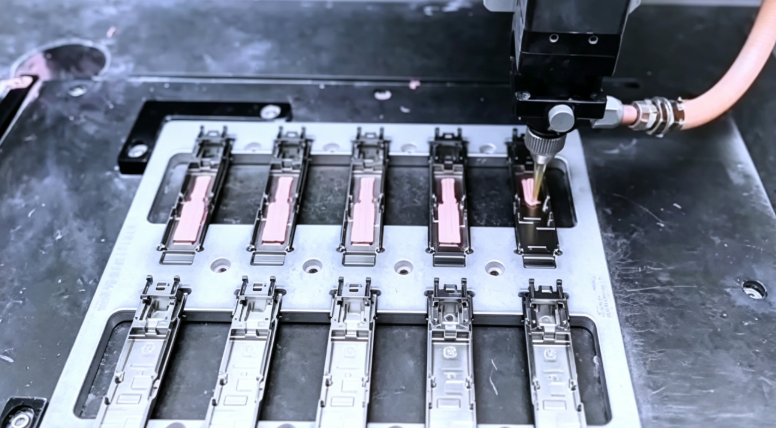
As electronic devices, automotive electronics, battery components, and other advanced products become smaller and more integrated, manufacturers face increasing challenges in adhesive dispensing.
A sealing bead that is slightly off-position can affect waterproofing. An inconsistent thermal adhesive pattern can affect heat transfer. For high-volume production, manual dispensing and fixed-position dispensing may also struggle to maintain consistent results when product positioning, dimensions, or dispensing paths vary.
So, how can manufacturers improve adhesive dispensing accuracy without sacrificing production efficiency?
An inline vision dispensing machine combines machine vision, precision motion control, and automated adhesive dispensing to detect the actual position of each workpiece and compensate the dispensing path before adhesive is applied. This approach is particularly useful for housing sealing, thermal conductive adhesive dispensing, structural bonding, battery components, and other applications where positioning consistency is critical.
Quick Answer: What Does an Inline Vision Dispensing Machine Do?
An inline vision dispensing machine uses an industrial camera or CCD vision system to identify the actual position, orientation, or reference features of a workpiece. The control system then calculates the required path compensation, allowing the dispensing valve to follow the programmed adhesive pattern more accurately.
A typical process is:
Workpiece Loading → Vision Recognition → Position Compensation → Precision Dispensing → Inspection
Compared with fixed mechanical positioning alone, vision-guided dispensing can compensate for normal product-position variations and provide greater flexibility for complex geometries and multiple product models.
What Is an Inline Vision Dispensing Machine?
An inline vision dispensing machine is an automated adhesive dispensing system designed to operate as part of a production line.
It typically combines:
·Industrial camera or CCD vision system
·Precision X/Y/Z motion system
·Adhesive dispensing valve
·Material supply and pressure or pump system
·Dispensing control software
·Product positioning or conveyor system
·Optional inline inspection system
·Optional barcode, QR-code, PLC, or MES integration
The key difference between a conventional dispensing machine and a vision-guided system is how the workpiece position is determined.
A conventional system may rely primarily on fixtures and predefined coordinates. A vision dispensing system can detect the actual position of the workpiece and adjust the programmed dispensing path accordingly.
Industry dispensing systems use similar concepts, combining vision guidance with motion control to improve bead placement and accommodate variations in product orientation or surface position.
How Does Vision-Guided Dispensing Work?
A typical inline vision dispensing process includes five steps.
Workpiece Positioning
The product enters the dispensing station through a conveyor, transfer mechanism, or automated loading system.
The workpiece does not necessarily need to be positioned at exactly the same coordinates every time, provided the variation remains within the vision system's detection and compensation range.
Vision Recognition
The industrial camera captures the workpiece and identifies predefined reference points, contours, holes, edges, or other recognizable features.
Depending on the application, the vision system may identify:
·Fiducial marks
·Product edges
·Housing contours
·Component locations
·Holes or mounting features
·Adhesive dispensing areas
Position Compensation
The control system compares the detected position with the programmed reference position.
If the workpiece has shifted or rotated, the dispensing coordinates can be adjusted accordingly.
For example:
Actual product position → Calculate X/Y/θ deviation → Apply coordinate compensation → Update dispensing path
Precision Dispensing
The dispensing valve applies adhesive along the compensated path.
The dispensing method can be configured according to the adhesive and application, including:
·Continuous bead dispensing
·Dot dispensing
·Multi-point dispensing
·Area dispensing
·Sealing paths
·Multiple parallel lines
·Irregular or segmented paths
Inspection and Process Control
An additional vision system can inspect the dispensing result.
Depending on the configuration, inspection may check:
·Adhesive presence
·Position deviation
·Bead continuity
·Coverage
·Basic bead dimensions
·Missing or abnormal adhesive
Inline vision inspection and adaptive dispensing are increasingly used to control adhesive bead placement and process variation.
Why Use Vision Dispensing for Housing Sealing?
Housing sealing is widely used in electronics, automotive electronics, sensors, battery components, and other products that require protection from moisture, dust, or environmental contamination.
The challenge is not simply applying adhesive. The adhesive bead must remain within the required sealing area and maintain sufficient continuity around the housing.
Common dispensing problems include:
·Bead offset
·Gaps or interruptions
·Uneven bead width
·Excess adhesive at corners
·Adhesive overflow
·Inconsistent sealing paths
·Difficult positioning on irregular housings
A vision dispensing machine can detect the actual housing position and compensate the dispensing path before application.
For example, if a housing shifts slightly during loading, the vision system can detect the deviation and adjust the programmed sealing path rather than dispensing at the original fixed coordinates.
This is particularly useful for products with:
·Narrow sealing grooves
·Irregular contours
·Curved edges
·Multiple sealing sections
·Different product models
·Tight adhesive-to-edge requirements
For sealing applications, the objective should be consistent bead placement and continuity, not simply maximum dispensing speed.
How Does It Improve Thermal Conductive Adhesive Dispensing?
Thermal conductive adhesive is used to bond components while providing a thermal path for heat dissipation.
The dispensing requirements are different from conventional housing sealing.
For thermal applications, manufacturers may need to control:
·Adhesive coverage
·Dispensing position
·Material volume
·Adhesive thickness
·Pattern consistency
·Distance between dispensing paths
·Contact area with the heat-transfer surface
Thermal conductive materials can be supplied through different dispensing methods depending on their viscosity, packaging, required volume, and curing characteristics. For example, some one-component thermally conductive adhesives are specifically designed for automatic syringe dispensing.
Vision-guided dispensing is useful when the thermal adhesive must be applied to a defined area or pattern and the product position varies from part to part.
Typical patterns may include:
·Continuous lines
·Parallel lines
·Dots
·Grid patterns
·Irregular paths
·Area dispensing
The correct pattern depends on the thermal design and adhesive specifications. Therefore, a dispensing machine should be configured according to the actual thermal interface material rather than assuming that one dispensing method is suitable for every thermal adhesive.
Can Inline Vision Dispensing Be Used for Battery and New Energy Applications?
Yes.
Automated dispensing is used in various battery and new energy manufacturing processes where adhesive application, sealing, bonding, or thermal management is required.
Potential applications include:
·Battery housing sealing
·Thermal conductive adhesive application
·Structural adhesive dispensing
·Component bonding
·Electronic module sealing
·Selected battery pack assembly processes
For these applications, a vision-guided system can be configured around the actual component geometry and dispensing requirements.
A typical process can be summarized as:
Recognize → Position → Dispense → Inspect
This approach can be especially useful when battery-related components have different dimensions, complex contours, or positioning variations.
However, battery manufacturing is highly application-specific. Adhesive selection, dispensing volume, curing requirements, safety requirements, and process validation should be evaluated together with the equipment configuration.
When Should You Choose an Inline Vision Dispensing Machine?
An inline vision dispensing machine is worth considering when one or more of the following conditions apply.
Product Positioning Varies
If products cannot always be loaded at exactly the same coordinates, vision compensation can reduce the effect of normal positioning variation.
The Dispensing Path Is Complex
Curved housings, narrow grooves, irregular contours, and multi-segment sealing paths can benefit from programmable vision-guided dispensing.
Multiple Product Models Are Produced
Different models may require different dispensing paths or adhesive volumes. Recipe management can simplify product changeover.
Production Volume Is High
Inline equipment can connect with conveyors and upstream/downstream automation to reduce manual handling.
Dispensing Quality Needs to Be Verified
An optional vision inspection system can identify missing adhesive, position deviations, or abnormal bead patterns.
Traceability Is Required
Barcode or QR-code identification can be combined with recipe selection and production data management when required by the production process.
How to Choose the Right Inline Vision Dispensing Machine?
Choosing a dispensing machine based only on positioning accuracy or machine speed can lead to an unsuitable configuration.
Manufacturers should evaluate the complete process.
Product Geometry
Determine whether the workpiece is:
·Flat
·Curved
·Irregular
·Multi-level
·Equipped with narrow grooves
·Sensitive to contact
Adhesive Characteristics
Evaluate:
·Viscosity
·One- or two-component formulation
·Curing method
·Working temperature
·Material packaging
·Pot life for two-component materials
Dispensing Pattern
Define whether the application requires:
·Dots
·Lines
·Sealing beads
·Parallel paths
·Area coverage
·Complex contours
Required Positioning and Repeatability
The required machine performance should be based on the actual product tolerance and adhesive process—not simply a catalog accuracy value.
Production Takt Time
The system should be evaluated based on the complete cycle time, including:
Loading + Vision Recognition + Dispensing + Inspection + Unloading
Line Integration
Consider whether the system needs to connect with:
·Conveyor systems
·PLC
·Barcode/QR-code readers
·MES
·Robot systems
·Inline inspection
·Upstream and downstream automation
This process-based approach helps manufacturers avoid selecting a machine that is technically capable but poorly matched to the actual production requirement.
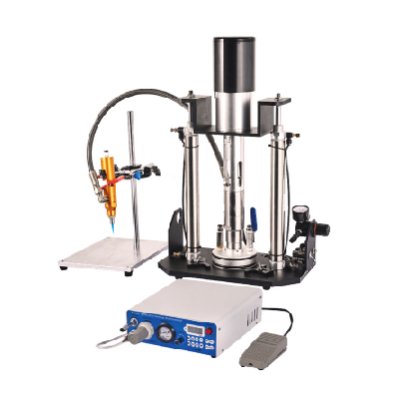
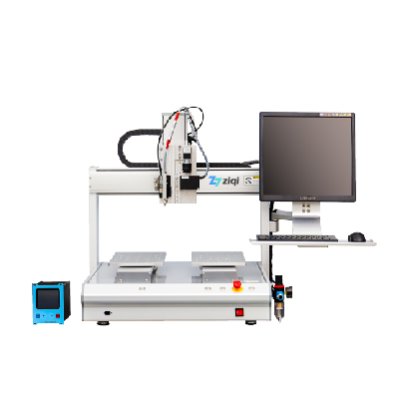
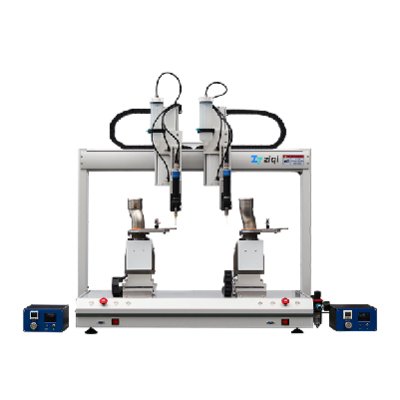
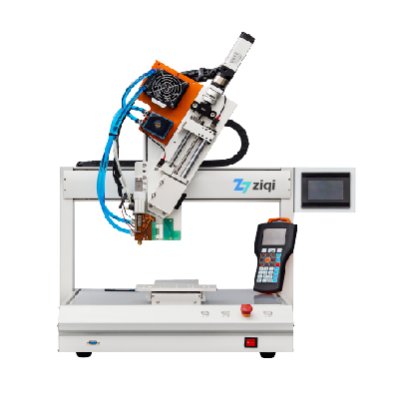
ZiQi Inline Vision Dispensing Solution
Shenzhen ZiQi Technology Co., Ltd. develops automated dispensing machines and industrial automation equipment for precision manufacturing applications.
For applications such as housing sealing, thermal conductive adhesive dispensing, structural bonding, and electronic component assembly, ZiQi can configure dispensing systems around the customer's product and production requirements.
Depending on the application, the system can integrate:
·Vision positioning
·Automatic path compensation
·Precision dispensing
·Multiple product recipes
·Adhesive supply systems
·Inline inspection
·Conveyor integration
·Production-line automation
Rather than selecting equipment based on a single machine specification, ZiQi recommends evaluating the complete dispensing process first.
The main engineering factors include:
Product geometry + adhesive properties + dispensing pattern + positioning tolerance + required cycle time + vision requirements + line integration
This approach allows the dispensing machine configuration to be matched more closely to the actual production process.
For manufacturers dealing with product-position variation, complex housing geometries, thermal adhesive application, or multiple product models, a customized inline vision dispensing solution can help improve process consistency and automation.
FAQ
What is an inline vision dispensing machine?
An inline vision dispensing machine combines an industrial vision system with automated adhesive dispensing. The vision system identifies the actual workpiece position, and the motion system compensates the dispensing path before adhesive application.
Can a vision dispensing machine be used for housing sealing?
Yes. Vision-guided dispensing is suitable for housing sealing when the product has positioning variations, complex contours, narrow sealing paths, or multiple product models.
Can it dispense thermal conductive adhesive?
Yes. With the appropriate dispensing valve, material supply system, and process configuration, vision dispensing equipment can be used for thermal conductive adhesives. Some thermally conductive adhesives are specifically formulated for automatic dispensing.
Can vision dispensing handle curved or irregular housings?
It can, depending on the machine's motion system, vision capability, product geometry, and required dispensing accuracy. More complex surfaces may require additional axis control or height detection.
What determines the configuration of a vision dispensing machine?
The main factors include product geometry, adhesive viscosity and curing method, dispensing volume, dispensing pattern, positioning tolerance, required cycle time, inspection requirements, and production-line integration.
Conclusion
An inline vision dispensing machine is more than an automated glue dispenser. It combines machine vision, precision motion control, adhesive metering, and optional inline inspection to make the dispensing process more adaptable to real-world production variation.
For housing sealing, the key benefit is maintaining the adhesive path around the required sealing contour.
For thermal conductive adhesive dispensing, the focus is controlling adhesive position, coverage, volume, and pattern consistency.
For battery and new energy applications, the system can provide a more standardized approach to sealing, bonding, and thermal material application.
The right solution ultimately depends on the complete process. By evaluating the product, adhesive, dispensing pattern, positioning tolerance, takt time, inspection requirements, and line integration together, manufacturers can select a vision dispensing system that is better matched to their production needs.