
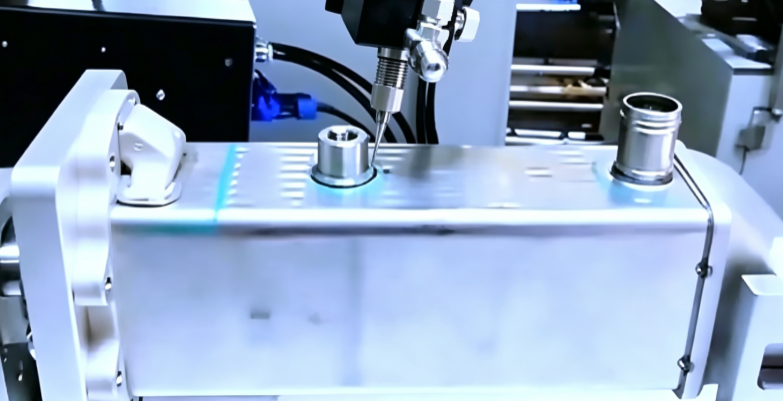
EGR coolers and automotive heat exchangers often contain curved weld seams, angled surfaces, narrow sealing areas, and other difficult-to-reach paths. These characteristics can make manual adhesive application inconsistent and make standard three-axis dispensing systems unsuitable for some applications.
For complex EGR cooler sealing applications, an automated dispensing system may combine a suitable dispensing valve, multi-axis motion, machine vision, and rotary positioning. The right configuration depends on the adhesive, bead specifications, sealing-path geometry, product orientation, and production requirements.
This article explains how to select an EGR cooler adhesive dispensing machine, when five-axis motion may be required, how vision guidance can compensate for positioning variation, and how rotary positioning can support two-sided dispensing.
Why Is Adhesive Dispensing Difficult on EGR Coolers?
EGR coolers and automotive heat exchangers are more complex than simple flat dispensing applications. Depending on the product design, the required sealing path may include:
·Straight or curved weld seams
·Vertical or angled surfaces
·Irregular contours
·Narrow sealing areas
·Multi-directional paths
·Difficult-to-access sections
A conventional three-axis XYZ dispensing machine can be effective when the adhesive path is flat and accessible from a fixed direction. However, when the dispensing nozzle needs to follow a three-dimensional path while maintaining an appropriate orientation, additional rotary motion may be required.
The adhesive itself can also affect dispensing performance. Automotive sealing materials may have relatively high viscosity or contain fillers. Their flow behavior can vary with material temperature, pressure, nozzle diameter, dispensing speed, and valve configuration.
Poorly matched process parameters may result in:
·Uneven bead width
·Insufficient adhesive coverage
·Excessive adhesive
·Interrupted dispensing
·Material accumulation at corners
·Manual touch-up
For this reason, EGR cooler adhesive dispensing should be treated as a complete sealing process, rather than simply an automated glue application step.
What Dispensing Machine Is Best for an EGR Cooler?
There is no single dispensing machine configuration that is best for every EGR cooler.
The equipment should be selected according to the adhesive characteristics, workpiece geometry, sealing path, bead requirements, product orientation, and cycle time.
For a complex EGR cooler, a possible automated configuration is:
Each technology solves a different process requirement.
The final configuration should always be validated with the actual adhesive and workpiece before equipment selection.
Which Dispensing Valve Is Suitable for EGR Cooler Adhesive?
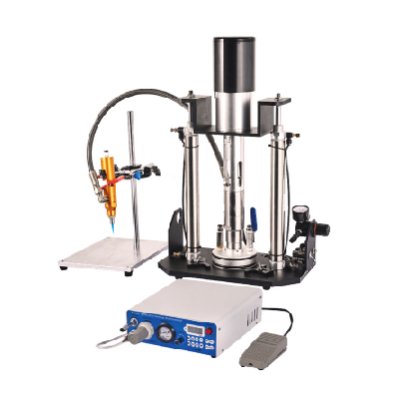
For relatively high-viscosity or particle-filled sealing materials, a screw dispensing valve can be considered when its metering characteristics are compatible with the adhesive.
A screw valve uses controlled screw rotation to meter material rather than relying only on pressure to push adhesive through the nozzle. This can provide controlled material delivery for suitable high-viscosity materials and continuous sealing applications.
Important selection parameters include:
·Adhesive viscosity
·Filler and particle characteristics
·Material temperature
·Material pressure
·Screw speed
·Nozzle diameter
·Required bead width and height
·Dispensing speed
·Required material flow rate
Therefore, the dispensing valve should not be selected based only on the adhesive name or nominal viscosity. Actual material testing is important, particularly when the adhesive contains fillers or has strong thixotropic behavior.
A screw dispensing valve may be suitable when the process requires:
·High-viscosity adhesive dispensing
·Controlled material output
·Continuous bead formation
·Consistent sealing paths
·Reduced dependence on manual adhesive application
The valve is only one part of the complete dispensing system.
When Is a Five-Axis Dispensing Machine Required?
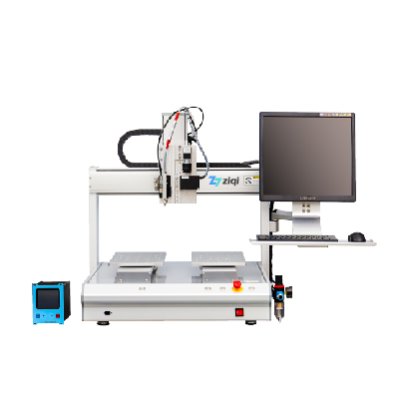
A three-axis dispensing machine may be sufficient when the sealing path is flat and accessible from a fixed direction. A five-axis system becomes more useful when the nozzle needs to change orientation while following a curved, angled, vertical, or three-dimensional path.
A standard three-axis machine moves along X, Y, and Z. Its limitations become more apparent when the nozzle must maintain a suitable angle relative to a complex sealing surface.
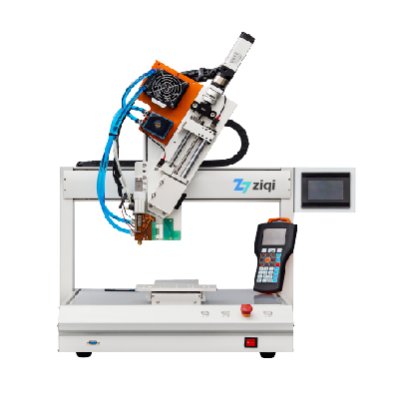
A five-axis dispensing machine adds rotary movement to the basic XYZ system. This allows the dispensing head to follow a programmed path while changing its orientation.
The benefit is therefore not simply having “more axes.” The key advantage is better nozzle accessibility and orientation control along complex dispensing paths.
For EGR cooler weld seams with significant changes in direction or surface orientation, five-axis motion can help maintain a more appropriate relationship between the nozzle and the workpiece.
However, five-axis motion is not automatically necessary for every EGR cooler. The sealing path should be evaluated first.
How Does Machine Vision Improve EGR Cooler Dispensing?
Even with a precisely programmed dispensing path, the actual position of each EGR cooler may vary because of:
·Workpiece positioning variation
·Dimensional tolerances
·Fixture tolerances
·Loading deviations
·Different product models
If the machine always follows fixed coordinates, these variations can cause the adhesive path to shift relative to the actual sealing area.
A machine vision-guided dispensing system can help compensate for these deviations.
A typical process is:
Load Workpiece → Image Capture → Feature Recognition → Position Compensation → Automatic Dispensing → Inspection
The vision system can identify a reference feature or relevant product position before dispensing.
The control system can then adjust the programmed dispensing path according to the detected position.
This can be particularly useful for manufacturers handling multiple EGR cooler or heat exchanger models.
However, machine vision should not be considered a replacement for good mechanical positioning. Stable fixtures, accurate machine mechanics, appropriate calibration, and vision-based compensation should work together.
How Can Rotary Positioning Support Two-Sided EGR Cooler Sealing?
Some EGR coolers may require adhesive dispensing on more than one surface. Manually turning the workpiece between dispensing operations introduces additional handling and repositioning steps.
This can increase:
·Positioning errors
·Labor requirements
·Cycle time
·Product orientation variation
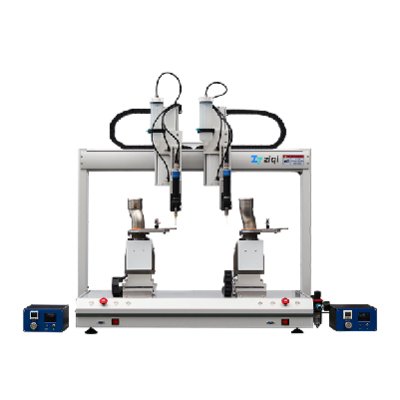
A rotary axis can be integrated into the dispensing system to change the workpiece or dispensing assembly orientation.
A typical sequence may be:
Side A Dispensing → Rotary Positioning → Side B Dispensing → Inspection
This allows different surfaces to be accessed within the automated process without necessarily requiring the operator to remove and manually reposition the product.
The exact rotary configuration depends on the product dimensions, center of rotation, sealing path, machine layout, and required accessibility.
How to Reduce Leakage Risk in EGR Cooler Sealing?
An adhesive dispensing machine alone cannot guarantee a leak-free EGR cooler. Reliable sealing depends on controlling the complete adhesive process.
Adhesive Selection
The adhesive should be compatible with the substrate and meet the required temperature, chemical, mechanical, and sealing conditions.
Bead Geometry
The bead must provide adequate and consistent coverage along the specified sealing area. Bead width, height, continuity, and placement should be controlled according to the application requirements.
Material Metering
Material output should remain stable throughout the dispensing cycle. Valve selection and process parameters should match the adhesive's flow characteristics.
Nozzle Orientation
For curved or angled paths, the nozzle angle and stand-off distance can affect bead formation. Multi-axis motion may help maintain a more consistent dispensing relationship with the workpiece.
Surface Condition
The substrate must be suitable for bonding or sealing. Depending on the material and adhesive, cleaning, surface preparation, or surface treatment may be required.
Curing
The adhesive should be cured according to the adhesive manufacturer's specified process conditions.
Inspection and Leak Testing
Depending on the application, the production process may incorporate visual inspection, bead inspection, dimensional inspection, or leak testing.
The objective should therefore be a repeatable dispensing and sealing process that meets the required leak-test criteria, rather than simply trying to “dispense glue without leakage.”
Recommended Automated Process for EGR Cooler Sealing
For a complex EGR cooler, a possible automated process is:
Automatic Loading → Vision Positioning → Five-Axis Motion → Adhesive Dispensing → Rotary Positioning → Second-Side Dispensing → Inspection
The actual configuration can be simplified or expanded according to the product.
For example:
Provides controlled delivery of suitable sealing adhesive.
Allows the dispensing nozzle to follow complex three-dimensional sealing paths while adjusting its orientation.
Detects product position or reference features and provides path compensation.
Provides access to multiple surfaces and can support automated two-sided dispensing.
PLC + Motion Control
Coordinates machine movement, dispensing parameters, vision compensation, and process sequences.
The goal is to create a controlled and repeatable dispensing process rather than simply replacing a manual glue application step with a robot.
Why Choose ZiQi for Automotive Adhesive Dispensing?
Shenzhen ZiQi Technology Co., Ltd. specializes in industrial automation equipment and customized dispensing solutions for manufacturing applications.
ZiQi's automation portfolio includes:
·Automatic Soldering Machines
·Customized Automation Production Lines
For automotive adhesive dispensing, the system can be configured according to the workpiece geometry, adhesive characteristics, dispensing path, positioning requirements, and production process.
For complex EGR cooler and automotive heat exchanger applications, ZiQi can evaluate whether a screw dispensing valve, five-axis motion system, machine vision, rotary positioning, or a combination of these technologies is appropriate.
The objective is to help manufacturers move from manual adhesive application toward a more stable, repeatable, and flexible automated sealing process.
Frequently Asked Questions
Can a three-axis machine dispense adhesive on an EGR cooler?
Yes, a three-axis machine may be sufficient when the sealing path is flat and accessible from a fixed direction. For curved, angled, vertical, or three-dimensional paths, five-axis motion may provide better nozzle accessibility and orientation control.
What dispensing valve is suitable for high-viscosity EGR cooler adhesive?
A screw dispensing valve can be considered for suitable high-viscosity or particle-filled adhesives because it provides controlled screw-based material metering. Final selection should be based on viscosity, filler characteristics, bead requirements, dispensing speed, and material testing.
Why is machine vision useful for EGR cooler dispensing?
Machine vision can detect the actual position of the workpiece or reference features and compensate the dispensing path for positioning deviations. It can be especially useful when product models or loading positions vary.
Can an automatic dispensing machine dispense adhesive on both sides?
Yes. Depending on the product structure and machine design, rotary positioning can provide access to different surfaces and support two-sided dispensing without requiring manual repositioning between operations.
Does automated dispensing guarantee that an EGR cooler will not leak?
No. Dispensing automation alone cannot guarantee leak-free performance. Leakage risk also depends on adhesive selection, bead geometry, surface condition, curing, process stability, and final inspection or leak testing.
What information is needed to customize an EGR cooler dispensing machine?
Useful information includes product drawings or samples, adhesive specifications, bead width and height, sealing-path geometry, production cycle time, number of product models, product orientation, and whether dispensing is required on one or multiple sides.
Conclusion
Automating adhesive dispensing for EGR coolers requires more than selecting a dispensing valve or standard XYZ machine.
For complex sealing applications, suitable adhesive metering, multi-axis motion, machine vision, and rotary positioning can be combined to address high-viscosity materials, three-dimensional sealing paths, positioning variation, and multi-sided dispensing requirements.
However, the optimal configuration should always be determined by the actual adhesive, workpiece geometry, bead specifications, accuracy requirements, and production conditions.
For manufacturers looking to automate EGR cooler or automotive heat exchanger adhesive dispensing, the best starting point is to evaluate the product and adhesive together and validate the dispensing process before final machine selection.
ZiQi can develop customized automated dispensing solutions based on your workpiece, adhesive, sealing path, and production requirements.