
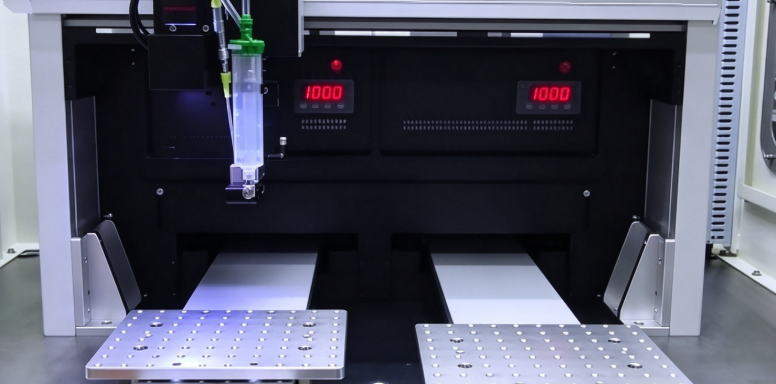
In precision manufacturing, adhesive dispensing and curing must be carefully coordinated to achieve consistent adhesive placement and reliable bonding results. When these processes require separate equipment, additional workpiece transfers and manual handling can increase production complexity.
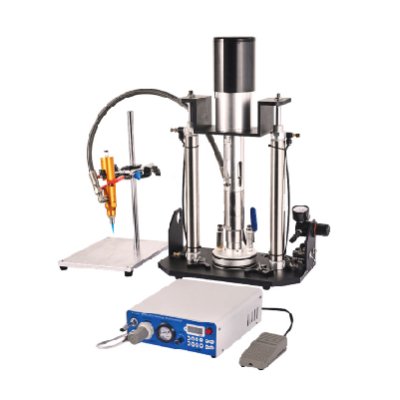
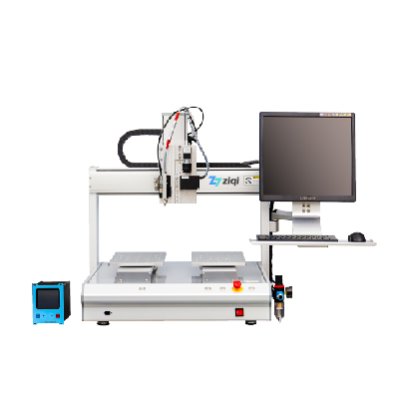
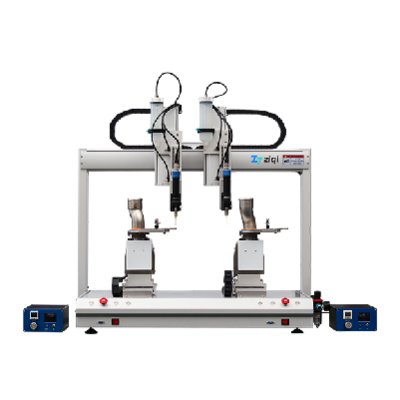
A floor-standing dual-station automatic dispensing and UVcuring machine integrates automatic adhesive dispensing and ultraviolet (UV) curing functions into one equipment platform. Its dual-station layout supports coordinated workpiece handling, while the integrated UV curing process helps complete adhesive processing within the same machine.
For manufacturers working with UV-curable adhesives, this integrated solution can help simplify production workflows and reduce the need to transfer workpieces between separate dispensing and curing stations. An optional vision positioning system can also be incorporated when more accurate workpiece recognition and dispensing path alignment are required.
The appropriate machine configuration depends on the workpiece geometry, adhesive properties, UV curing requirements, positioning tolerance, and production targets.
How Does a Dual-Station Automatic Dispensing and UV Curing Machine Work?
The machine combines an automatic dispensing mechanism, two workpiece stations, and an integrated UV curing section. Its exact operating sequence depends on the machine's control program and configuration.
Workpiece Loading and Positioning
The operator or an automated handling system places the workpiece in the designated station. A fixture holds the component in position during processing to help maintain alignment with the programmed dispensing path.
Consistent workpiece positioning is important because variations in component placement can affect adhesive location and application quality.
Automatic Adhesive Dispensing
The dispensing mechanism applies UV-curable adhesive along programmed paths or at specified locations on the workpiece.
The dispensing parameters are configured according to the adhesive's viscosity, required application quantity, component geometry, and process requirements.
Depending on the product design, adhesive may be applied to designated bonding areas, component edges, or other specified locations.
Integrated UV Curing
After adhesive application, the workpiece undergoes ultraviolet curing within the integrated machine.
UV curing uses ultraviolet light to initiate or promote curing in compatible adhesive formulations. The required wavelength, light intensity, exposure time, and other process conditions depend on the adhesive manufacturer's specifications and the application.
Adhesive selection is therefore an important part of equipment evaluation. The UV source and curing configuration must be compatible with the material and the required curing result.
Dual-Station Operation
The machine has two workpiece stations that can be coordinated according to the programmed operating sequence.
Depending on the actual control logic, one station may be prepared for the next cycle while the other performs automated processing. This arrangement can help reduce waiting time associated with workpiece handling when loading and unloading can overlap with processing.
The actual cycle time depends on dispensing duration, UV exposure requirements, station movements, handling time, and safety controls.
Workpiece Unloading and Inspection
After dispensing and the required UV curing process are completed, the workpiece is removed for inspection or transferred to the next manufacturing stage.
By integrating adhesive dispensing and UV curing within one machine, manufacturers can simplify process coordination and reduce transfers between separate processing stations.
How Does Vision Positioning Improve Dispensing Accuracy?
In precision adhesive dispensing, workpiece placement may vary because of fixture tolerances, loading variation, or component geometry. These deviations can cause the dispensing path to shift relative to the intended application area.
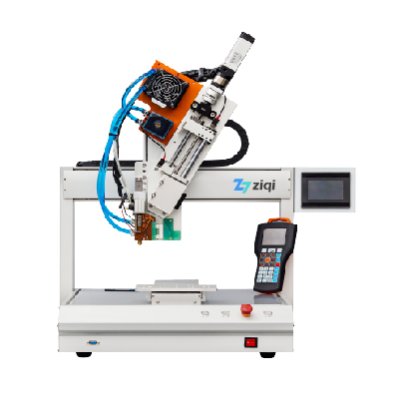
An optional vision positioning system can identify selected workpiece features and provide positional information to the machine's control system.
Depending on the vision configuration, this can support several functions:
·Workpiece recognition: Identifying reference features to determine the actual workpiece position.
·Dispensing coordinate correction: Adjusting dispensing coordinates according to the recognized position.
·Path alignment: Helping align the programmed dispensing path with the intended application area.
·More consistent adhesive placement: Reducing positioning-related errors when the vision, motion-control, and dispensing systems are properly configured.
Vision positioning is particularly useful when workpiece placement varies or when adhesive must follow a defined path relative to recognizable product features.
However, vision positioning does not independently guarantee final dispensing accuracy. Overall performance also depends on camera calibration, lighting, image processing, mechanical positioning, fixture stability, dispensing characteristics, and adhesive behavior.
For applications with stable fixture positioning and straightforward dispensing paths, a standard configuration without vision may be sufficient.
Key Benefits of an Integrated Dispensing and UV Curing System
Integrated Dispensing and UV Curing
Combining automatic dispensing and UV curing in one machine helps coordinate two process stages within a single equipment platform. This can reduce the need for separate dispensing and curing stations and simplify workpiece transfers.
Dual-Station Workpiece Handling
The dual-station layout provides flexibility for coordinating workpiece preparation and automated processing. Depending on the operating sequence, it may help reduce non-processing time between cycles.
Actual production benefits depend on the dispensing time, UV exposure requirements, handling method, and machine configuration.
Controlled Adhesive Application
Programmed dispensing paths and adjustable process parameters help control adhesive placement and application quantity.
The achievable result depends on the dispensing mechanism, adhesive properties, workpiece conditions, and process settings. Application testing is necessary when specific dispensing tolerances must be achieved.
Optional Vision-Assisted Positioning
For applications requiring workpiece recognition or dispensing path correction, an optional vision positioning system can provide additional positioning flexibility.
Whether vision is necessary depends on the required positioning tolerance, workpiece variation, fixture design, and application complexity.
Application-Based Configuration
The machine configuration can be evaluated according to workpiece dimensions, adhesive characteristics, UV curing requirements, dispensing path, positioning tolerance, and production capacity.
Selecting these functions according to actual process needs helps manufacturers avoid unnecessary automation complexity.
Applications of Automatic Dispensing and UV Curing Machines
Automatic dispensing and UV curing equipment can be evaluated for manufacturing processes that use compatible UV-curable adhesives. The specific application must be confirmed according to the product design and material requirements.
Electronic Component Assembly
Electronic components and assemblies may require adhesive for bonding, fixing, or other assembly operations. Automated dispensing helps control adhesive placement, while integrated UV curing supports the subsequent curing stage when the selected adhesive is UV-curable and the joint geometry allows sufficient UV exposure.
Precision Component Bonding
Components with defined bonding areas may benefit from programmed adhesive application followed by UV curing.
The adhesive must be compatible with the joined materials, and the curing process must meet the adhesive manufacturer's requirements. Component geometry and light accessibility should also be considered during process evaluation.
Product Edge Sealing
Some products require adhesive or sealant along designated edges. Automated dispensing can help maintain a consistent application path, while UV curing can support the process when a suitable UV-curable material is used.
The selected material must be appropriate for the intended sealing function and environmental conditions.
Metal-to-Plastic Assembly
Certain assemblies use UV-curable adhesives to bond metal and plastic components. Equipment suitability depends on the adhesive formulation, surface condition, joint design, and UV light accessibility.
Some UV-curable adhesives require additional curing mechanisms when light cannot reach all bonded areas. These requirements should be checked against the selected material specifications before equipment configuration.
These are potential application categories rather than verified applications of every machine configuration. Actual suitability should be established through material and process evaluation.
How to Choose the Right Automatic Dispensing and UV Curing Machine
Selecting a UV dispensing and curing machine requires evaluating the complete process, including adhesive application, ultraviolet curing, workpiece positioning, and production handling.
UV-Curable Adhesive Compatibility
Confirm the adhesive type, viscosity, application quantity, and material compatibility. Review the adhesive manufacturer's technical data to determine the required UV wavelength, light intensity, exposure conditions, and curing criteria.
Not every adhesive is suitable for the same UV curing configuration.
Workpiece Dimensions and Geometry
Evaluate component dimensions, shape, dispensing locations, fixture requirements, and available working space. Complex geometry may affect nozzle access, dispensing paths, and UV light exposure.
Dispensing Accuracy
Define the required adhesive placement tolerance and application consistency. Determine whether fixture-based positioning is sufficient or whether vision-assisted coordinate correction is needed.
If vision positioning is required, confirm which workpiece features can be recognized and what positional corrections the system supports.
UV Curing Performance
Evaluate the adhesive's curing requirements and the accessibility of the areas to be cured. Confirm that the proposed UV source and exposure arrangement are suitable for the material and workpiece geometry.
Curing validation should follow the adhesive manufacturer's specifications and the application's quality requirements.
Production Capacity and Cycle Time
Evaluate dispensing time, UV exposure time, workpiece handling, and the required production output.
A dual-station configuration may help coordinate workpiece preparation and processing, but the actual cycle time must be assessed using the complete production sequence.
Automation Integration
Consider loading and unloading methods, fixture design, operator access, safety interlocks, and integration with the existing production workflow.
Evaluating these requirements before equipment selection helps manufacturers identify a configuration that fits their actual process needs.
Automatic Dispensing and UV Curing Solutions from Shenzhen ZiQi Technology Co., Ltd.
Shenzhen ZiQi Technology Co., Ltd. provides industrial automation equipment solutions for manufacturing applications, including automatic dispensing systems.
For manufacturing processes requiring UV-curable adhesive application, an integrated dispensing and UV curing machine can help coordinate adhesive dispensing and curing within one equipment platform. The dual-station arrangement supports workpiece handling, while optional vision positioning can be considered when additional workpiece recognition and dispensing path alignment are required.
The appropriate configuration depends on the product structure, adhesive properties, UV curing requirements, dispensing path, positioning tolerance, and production objectives.
To evaluate a suitable equipment solution, manufacturers can prepare:
·Product drawings, workpiece samples, or production videos.
·UV-curable adhesive specifications or technical data sheets.
·Required dispensing locations and path details.
·UV curing conditions and quality requirements.
·Target production capacity and cycle time.
·Positioning tolerance and automation requirements.
These details help establish the requirements for equipment evaluation and configuration planning.
Contact Shenzhen ZiQi Technology Co., Ltd. to discuss your UV adhesive dispensing and curing process and evaluate a suitable automation solution for your manufacturing application.
Frequently Asked Questions
What is an automatic dispensing and UV curing machine?
An automatic dispensing and UV curing machine combines an adhesive dispensing mechanism and a UV curing system in one equipment platform. It automates adhesive application and the subsequent ultraviolet curing process for compatible UV-curable materials.
What is the advantage of a dual-station dispensing and curing machine?
A dual-station design provides two workpiece stations for coordinating handling and automated processing. Depending on the operating sequence and process duration, it may help reduce waiting time between production cycles.
Which adhesives can be used in a UV dispensing and curing machine?
The machine must be configured for adhesives compatible with its UV curing system. Adhesive viscosity, UV wavelength requirements, curing conditions, material compatibility, and joint geometry should be evaluated before selecting the equipment.
Does the machine require vision positioning?
No. Vision positioning is useful when workpiece recognition or dispensing path correction is required. For applications with stable workpiece placement and straightforward dispensing paths, a standard positioning configuration may be sufficient.
What factors affect UV adhesive curing?
UV curing depends on the adhesive formulation, UV wavelength, light intensity, exposure time, light accessibility, and workpiece geometry. The required conditions should be confirmed using the adhesive manufacturer's technical specifications and appropriate process validation.
Can UV curing be used for opaque or shadowed bonding areas?
UV curing may be limited when ultraviolet light cannot reach the adhesive. Depending on the adhesive formulation and joint design, a UV-curable adhesive with a secondary curing mechanism may be considered. Material compatibility and curing requirements should be confirmed before selecting the process.
Can a dual-station machine improve production efficiency?
An integrated design can reduce workpiece transfers between separate dispensing and curing stations. The dual-station arrangement may also help coordinate handling and automated processing. Actual efficiency improvements depend on the complete production cycle, including dispensing, UV exposure, loading, and unloading.
Conclusion
A floor-standing dual-station automatic dispensing and UV curing machine integrates adhesive application and ultraviolet curing within one equipment platform. Its dual-station layout supports coordinated workpiece handling, while optional vision positioning can help align dispensing paths with recognized workpiece locations.
For applications using UV-curable adhesives, the equipment configuration should be selected according to adhesive compatibility, UV curing requirements, workpiece geometry, positioning tolerance, and production capacity.
By evaluating these factors before equipment selection, manufacturers can identify an automated dispensing and UV curing solution that matches their actual production requirements.
Shenzhen ZiQi Technology Co., Ltd. can help assess the equipment configuration based on the intended adhesive dispensing and UV curing process.