
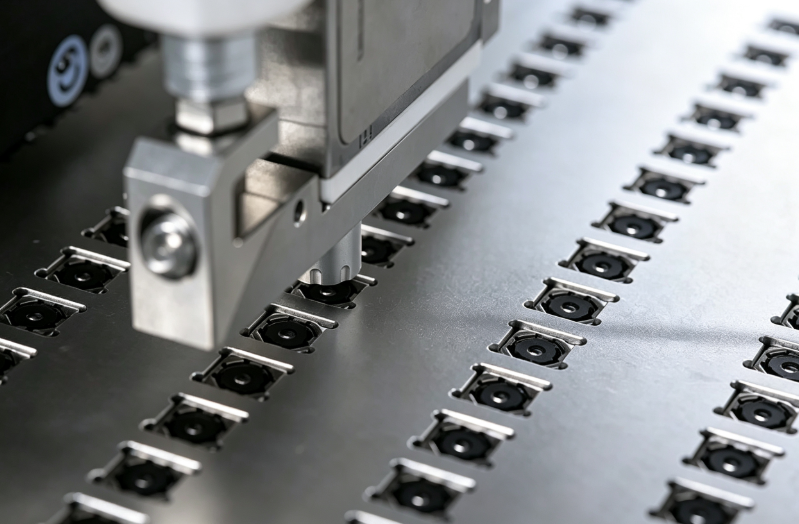
As camera modules become smaller, thinner, and more integrated, camera module lens bonding requires increasingly precise adhesive application. The bonding area may be narrow, while nearby optical components leave little room for adhesive overflow or positioning errors.
The main challenge is not simply applying adhesive. Manufacturers need to place the right amount of adhesive in the right position with consistent bead geometry, while maintaining stable production quality.
A vision dispensing machine can help address this challenge by detecting the actual position of the lens, lens barrel, or other predefined reference features before dispensing. The dispensing path can then be adjusted according to the detected position.
However, vision positioning is only one part of the process. Final dispensing performance also depends on the motion system, fixture, dispensing valve, adhesive properties, curing process, and process parameters.
What Is Camera Module Lens Bonding?
Camera module lens bonding is the process of applying adhesive to a defined bonding interface to secure a lens assembly, lens barrel, housing, or related camera-module component.
Depending on the product structure and adhesive specification, the bonding process may use materials such as:
·UV-curable adhesive
·Epoxy adhesive
·Other application-specific optical or structural adhesives
The exact bonding interface depends on the camera module design. For example, adhesive may be applied between a lens barrel and housing or between other mechanically related components.
A precision dispensing process generally needs to achieve four objectives:
·Accurate adhesive placement
·Consistent adhesive volume
·Stable bead geometry
·Minimal adhesive overflow
Because adhesive may be applied close to optical components, dispensing quality should be evaluated as a complete process rather than simply by machine positioning accuracy.
What Are the Main Challenges in Camera Lens Bonding?
The biggest challenge in camera lens bonding is maintaining consistent adhesive placement and volume within a limited bonding area without allowing material to migrate toward sensitive optical components.
Several factors make precision dispensing important.
Narrow Bonding Areas
Camera module structures can contain relatively small or narrow bonding interfaces. The adhesive may need to follow a circular, arc-shaped, or localized path around a lens or lens barrel.
A small positioning deviation can change the relationship between the adhesive bead and the intended bonding area.
For this reason, stable motion control and repeatable positioning are important.
Risk of Adhesive Overflow
Excessive adhesive can extend beyond the intended bonding area.
For camera assemblies, uncontrolled adhesive flow may create contamination risks if material moves toward optical surfaces or other sensitive components.
However, vision positioning alone cannot prevent adhesive overflow.
Overflow can also be affected by:
·Adhesive volume
·Viscosity
·Dispensing pressure
·Dispensing speed
·Nozzle height
·Valve response
·Start/stop behavior
·Workpiece geometry
A reliable process therefore needs both accurate positioning and controlled material delivery.
Workpiece Position Variation
The actual position of a lens or lens barrel may vary slightly because of:
·Fixture tolerance
·Loading variation
·Component dimensional tolerance
·Rotation deviation
·Mechanical movement
A fixed-coordinate dispensing process can work effectively when the workpiece and fixture are highly repeatable.
However, when positioning variation needs to be detected and compensated automatically, vision-guided dispensing can provide an additional positioning reference.
Adhesive Flow Variation
Even when the dispensing position is correct, inconsistent adhesive delivery can affect bonding quality.
Material flow can be influenced by:
·Viscosity
·Temperature
·Pressure
·Valve characteristics
·Dispensing speed
·Nozzle condition
·Material working life
Therefore, camera module dispensing accuracy is a system-level result rather than a single machine specification.
How Does Vision-Guided Dispensing Work for Camera Lens Bonding?
Vision-guided dispensing improves camera lens bonding by detecting the actual workpiece position, calculating positional deviation, and compensating the programmed dispensing path before adhesive application.
A typical process includes the following steps.
Workpiece Loading
The lens, lens barrel, or camera module is placed into a fixture or automated dispensing station.
The fixture provides a repeatable mechanical reference while the vision system identifies predefined product features.
Vision Image Acquisition
An industrial camera captures an image of the workpiece.
Depending on product geometry and contrast, the vision system may identify:
·Lens edges
·Lens-barrel contours
·Circular features
·Reference marks
·Other predefined positioning features
The appropriate vision target depends on the actual product design.
Position Calculation
The vision software compares the detected feature with the programmed reference position.
Depending on the machine configuration, the system can calculate deviations such as:
·X-axis offset
·Y-axis offset
·Rotation angle
For more complex applications, additional motion axes or sensing methods may be required.
Dispensing Path Compensation
The machine applies the calculated correction to the programmed dispensing path.
Instead of relying only on a fixed coordinate, the dispensing path can be adjusted according to the detected workpiece position.
This is particularly useful when the bonding path is narrow and small positional deviations could affect adhesive placement.
Adhesive Dispensing
After position compensation, the dispensing valve or pump applies adhesive along the required bonding path.
Depending on adhesive properties, required bead geometry, dispensing volume, and production speed, the system may use:
·Syringe dispensing
·Other precision dispensing valves
Vision positioning determines where the adhesive should be applied; the dispensing system determines how the material is delivered.
This distinction is important when evaluating a camera module dispensing machine.
How Does Vision Dispensing Improve Camera Lens Bonding Accuracy?
Vision dispensing can improve the repeatability of camera module adhesive application in several ways.
It compensates for workpiece-position variation
The vision system can identify the actual position of predefined features instead of assuming that every workpiece is located exactly at the programmed coordinate.
It improves dispensing path consistency
After position compensation, the motion system can follow an adjusted dispensing path.
It supports narrow bonding applications
When the adhesive path has limited available space, positional compensation can help maintain the intended relationship between the bead and bonding interface.
It reduces dependence on manual positioning
Automated vision positioning can reduce the effect of certain loading variations between production cycles.
However, vision does not replace mechanical fixturing or dispensing-process control. The best results come from coordinating vision, motion, fixture, adhesive, valve, and process parameters.
What Determines Camera Module Dispensing Accuracy?
A common mistake is to evaluate a dispensing machine only by its advertised positioning accuracy.
In practice, final adhesive placement depends on several interconnected systems.
Vision System
Camera resolution, lens selection, lighting, image contrast, and vision algorithms influence how reliably the system can identify the target feature.
Motion System
The motion platform determines how accurately the dispensing head follows the corrected path.
Fixture
A stable and repeatable fixture provides a reliable reference for both vision positioning and dispensing.
The valve or pump influences material flow, response time, dispensing volume, and bead formation.
Adhesive
Adhesive viscosity, temperature, curing behavior, working life, and material stability can significantly affect dispensing performance.
Process Parameters
Important parameters may include:
·Dispensing pressure
·Dispensing speed
·Valve opening time
·Nozzle height
·Material temperature
·Start/stop parameters
Therefore:
Vision accuracy alone does not represent final dispensing accuracy.
A complete evaluation should consider the vision system + motion system + fixture + dispensing system + adhesive + process parameters as one process.
How to Choose a Vision Dispensing Machine for Camera Module Lens Bonding?
When selecting a camera module dispensing machine, manufacturers should evaluate the complete process rather than focusing on a single specification.
Product Geometry
Consider:
·Lens size
·Lens-barrel structure
·Bonding interface
·Available dispensing space
·Optical clearance
·Circular or irregular dispensing paths
Adhesive
Provide the equipment supplier with:
·Adhesive type
·Viscosity
·Required dispensing volume
·Cure method
·Working life
·Temperature requirements
Required Bead Geometry
Define:
·Bead width
·Bead height
·Continuous or segmented pattern
·Start/stop requirements
·Dispensing tolerance
Vision Positioning
Evaluate whether the system can reliably identify the required product features.
The camera, lens, lighting, fixture, and vision software should be evaluated as one system.
Dispensing System
Select the valve or pump according to:
·Adhesive characteristics
·Required volume
·Bead size
·Dispensing speed
·Contact/non-contact requirements
Production Requirements
Consider:
·Cycle time
·Production volume
·Automatic loading
·Automatic unloading
·Recipe management
·Barcode or QR-code identification
·Production data recording
Inspection
Where adhesive quality needs to be verified automatically, consider integrating post-dispensing vision inspection.
Can Camera Lens Bonding Equipment Be Customized?
Yes. Camera module lens bonding equipment can be customized according to product geometry, adhesive properties, dispensing requirements, and production targets.
A customized system may combine:
Vision System + Precision Motion Platform + Dispensing Valve + Adhesive Supply + Product Fixture + Curing System + Inspection System + Automation Control
The final configuration should be determined according to the actual application.
For challenging applications, sample testing is also recommended before equipment selection.
Testing can help verify:
·Adhesive compatibility
·Dispensing stability
·Bead geometry
·Positioning performance
·Cycle time
·Curing requirements
·Inspection requirements
This application-based approach is generally more useful than selecting equipment based only on a standard machine specification.
About ZiQi
Shenzhen ZiQi Technology Co., Ltd. specializes in the development and manufacturing of automated dispensing and industrial automation equipment.
ZiQi provides dispensing solutions for applications across electronics, automotive electronics, new energy, semiconductor, and other precision manufacturing processes.
Its automation solutions can integrate:
·Machine vision
·Precision motion control
·Adhesive dispensing systems
·Product fixtures
·Curing systems
·Vision inspection
·Automated production functions
For camera module lens bonding applications, ZiQi can evaluate the product geometry, adhesive characteristics, dispensing pattern, bead requirements, positioning requirements, and production targets to determine a suitable vision-guided dispensing configuration.
FAQ
What is camera module lens bonding?
Camera module lens bonding is the process of applying adhesive to a defined bonding interface to secure a lens assembly, lens barrel, housing, or related camera-module component.
Why is precision dispensing important for camera lens bonding?
The bonding area may be narrow and close to sensitive optical components. Accurate adhesive placement, controlled material delivery, and stable bead geometry can help improve process consistency and reduce the risk of excess adhesive.
How does vision positioning improve lens bonding?
A vision system identifies predefined product features and calculates the actual workpiece position. The dispensing path can then be compensated according to the detected positional deviation.
How do you prevent adhesive overflow in camera lens bonding?
Overflow should be controlled through a combination of accurate adhesive positioning, appropriate material volume, dispensing pressure, speed, nozzle height, valve response, and adhesive-flow control. Vision positioning alone cannot prevent overflow.
Can a vision dispensing machine compensate for lens barrel position deviation?
Yes, depending on the machine configuration and vision system, predefined positional deviations such as X/Y offset and rotational deviation can be detected and used to compensate the dispensing path.
Can camera module lens bonding equipment be customized?
Yes. Equipment can be customized according to product dimensions, bonding geometry, adhesive characteristics, bead requirements, cycle time, vision requirements, and production automation needs.
Conclusion
Camera module lens bonding requires precise control of adhesive position, volume, and bead geometry because the bonding area can be narrow and located close to sensitive optical components.
Vision-guided dispensing provides an effective way to detect workpiece position and compensate the dispensing path before adhesive application.
However, vision is only one part of the dispensing process. Final bonding performance depends on the interaction between vision positioning, motion control, fixture stability, adhesive properties, dispensing technology, curing, and process parameters.
For manufacturers evaluating a camera module dispensing machine, the best approach is therefore to evaluate the complete application rather than focusing on a single positioning specification.
When properly configured and validated through application testing, a vision-guided dispensing system can provide a more repeatable and controllable solution for automated camera module lens bonding.
Looking for a Camera Module Lens Bonding Solution?
Send ZiQi your product drawings, adhesive information, dispensing pattern, required bead size, and target cycle time. ZiQi can evaluate the application requirements and recommend a suitable vision-guided dispensing configuration for your production process.