
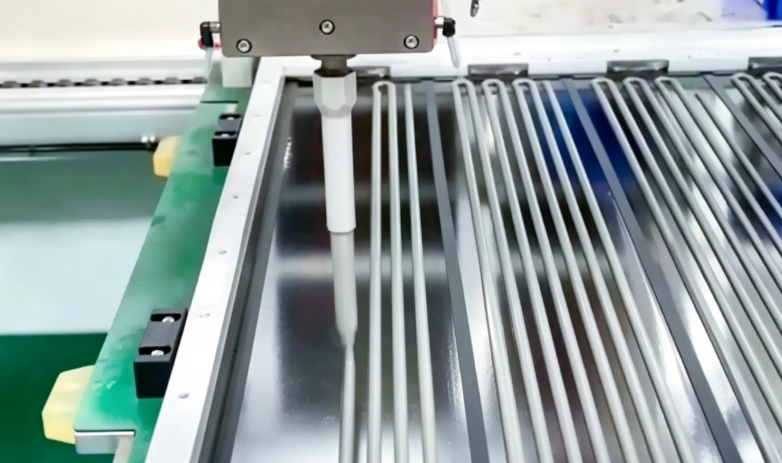
BMS battery assemblies require reliable bonding, sealing, insulation, and thermal management. As battery designs become more compact and production volumes increase, manual adhesive application becomes difficult to control consistently.
The key to reliable BMS battery dispensing is not simply applying more adhesive or increasing dispensing speed. It is controlling material delivery, dispensing position, bead geometry, and process repeatability according to the actual battery structure and adhesive.
This article explains the main challenges of BMS battery adhesive dispensing, how to select the right dispensing machine, and which process parameters should be controlled.
Quick Answer: What Machine Is Used for BMS Battery Dispensing?
The appropriate dispensing machine depends on the adhesive type, viscosity, dispensing pattern, required volume, product geometry, and production cycle.
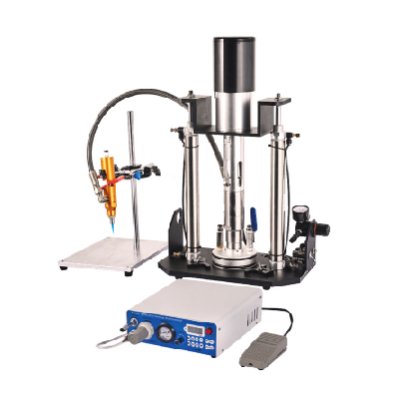
·Pneumatic dispensing systems can be suitable for certain low- to medium-viscosity adhesives.
·Screw or positive-displacement systems can be considered for higher-viscosity materials requiring stable material output.
·1K or 2K metering and dispensing systems are used according to the adhesive formulation.
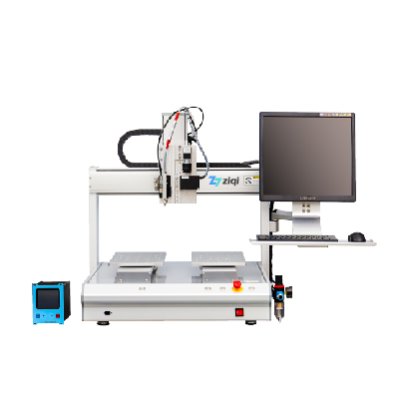
·Machine vision can compensate for product positioning variations.
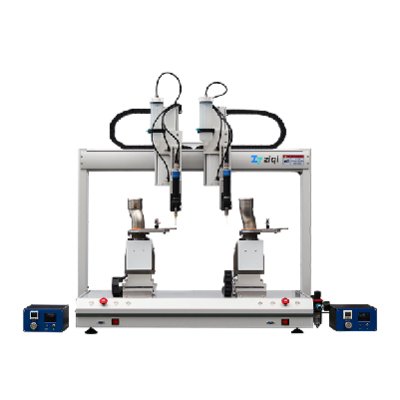
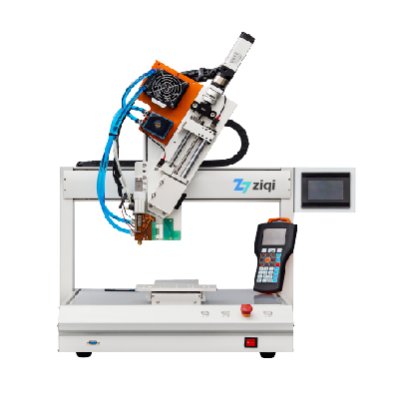
·3-axis systems may be sufficient for many planar dispensing applications, while multi-axis equipment can be considered for complex 3D paths.
·Inline dispensing and inspection can be integrated for higher-volume production.
For battery sealing, industry systems commonly focus on bead placement, material volume, flow rate, and, for two-component materials, mix ratio.
What Is BMS Battery Adhesive Dispensing?
BMS battery dispensing refers to the controlled application of adhesive, sealant, thermal interface material, or other functional materials during battery assembly.
Depending on the battery design, dispensing may be required for:
·Battery cell bonding
·Battery module bonding
·Battery pack sealing
·Structural bonding
·Thermal management
·Component fixation
·Potting or encapsulation
·Protective applications
For example, battery pack sealing commonly uses a continuous bead around the enclosure. Form-in-place gasket (FIPG) and cure-in-place gasket (CIPG) processes are both used in battery pack manufacturing, depending on the material and assembly process.
The dispensing system therefore needs to match the specific application rather than treating all battery adhesives as the same material.
Why Is BMS Battery Dispensing Difficult?
The main challenge is consistent adhesive application.
Battery adhesives can vary significantly in viscosity, flow characteristics, curing behavior, and mixing requirements. At the same time, battery components may have different dimensions, surfaces, and dispensing paths.
Too much adhesive
Excess material can cause:
·Overflow
·Material waste
·Contamination of adjacent components
·Increased curing time
·Assembly interference
Too little adhesive
Insufficient material can lead to:
·Incomplete sealing
·Weak bonding
·Insufficient thermal contact
·Inconsistent protection
·Inconsistent bead geometry
For sealing applications, variations in bead width, height, or position can affect the final seal. Graco specifically identifies bead placement, material volume, flow rate, and mix ratio as important factors for battery pack sealing.
For thermal interface materials, controlling material distribution and avoiding air gaps is also important for heat transfer.
Therefore, the dispensing machine must control more than just the movement of the nozzle.
How Can BMS Battery Dispensing Consistency Be Improved?
A stable dispensing process normally requires four elements.
Stable material delivery
The supply system must provide consistent material flow.
Depending on the adhesive, this may involve:
·Pressure tanks
·Cartridges or syringes
·Pneumatic pumps
·Screw pumps
·Metering pumps
·Heated material supply systems
Suitable dispensing valve
The valve should be selected according to viscosity, flow rate, bead size, and dispensing pattern.
A valve designed for a low-viscosity adhesive may not be appropriate for a high-viscosity thermal compound.
Accurate motion control
The dispensing head must follow the programmed path consistently.
For simple planar products, 3-axis motion may be sufficient. For curved surfaces, different heights, or angled dispensing paths, additional axes can provide greater flexibility.
Vision positioning
Machine vision can identify reference points on the battery and compensate for position or rotation deviations.
This is particularly useful when products are manually loaded or when several battery models share the same production equipment.
Vision-based monitoring can also be used for process inspection. Atlas Copco, for example, describes vision monitoring of bead position, width, and continuity in battery cell-stack adhesive applications.
How to Choose a BMS Battery Dispensing Machine?
The machine should be selected based on the material + product + dispensing pattern + production requirement.
For battery sealing
The priority is usually:
Continuous bead + accurate position + stable volume + repeatability
For long perimeter beads, the material delivery system should also be capable of maintaining continuous flow without unwanted gaps or overlaps. Nordson highlights bead length, meter sizing, bead placement, and controlled dispensing as important considerations in battery pack and module applications.
For thermal interface materials
The system should consider:
·High material viscosity
·Required flow rate
·Material temperature
·Pump capacity
·Metering accuracy
·Air-gap control
·Material abrasiveness
Thermal gap fillers can be particularly demanding because they may be highly viscous and abrasive.
For 2K adhesive
The dispensing system needs accurate:
A/B ratio → metering → mixing → dispensing
The selected system should also account for pot life and mixer change requirements.
For complex battery geometries
If the dispensing path involves different heights, curved surfaces, or changing dispensing angles, a multi-axis system may be considered.
The number of axes should be determined by the actual dispensing path—not simply by choosing the machine with the highest axis count.
BMS Battery Dispensing Workflow
A typical automated process can follow this sequence:
Loading → Positioning → Vision Alignment → Material Feeding → Automatic Dispensing → Curing / Assembly → Inspection
Product Loading
The battery component or assembly enters the dispensing station.
Positioning
The product is mechanically positioned or aligned using machine vision.
Vision Alignment
The camera identifies reference points and compensates for X/Y offset or rotation when required.
Adhesive Feeding
The selected pump, pressure system, or metering system supplies the adhesive.
For 2K materials, the system meters and mixes the two components before dispensing.
Automatic Dispensing
The dispensing valve follows the programmed path while controlling material output and movement speed.
Curing or Assembly
Depending on the adhesive, the product proceeds to curing or the next assembly step.
Inspection
The dispensing result can be checked for:
·Bead presence
·Bead continuity
·Bead width
·Bead position
·Excess adhesive
·Missing adhesive
·Overall appearance
Key Technical Parameters for Battery Dispensing
The most important parameters are not necessarily the machine's maximum speed or positioning accuracy.
Adhesive viscosity
Determines the required pump, valve, pressure, and nozzle configuration.
Flow rate
Must match the required bead size and production speed.
Dispensing pressure
Needs to remain stable enough to maintain consistent material output.
Dispensing speed
Material flow and motion speed need to be matched to maintain consistent bead geometry.
Dispensing height
The nozzle-to-product distance can influence bead formation and consistency.
Bead width and height
Important indicators for sealing and bonding applications.
Dispensing volume
Especially important when precise adhesive consumption or sealing performance is required.
Mix ratio
Critical for 2K adhesives and thermal compounds.
Temperature
Some high-viscosity materials require temperature control to achieve stable flow characteristics. Industrial battery dispensing systems can therefore incorporate heated or temperature-controlled material delivery.
How Should BMS Battery Dispensing Quality Be Evaluated?
A machine should not be evaluated only from its catalog specifications.
Before production, manufacturers should test the actual battery + adhesive + dispensing path.
Key evaluation criteria include:
·Bead position
·Bead width
·Bead height
·Dispensing volume
·Bead continuity
·Mix ratio for 2K materials
·Cycle time
·Material consumption
·Repeatability
·Final bonding or sealing performance
For battery applications, actual sample testing is particularly valuable because adhesive properties and product geometry can significantly affect the final dispensing result. Both Graco and Dürr describe application/process development and material-specific testing as part of developing battery dispensing solutions.
FAQ
What machine is used for battery adhesive dispensing?
An automatic dispensing machine with a suitable material supply system, dispensing valve, motion platform, and optional vision system can be used. The configuration depends on the adhesive and battery application.
What adhesive is used for battery pack sealing?
Common materials include one- and two-component silicones, polyurethane, butyl-based sealants, and other application-specific materials.
What dispensing system is suitable for thermal gap filler?
Thermal gap fillers can require high-flow material delivery, robust pumping, and precise metering because they are often highly viscous and may contain abrasive fillers.
Do I need a vision system for battery dispensing?
Not every application requires vision. It becomes particularly useful when product positioning varies or the dispensing path must align precisely with product features.
Is a 3-axis dispensing machine enough?
For many planar applications, 3-axis motion may be sufficient. More complex 3D dispensing paths may require additional axes.
How can battery dispensing defects be reduced?
Start with the correct material delivery and valve configuration, then optimize pressure, flow rate, dispensing speed, nozzle height, and path accuracy through actual sample testing.
ZiQi BMS Battery Dispensing Solution
Shenzhen ZiQi Technology Co., Ltd. develops automatic dispensing machines and customized automation solutions for battery, electronics, automotive electronics, and precision manufacturing applications.
For BMS battery dispensing, ZiQi can configure the equipment according to:
·Battery structure
·Adhesive type
·Material viscosity
·Dispensing pattern
·Required glue volume
·Accuracy requirements
·Production cycle
·Automation level
A typical solution can integrate:
Material Supply + Dispensing Valve + Precision Motion Control + Machine Vision + Automatic Positioning + Recipe Management
For higher-volume production, loading and unloading, inline inspection, barcode identification, and other automation functions can also be integrated where required.
Most importantly, machine configuration should be validated using the customer's actual battery and adhesive. Sample testing helps determine the appropriate valve, pump, nozzle, dispensing parameters, and motion configuration before the equipment is finalized.
Conclusion
Reliable BMS battery adhesive dispensing depends on more than simply automating the glue application process.
The key is to achieve consistent control of:
Material → Flow → Position → Bead Geometry → Process Repeatability
Battery sealing, structural bonding, thermal management, and other applications may require different dispensing technologies. High-viscosity thermal materials, 2K adhesives, long sealing beads, and complex product geometries each create different equipment requirements.
For this reason, the right dispensing machine should be selected based on the actual battery, adhesive, dispensing path, and production requirements, followed by sample validation before mass production.
For BMS battery dispensing, the goal is not simply to dispense faster—it is to dispense accurately, consistently, and repeatably.