
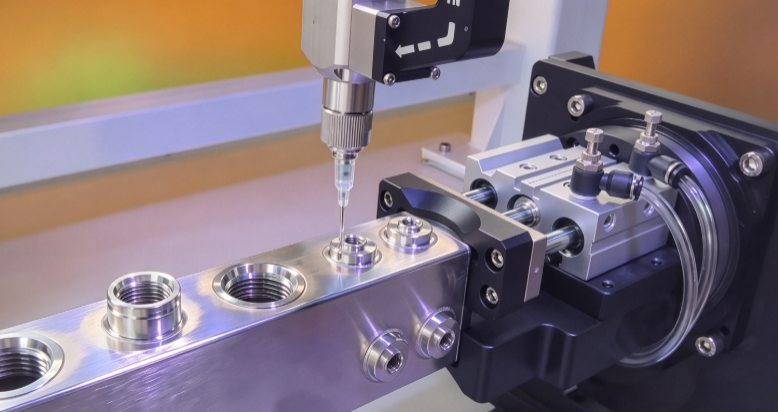
Liquid cooling manifolds play an important role in thermal management systems used in AI servers, data centers, and high-performance computing equipment. During manufacturing, brazing paste must be applied accurately to designated areas to support consistent brazing processes and reliable joint formation.
However, liquid cooling manifolds often feature multiple ports, different surface heights, and complex geometries. Manual application can make it difficult to maintain consistent material output, application thickness, and positioning accuracy.
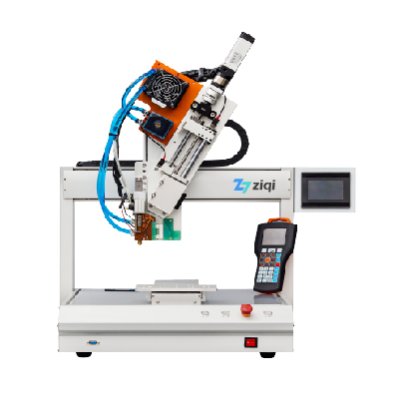
An automatic brazing paste dispensing machine provides a more controlled approach by integrating CCD vision positioning, screw-valve metering, and rotary positioning technology.
These functions help automate material application across multiple dispensing positions while reducing repeated manual handling.
Why Does Liquid Cooling Manifold Manufacturing Require Automated Dispensing?
Liquid cooling manifolds distribute coolant through multiple channels and connections. Their structures typically include several ports and brazing areas located on flat surfaces, corners, and irregular contours.
Applying brazing paste to these areas requires controlled material output and accurate positioning to meet process requirements.
Manual application can present several challenges:
Inconsistent dispensing volume: Material output may vary depending on operator technique and application speed.
Uneven application thickness: Excessive or insufficient brazing paste can affect process consistency and subsequent brazing quality.
Complex multi-surface application: Different dispensing angles and surface positions make manual operation more difficult.
Production variation: Repeated manual positioning and application can introduce inconsistencies between workpieces.
For manufacturers producing complex liquid cooling components, automated dispensing helps standardize the application process and reduce dependence on manual operation.
How Does a Vision-Guided Dispensing Machine Improve the Process?
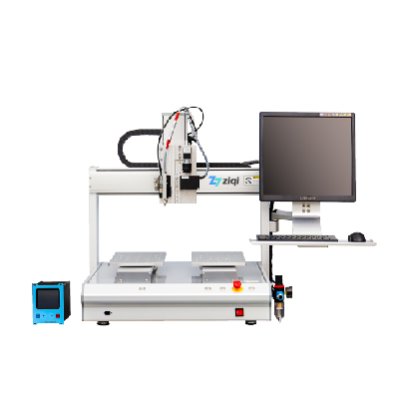
The ZiQi ZQ-CCD661WDH automatic vision-guided dispensing machine integrates three key technologies to address the requirements of liquid cooling manifold brazing paste application.
CCD Vision Positioning for Accurate Dispensing
The CCD vision system identifies workpiece features and determines dispensing positions before the machine executes the corresponding dispensing path.
The ZQ-CCD661WDH features a stated vision resolution of 0.012 mm/pixel and supports one-click DXF drawing import. This allows dispensing paths to be configured according to product geometry and helps simplify program preparation when switching between different workpiece models.
By combining visual recognition with automated motion control, the system can compensate for workpiece positioning variations within its configured recognition and correction range.
The 0.012 mm/pixel specification represents image-to-object spatial resolution and should not be interpreted as the overall dispensing accuracy of the machine.
Screw-Valve Metering for High-Viscosity Materials
Brazing paste is generally a high-viscosity material, making controlled material delivery an important requirement for automated application.
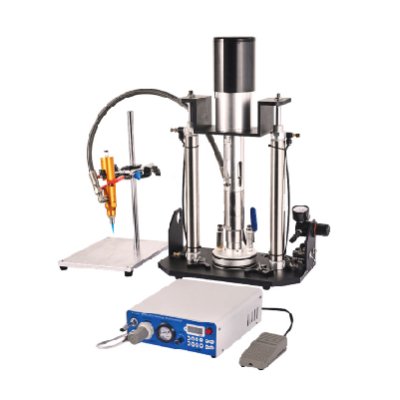
The machine uses a screw-valve dispensing system based on a rotor-and-stator structure. As the rotor rotates inside the stator, material is transported through the dispensing chamber and delivered to the outlet.
The dispensing output is primarily controlled by rotor speed, supporting controlled material metering in suitable applications. Actual output may still be affected by material viscosity, particle characteristics, supply conditions, and dispensing system configuration.
The system is equipped with a 100 W servo motor, with a maximum rotational speed of 400 rpm. Its stated applicable viscosity range is 10,000–200,000 cps, subject to material compatibility and application testing.
This metering approach provides a practical solution for automated dispensing applications involving high-viscosity materials such as brazing paste.
360° Rotary Positioning for Multi-Surface Dispensing
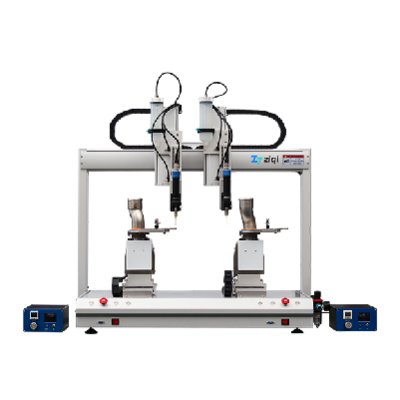
In addition to its standard three-axis working range of 600 × 600 × 100 mm, the machine incorporates a 360° rotary axis.
This configuration allows the workpiece to rotate during processing, enabling the dispensing head to access multiple surfaces and different dispensing positions within one fixture setup.
Compared with conventional three-axis dispensing, rotary positioning can reduce repeated manual workpiece repositioning and help maintain consistent reference positioning throughout the process.
The actual accessible processing range depends on workpiece geometry, fixture design, rotary-axis configuration, and dispensing tool orientation.
Together, CCD vision positioning, screw-valve metering, and rotary positioning provide a flexible automated solution for complex brazing paste application.
Automatic Rotary Dispensing vs. Traditional Dispensing Methods
Different dispensing methods offer different advantages depending on workpiece geometry, production volume, and application requirements.
Manual Dispensing
Manual dispensing is flexible and suitable for simple applications or small production batches. However, dispensing volume, application thickness, and positioning consistency can depend heavily on operator experience.
Conventional Three-Axis Dispensing
Three-axis dispensing machines are suitable for flat surfaces and accessible dispensing paths. When workpieces have side surfaces, angled areas, or multiple dispensing faces, additional repositioning or customized fixtures may be necessary.
Automatic Rotary Dispensing
Rotary dispensing combines automated material application with workpiece rotation. It allows multiple dispensing surfaces to be processed within one fixture setup, reducing repeated manual handling and helping improve process consistency.
For liquid cooling manifolds with multiple brazing positions, rotary positioning can provide greater processing flexibility.
The ZQ-CCD661WDH has a stated positioning repeatability of ±0.03 mm. This specification refers to the machine's stated positioning repeatability and should not be regarded as the overall dispensing accuracy. Actual application performance depends on the combined performance of the vision system, motion platform, fixture, and material dispensing process.
The appropriate dispensing solution ultimately depends on workpiece complexity, production requirements, material characteristics, and quality standards.
Real Application: Brazing Paste Dispensing for Liquid Cooling Manifolds in Thailand
As AI servers and high-performance computing systems continue to increase thermal management requirements, manufacturers need reliable processes for producing liquid cooling components.
To address these manufacturing requirements, ZiQi Technology supplied a ZQ-CCD661WDH automatic dispensing machine to Mansfield Technology (Thailand) Co., Ltd. for brazing paste application on liquid cooling manifolds.
The project integrates three main technologies:
·CCD vision positioning: Identifies workpiece features and determines dispensing positions.
·Screw-valve dispensing: Provides controlled material delivery for high-viscosity brazing paste.
·360° rotary positioning: Changes workpiece orientation to accommodate multiple dispensing surfaces.
This configuration was developed around the customer's workpiece structure and specific application requirements.
Repeat Orders and Equipment Adaptability
Before this project, the customer had already purchased two machines from ZiQi Technology and subsequently placed another order.
The previous machines were used for flow distribution blocks, while the subsequent equipment configuration addressed liquid cooling manifold applications.
Although the workpiece structures and dispensing requirements differed, the underlying automation platform could be adapted through adjustments to machine configuration, fixtures, and processing programs.
This project illustrates how customized dispensing equipment can support different industrial components and evolving production requirements.
For manufacturers evaluating automated brazing paste application, actual customer projects provide useful references for understanding how vision positioning, material metering, and rotary mechanisms can be integrated into a production solution.
What Should Manufacturers Consider When Selecting a Brazing Paste Dispensing Machine?
Selecting an automatic dispensing machine requires more than checking its working range or motor specifications. Manufacturers should evaluate the complete application process before choosing equipment.
Key considerations include:
Workpiece Geometry
Identify the number and location of brazing areas, including whether they are positioned on flat, angled, or irregular surfaces.
Production Requirements
Determine daily output, cycle time, and the required level of automation to select an appropriate machine configuration.
Material Properties
Confirm brazing paste viscosity, flow characteristics, particle properties, and compatibility with the dispensing valve.
Dispensing System
Select a suitable metering method based on material characteristics, required dispensing volume, and application conditions.
Rotary Positioning
Evaluate whether a rotary axis is necessary to access multiple surfaces without repeated manual repositioning.
Application Testing
Test the actual brazing paste and workpieces under realistic production conditions to evaluate material output, application consistency, and process stability.
A successful dispensing solution should be evaluated through actual material testing and complete production process validation, rather than machine specifications alone.
Frequently Asked Questions
Why Is Automated Dispensing Important for Liquid Cooling Manifold Manufacturing?
Liquid cooling manifolds often have multiple ports and complex geometries. Automated dispensing combines vision positioning and controlled material delivery to improve application consistency across different brazing areas. Rotary positioning can also help process multiple surfaces within one fixture setup.
Can a Screw-Valve Dispensing System Handle High-Viscosity Brazing Paste?
A screw-valve system is suitable for many high-viscosity materials because it uses a rotor-and-stator mechanism to transport and meter material. However, compatibility depends on the brazing paste formulation, particle characteristics, viscosity, and dispensing requirements. Actual material testing is recommended before production.
What Are the Benefits of a Rotary Axis in Automated Dispensing?
A rotary axis changes the workpiece orientation during processing, allowing the dispensing head to access different surfaces and dispensing positions. This can reduce repeated manual repositioning and simplify multi-surface dispensing operations.
Can One Vision-Guided Dispensing Machine Handle Different Liquid Cooling Manifold Designs?
A vision-guided dispensing machine can support different workpiece models through configured recognition parameters, dispensing programs, and suitable fixtures. However, each product model requires appropriate path verification and application testing to confirm processing feasibility.
Conclusion
Consistent brazing paste application is an important part of liquid cooling manifold manufacturing. As workpiece structures become more complex, manufacturers need automated dispensing solutions that combine accurate positioning, controlled material delivery, and flexible processing capabilities.
By integrating CCD vision positioning, screw-valve metering, and 360° rotary positioning, the ZiQi ZQ-CCD661WDH provides an automated solution for liquid cooling manifold brazing paste applications.
With experience in customized dispensing equipment and overseas manufacturing projects, ZiQi Technology develops automated dispensing solutions based on specific workpiece structures, material properties, and production requirements.