
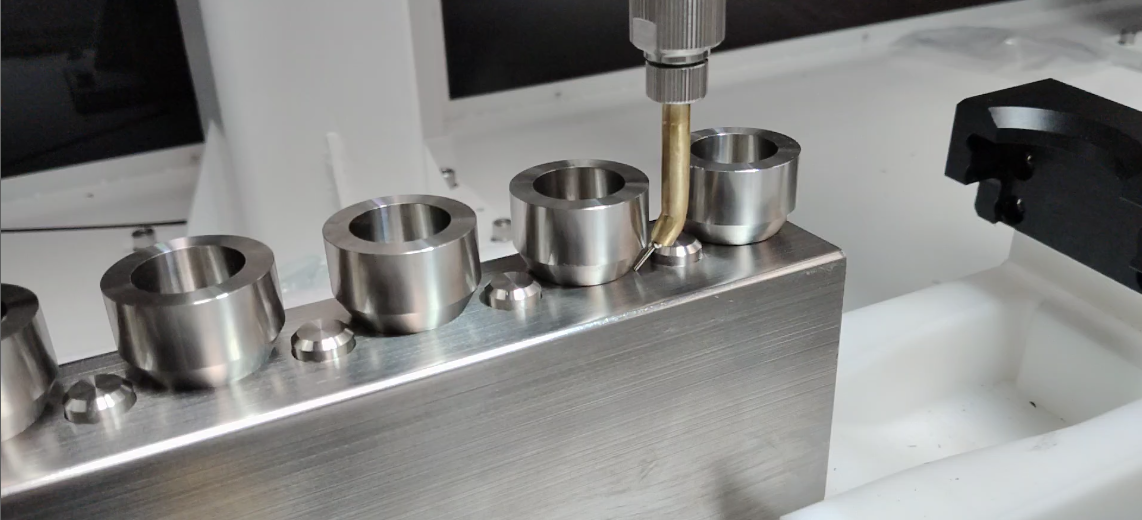
As AI servers and high-performance computing (HPC) systems continue to demand higher thermal management performance, liquid cooling technology is becoming increasingly important in modern data center infrastructure. This growth is driving demand for more advanced liquid cooling components, including liquid cooling manifolds and distribution plates.
In liquid cooling manifold manufacturing, brazing paste application is an important process before vacuum brazing. Accurate paste positioning, controlled dispensing volume, and consistent joint coverage help establish stable conditions for subsequent brazing operations.
However, liquid cooling manifolds often feature long main pipes, multiple branch connections, and complex joint geometries. Applying brazing paste manually to these structures can make it difficult to maintain consistent application quality and production efficiency.
An automatic brazing paste dispensing machine equipped with local CCD vision positioning, four-axis motion control, and automatic rotary dispensing provides an automated solution for these challenges. By coordinating vision recognition, workpiece rotation, and precision dispensing, the system helps improve brazing paste application consistency for complex liquid cooling manifold structures.
Challenges of Brazing Paste Application in Liquid Cooling Manifold Manufacturing
Liquid cooling manifolds used in AI server cooling systems can feature complex structures with multiple branch pipes connected to a long main pipe.
A typical application may involve a main pipe measuring approximately 2–3 meters in length, with 4–16 branch pipes of different diameters and orientations.
These connections require brazing paste to be applied to designated joint areas, often around the full circumference of each branch pipe.
Before vacuum brazing, the brazing paste must be distributed appropriately across the required joint surfaces. Variations in paste quantity, positioning, or coverage may affect the subsequent brazing process.
For manufacturers handling multiple branch connections and different manifold specifications, manual application presents several challenges.
Inconsistent Brazing Paste Application
Manual application relies heavily on operator experience and hand control. Differences in application technique can result in variations in paste quantity, coating thickness, and coverage.
For manifolds with multiple circumferential joints, maintaining consistent application around every connection can be particularly challenging.
Insufficient or excessive brazing paste may affect filler metal distribution and joint formation during subsequent brazing.
Low Production Efficiency
Applying brazing paste to multiple branch connections requires repeated manual positioning and movement around the workpiece.
For complex manifold structures, the process can involve considerable repetitive handling and operator intervention.
As production volumes increase, manual application may become a bottleneck due to labor requirements, operator training, and inconsistent processing times.
Difficult Workpiece Positioning and Surface Access
Long manifold structures and branch pipes arranged at different angles create additional positioning challenges.
Operators may need to repeatedly adjust the workpiece to access different joint surfaces. Maintaining a consistent application path around each connection becomes more difficult when workpiece positioning varies.
An automated system with vision-guided positioning and rotary motion can reduce these challenges by coordinating workpiece recognition, movement, and dispensing operations.
Automatic Brazing Paste Dispensing Solution for Liquid Cooling Manifolds
To address these manufacturing requirements, Shenzhen Ziqi Technology developed an automatic brazing paste dispensing solution for a liquid cooling component manufacturer in Guangdong, China.
The system integrates a local CCD vision positioning system, four-axis motion control, automatic workpiece rotation, and a precision screw valve dispensing mechanism.
Its operating principle is to identify the designated branch pipe and joint positions through machine vision, correct the dispensing coordinates, and coordinate workpiece rotation with programmed dispensing movement.
Unlike conventional manual application, the automated system follows programmed dispensing paths while the workpiece rotates to expose the required joint surfaces.
This configuration is designed for long workpieces with multiple branch connections and circumferential brazing paste application requirements.
Key Equipment Specifications
The automatic brazing paste dispensing machine is configured with the following specifications:
·XYZ Working Travel: 3000 × 500 × 100 mm
·Machine Positioning Repeatability: ±0.02 mm
·Motion Configuration: Four-axis linkage
·Rotary Function: Automatic workpiece rotation for 360° dispensing
·Vision System: CCD camera for branch pipe recognition and dispensing position correction
·Dispensing Valve: Precision screw valve
·Dispensing Weight Performance: ±0.5 mg under specified test conditions
The four-axis motion configuration combines three linear axes (X, Y, and Z) with one rotary axis. This arrangement allows the dispensing system to accommodate long manifold structures and multiple branch connections.
The equipment parameters describe the configured machine. Actual dispensing performance depends on workpiece geometry, material properties, process settings, and specified testing conditions.
Local CCD Vision Positioning and Automatic Dispensing Path Correction
Accurate positioning is particularly important when applying brazing paste to multiple branch connections on a long liquid cooling manifold.
The machine uses a CCD camera mounted near the dispensing head. The camera moves together with the dispensing head rather than relying solely on a fixed-position image of the entire workpiece.
During operation, the camera captures local images near the designated dispensing positions. The vision system identifies relevant branch pipe features and joint locations, then uses the recognition results to correct the dispensing coordinates.
This local vision positioning method helps compensate for minor workpiece placement deviations and reduces dependence on precise manual alignment.
By performing localized image recognition near the dispensing area, the system supports more accurate positioning when processing long workpieces with multiple joints and different branch orientations.
The corrected coordinates are then used by the motion control system to guide the dispensing head along the programmed application paths.
Automatic Rotary Dispensing for 360° Circumferential Joints
One of the main challenges in liquid cooling manifold manufacturing is applying brazing paste around the full circumference of branch pipe connections.
The machine addresses this requirement through coordinated workpiece rotation and dispensing movement.
During operation, the workpiece rotates automatically while the dispensing head applies brazing paste to the designated joint areas. The rotary axis and dispensing path work together to complete circumferential application around the branch pipe connections.
This approach reduces the need for repeated manual workpiece repositioning and helps maintain more consistent paste coverage along programmed dispensing paths.
The rotary mechanism can also support dispensing on designated front, side, and bottom surfaces according to the workpiece structure and programmed processing requirements.
Combined with the local CCD vision system, automatic rotary dispensing allows the equipment to accommodate complex manifold geometries and multiple application positions.
Precision Screw Valve for Controlled Brazing Paste Dispensing
The dispensing valve plays an important role in maintaining consistent brazing paste application.
This system uses a precision screw valve to control paste delivery according to programmed dispensing parameters.
Compared with manually controlled application, automated dispensing provides more consistent control over the dispensing process, helping reduce variations caused by differences in operator technique.
The dispensing parameters can be configured according to the brazing paste characteristics, required application quantity, joint geometry, and production requirements.
For brazing applications, the selected dispensing parameters should be validated using the actual paste formulation and workpiece materials to ensure suitable application results.
Actual Application Results and Manufacturing Benefits
In the liquid cooling manifold application, the automated system performs brazing paste application through coordinated local vision positioning, four-axis movement, and automatic workpiece rotation.
Compared with manual application, the solution provides several practical manufacturing benefits.
Improved Application Consistency
Vision-guided positioning and programmed dispensing paths help reduce variations caused by manual alignment and hand-controlled application.
The precision screw valve provides controlled paste delivery according to the configured process parameters.
More Complete Circumferential Coverage
Automatic workpiece rotation allows the dispensing head to access designated areas around branch pipe connections.
Programmed rotary movement helps reduce the risk of missed sections along the intended dispensing path.
Reduced Manual Handling
The automatic rotary mechanism minimizes repeated manual workpiece repositioning during the dispensing process.
This helps simplify operations when processing manifolds with multiple branch connections.
Improved Production Efficiency
Automated movement and dispensing reduce the need for repetitive manual application.
The equipment can perform programmed dispensing operations across multiple joint locations, supporting more consistent production workflows.
Faster Product Changeover
Different manifold specifications can be accommodated by changing the corresponding dispensing programs and positioning fixtures.
Under the specified production conditions, product changeover can be completed in approximately five minutes. Actual changeover time depends on fixture configuration, product differences, and process preparation requirements.
It is important to note that automated dispensing improves the consistency of the paste application stage but does not independently guarantee final brazing quality. The final result also depends on filler metal selection, base material compatibility, joint clearance, surface preparation, and vacuum furnace parameters.
Brazing Paste Compatibility with Vacuum Brazing
Selecting the correct brazing paste is essential when developing an automated dispensing process for vacuum brazing applications.
Not all brazing pastes are suitable for vacuum brazing. The selected formulation must be compatible with the base materials, filler metal, and vacuum furnace process.
Particular attention should be paid to binder decomposition, outgassing behavior, and potential residue formation during heating.
Inappropriate paste formulations or unsuitable thermal processing conditions may affect furnace cleanliness and brazed joint quality.
Before production, manufacturers should verify the brazing paste specifications, recommended heating cycle, and compatibility with the vacuum brazing process in cooperation with the material supplier and furnace process engineer.
The dispensing system should also be tested with the actual brazing paste to establish suitable dispensing parameters and ensure stable material delivery.
Important Factors When Selecting an Automatic Brazing Paste Dispensing Machine
Choosing an automatic brazing paste dispensing machine requires more than considering positioning accuracy or dispensing speed.
Manufacturers should evaluate the complete relationship between workpiece geometry, material characteristics, dispensing requirements, and downstream brazing processes.
Important considerations include:
·Workpiece Dimensions: Main pipe length, branch pipe quantity, and overall manifold geometry.
·Joint Structure: Branch pipe diameters, connection angles, and circumferential application requirements.
·Vision Positioning: Required recognition features, camera configuration, and positioning compensation.
·Rotary Motion: Workpiece rotation method, fixture design, and access to different joint surfaces.
·Dispensing Requirements: Required paste quantity, application path, and coverage consistency.
·Valve Selection: Compatibility between the dispensing valve and brazing paste characteristics.
·Material Feeding: Paste supply stability and suitability for continuous production.
·Vacuum Brazing Compatibility: Paste formulation, binder behavior, and furnace process requirements.
A properly configured dispensing system should be developed around the actual workpiece structure and validated using the intended brazing paste and production conditions.
Conclusion: Improving Liquid Cooling Manifold Manufacturing with Automated Brazing Paste Dispensing
As liquid cooling systems become increasingly important in AI server and high-performance computing applications, manufacturers need reliable and consistent processes for producing complex liquid cooling components.
An automatic brazing paste dispensing machine integrating local CCD vision positioning, four-axis motion control, precision screw valve dispensing, and automatic workpiece rotation provides an effective approach to automating brazing paste application before vacuum brazing.
By identifying local joint positions, correcting dispensing coordinates, and coordinating rotary movement with programmed dispensing paths, the system helps improve application consistency while reducing repetitive manual handling.
For manufacturers producing liquid cooling manifolds and other complex brazed components, customized automated dispensing equipment can support more controlled and efficient manufacturing processes.
Shenzhen Ziqi Technology specializes in customized automatic dispensing equipment for industrial manufacturing applications, including precision dispensing, vision-guided positioning, and rotary dispensing solutions.
Contact Shenzhen Ziqi Technology to discuss an automatic brazing paste dispensing solution tailored to your liquid cooling manifold structure, brazing paste requirements, and production process.