
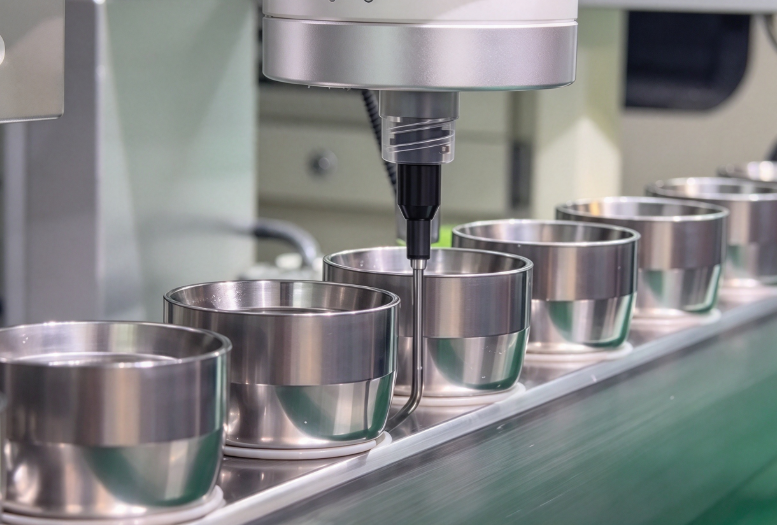
As AI data centers demand higher computing performance, liquid cooling is becoming increasingly important for high-density computing infrastructure. According to TrendForce, liquid cooling penetration among AI chips is projected to reach 53% in 2026, up from approximately 33% in 2025.
Liquid cooling manifolds distribute coolant through designated channels and branches within a cooling system. Their manufacturing quality depends on reliable joints, accurate assembly, and consistent process control. For manifold designs manufactured through vacuum brazing with brazing paste, controlled paste application is an important step in preparing components for the subsequent joining process.
How can automated brazing paste dispensing improve liquid cooling manifold manufacturing? By combining controlled material delivery, programmable motion, and, where required, vision positioning, an appropriately configured dispensing system can help improve application repeatability and accommodate different workpiece geometries. The actual results depend on the brazing paste, component design, equipment configuration, and validated process requirements.
Why Is Precise Brazing Paste Application Important for Liquid Cooling Manifolds?
Liquid cooling manifolds may incorporate pipes, connectors, channels, and other metallic components. Depending on the design and material, manufacturers may use vacuum brazing or other joining methods to produce the required connections.
When a manifold is designed for a brazing process that uses paste, the material must be applied at the specified locations and in the required quantity. Application position, coverage, and consistency can affect the subsequent brazing process.
Manufacturers commonly need to address four challenges.
Complex joint geometries
Manifolds may contain circular interfaces, curved surfaces, multiple connection points, and restricted application areas. The dispensing path must match the actual joint design and the specified paste application locations.
Consistent material deposition
Variations in paste quantity, coverage, or material flow can lead to inconsistent process conditions. A suitable dispensing system should maintain controlled material delivery within the application requirements.
Workpiece positioning deviations
Small differences in workpiece placement can shift the application path. Where the workpiece geometry and system configuration permit, vision-guided positioning can help compensate for certain deviations relative to defined reference features.
Multiple product specifications
Different manifold models may have different dimensions, joint locations, and application paths. Programmable dispensing and appropriately designed fixtures can support product changeovers without requiring an entirely new fixed-path setup for every model.
For manufacturers seeking to standardize these operations, automated brazing paste dispensing offers a way to reduce repetitive manual handling and establish more repeatable application procedures.
How Does Automated Brazing Paste Dispensing Work?
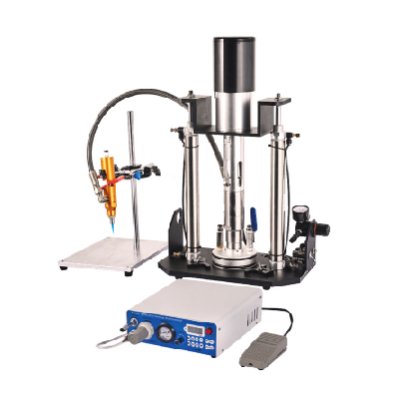
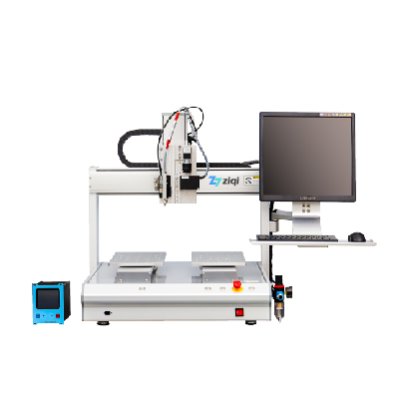
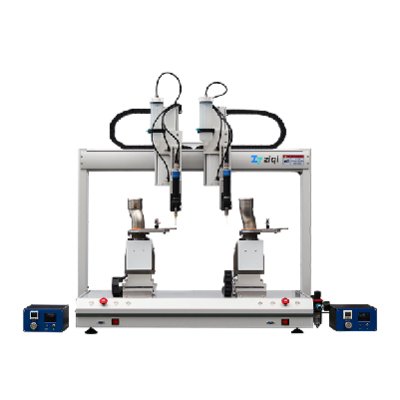
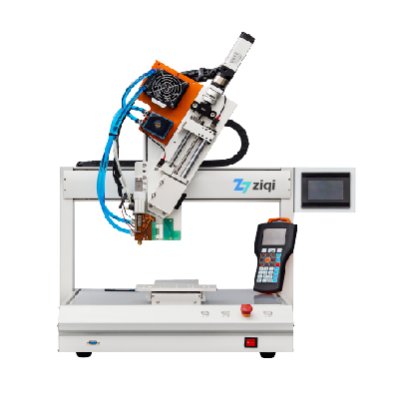
An automated brazing paste dispensing system typically combines a material supply unit, dispensing valve or nozzle, motion platform, control system, and optional machine vision. Each component must be selected according to the actual paste and workpiece requirements.
Vision-Guided Workpiece Positioning
An industrial vision system can identify predefined reference points, edges, or other suitable features on a liquid cooling manifold. After calibration, the system can use the detected position to adjust the programmed dispensing path within its supported compensation range.
This approach can help accommodate certain workpiece placement variations and reduce dependence on highly precise manual positioning.
However, vision guidance does not automatically correct every dimensional or geometric deviation. Actual performance depends on the camera, lighting, calibration, workpiece surface, fixture design, motion system, and inspection algorithm.
For complex three-dimensional manifolds, manufacturers should confirm whether the proposed vision and motion configuration can reach and identify all required application locations.
Programmable Dispensing Paths
Liquid cooling manifolds can differ in pipe diameter, connector arrangement, joint geometry, and overall dimensions. A programmable dispensing system allows the application path and motion sequence to be configured for the specific workpiece.
Depending on the required geometry, the equipment may use a suitable multi-axis motion platform, customized fixtures, and product-specific programs.
For manufacturers producing multiple models, this approach can simplify recipe management and changeovers. The feasibility of each path should be verified against the actual workpiece, required access angles, and dispensing tolerance.
Controlled Brazing Paste Delivery
Brazing paste is not interchangeable with conventional adhesive. It typically contains brazing filler metal particles combined with a formulated binder, and its handling characteristics depend on the specific product.
Before selecting the dispensing equipment, manufacturers should evaluate the paste's viscosity or flow behavior, particle size, settling characteristics, compatibility with the feed system, and recommended application conditions.
The dispensing valve, nozzle opening, feed mechanism, and operating parameters must be suitable for the material. An unsuitable configuration may cause unstable delivery, clogging, inconsistent deposits, or excessive material variation.
The required paste location is equally important. Depending on the brazing filler metal and joint design, paste may be specified adjacent to a joint rather than inside the joint itself.
Manufacturers should follow the paste supplier's technical instructions and the validated brazing process rather than applying a universal placement rule.
For example, Lucas-Milhaupt's VACUBRAZE 33 technical data sheet describes a specific aluminum vacuum brazing paste intended for selective application as supplementary filler metal. Its recommended application location illustrates why material-specific process validation is necessary.
Repeatable Automated Operation
Once the material supply, dispensing path, and process parameters have been validated, automated operation can reduce repetitive manual tasks and help standardize the application sequence.
Depending on the production setup, stored programs and controlled motion can also support product changeovers and improve process traceability when appropriate monitoring and data-recording functions are integrated.
Nevertheless, dispensing repeatability alone does not establish final brazed-joint quality. Material compatibility, surface preparation, joint design, assembly conditions, and the validated brazing cycle remain important factors.
What Should Manufacturers Check Before Selecting a Brazing Paste Dispensing Machine?
Selecting an automatic dispensing machine for liquid cooling manifold manufacturing requires more than checking positioning accuracy. The system must be suitable for both the material application and the downstream brazing process.
Workpiece Geometry and Application Requirements
Identify the number and location of the joints, the required application paths, the available nozzle access, and any curved or restricted surfaces.
Define the target paste quantity, coverage, application tolerance, and acceptable process variation. These requirements provide a practical basis for equipment evaluation.
Brazing Paste Compatibility
Confirm the exact paste formulation and consult the material supplier's technical data sheet.
Evaluate particle size, flow characteristics, storage and mixing requirements, material compatibility, and the suitability of the proposed feed and dispensing components.
Do not assume that a dispensing system designed for conventional adhesives can process every type of brazing paste.
Vision and Motion Configuration
Determine whether machine vision is necessary to accommodate workpiece positioning variations. If required, verify that the camera can identify the relevant features and that the motion platform can reach all specified application locations.
Calibration, fixture repeatability, lighting conditions, and workpiece variability should be considered during testing.
Product Changeovers and Production Integration
For manufacturers producing several manifold models, assess how programs, fixtures, and application parameters will be managed during changeovers.
Also consider cycle-time requirements, material replenishment, cleaning and maintenance, operator access, and integration with existing production equipment.
Sample Testing and Process Validation
Before committing to a production configuration, conduct trials using the actual manifold and brazing paste.
A practical evaluation should verify:
·Material delivery stability and nozzle suitability.
·Application position, quantity, and coverage.
·Repeatability across representative operating cycles.
·Vision recognition and positioning performance, where applicable.
·Compatibility with the specified assembly and brazing process.
Where required, subsequent brazed samples should be inspected using the customer's applicable quality criteria, including leak or pressure-related testing when specified for the component.
This process helps determine whether the proposed equipment can meet the actual manufacturing requirements rather than relying on nominal machine specifications alone.
ZiQi's Approach to Customized Dispensing Automation
Shenzhen ZiQi Technology Co., Ltd. develops automatic dispensing equipment and customized industrial automation solutions for precision manufacturing applications.
For liquid cooling manifold projects involving brazing paste, the appropriate equipment configuration should be determined from the component geometry, material specifications, application requirements, and production workflow.
Depending on the application, the proposed solution may be evaluated for programmable dispensing paths, vision-guided positioning, suitable material delivery components, and customized workholding arrangements.
Before confirming a configuration, ZiQi can assess the application requirements and determine which equipment features need to be validated through sample testing. Material compatibility, dispensing stability, positioning performance, and suitability for the subsequent brazing process should all be considered.
To support an initial application assessment, manufacturers can provide:
·Liquid cooling manifold drawings or representative samples.
·Brazing paste specifications and the supplier's technical data sheet.
·Required paste application locations and quality criteria.
·Target production conditions and changeover requirements.
These details help establish whether a vision-guided system is appropriate and which dispensing configuration should be evaluated. Final equipment recommendations should be based on application testing and the customer's production requirements.
Conclusion
As liquid cooling expands across AI data center infrastructure, manufacturers need reliable production processes for the components that distribute coolant throughout these systems.
For liquid cooling manifolds designed for vacuum brazing with brazing paste, automated dispensing can help improve application repeatability, support programmable paths, and accommodate certain positioning variations when the system is properly configured.
The key to successful implementation is not simply selecting a high-precision dispensing machine.
It is matching the material delivery system, workpiece positioning, application requirements, and downstream brazing process.
Shenzhen ZiQi Technology Co., Ltd. provides automatic dispensing equipment and customized industrial automation solutions. Contact ZiQi to discuss your liquid cooling manifold application, brazing paste requirements, and equipment evaluation needs.
FAQ
Can an automatic dispensing machine dispense brazing paste for liquid cooling manifolds?
Yes, an automatic dispensing machine may be suitable for brazing paste applications, provided that the material properties, dispensing components, and process parameters are compatible. Manufacturers should evaluate the paste formulation, particle size, flow characteristics, and required application pattern before selecting a system.
Why is vision-guided dispensing useful for liquid cooling manifold manufacturing?
Vision-guided dispensing can identify predefined workpiece features and compensate for certain positioning variations within the system's configured capabilities. It can help maintain the intended application path when workpiece placement varies, provided that the vision system, calibration, and motion platform are suitable for the application.
What should be considered when selecting a brazing paste dispensing system?
Key considerations include brazing paste compatibility, particle size, material delivery stability, nozzle suitability, workpiece geometry, application requirements, and production conditions. Sample testing with the actual paste and manifold is recommended before confirming the equipment configuration.
Does accurate brazing paste dispensing guarantee high-quality brazed joints?
No. Consistent paste application is only one factor affecting brazed-joint quality. Material compatibility, surface preparation, joint design, assembly conditions, and the brazing cycle also influence the final result. The complete process should be validated against the applicable quality requirements.
Can ZiQi provide a customized dispensing solution for liquid cooling manifolds?
Shenzhen ZiQi Technology Co., Ltd. develops automatic dispensing equipment and customized industrial automation solutions. For liquid cooling manifold applications, the proposed configuration should be evaluated based on the workpiece design, brazing paste specifications, application requirements, and production conditions. Manufacturers can provide drawings or samples for an initial application assessment.