
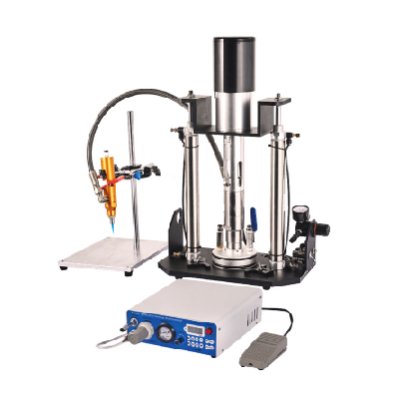
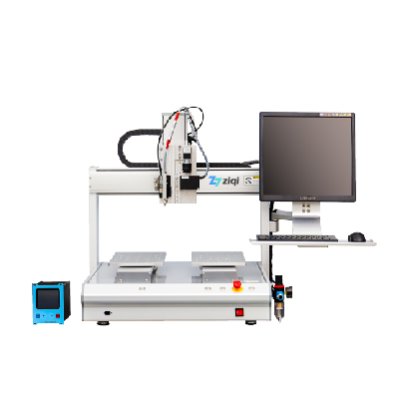
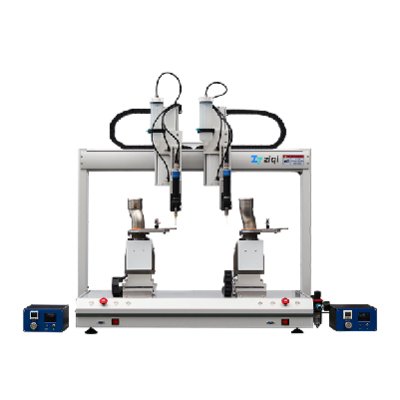
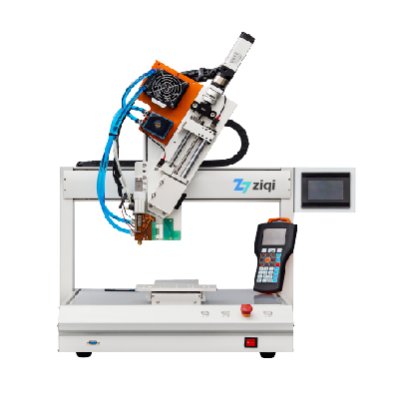
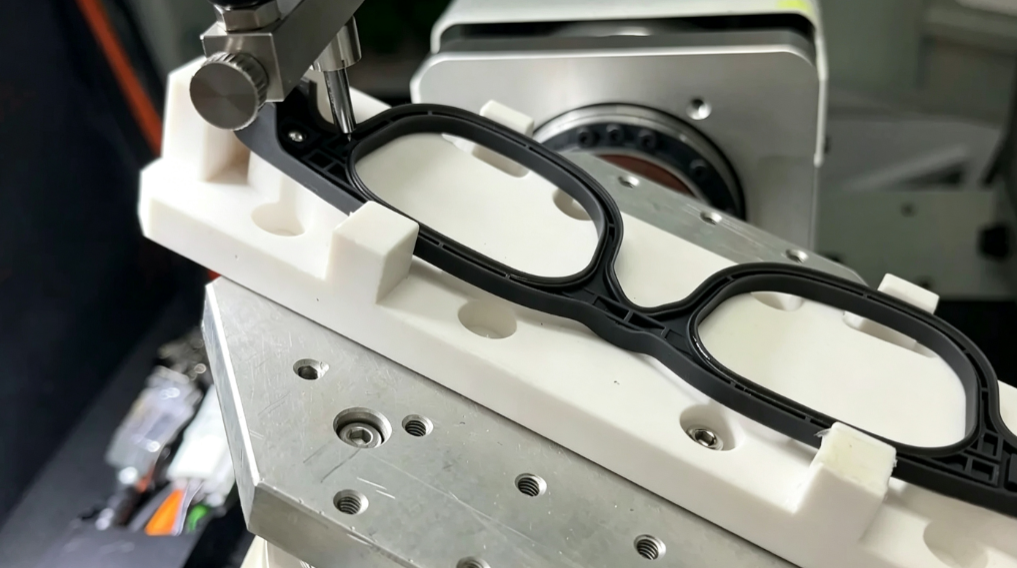
As AR/VR glasses, AI smart glasses, and other wearable devices become smaller and more integrated, adhesive dispensing requires greater control over positioning, dispensing angle, and 3D path accuracy. Curved frames, lens edges, narrow grooves, and inclined bonding surfaces can be difficult to process with a conventional 3-axis dispensing system.
A 5-axis vision dispensing machine combines XYZ motion with rotary and tilting axes and integrates vision positioning to apply adhesive along curved, inclined, and complex 3D surfaces. This makes it suitable for precision bonding, sealing, and other adhesive dispensing applications in smart glasses and wearable electronics.
Why Use 5-Axis Dispensing for Smart Glasses?
Smart glasses typically contain compact structures and irregular geometries. Adhesive may need to be applied along a curved frame, around a lens edge, inside a narrow groove, or on a surface that changes orientation along the dispensing path.
A 5-axis dispensing machine adds two rotary or tilting axes to the conventional XYZ motion system. The dispensing valve can therefore change its orientation while following the programmed path, helping maintain a suitable dispensing angle on complex surfaces.
Five-axis dispensing is particularly useful when the application requires:
·Curved or inclined surface dispensing
·Multi-angle adhesive application
·Complex 3D dispensing paths
·Narrow or difficult-to-reach areas
·Continuous adhesive lines along non-linear contours
Five-axis dispensing systems are already offered for applications such as wearable products, AR/VR glasses, curved frames, and other non-linear dispensing applications.
5-Axis vs. 3-Axis Dispensing: Which Is Better?
A 3-axis dispensing machine can be an effective solution for flat surfaces and relatively simple 2D dispensing paths. However, when the dispensing path follows a curved or inclined surface, the fixed dispensing orientation may become a limitation.
A 5-axis system provides additional rotary and tilting movement, allowing the dispensing valve to adapt its orientation to the workpiece.
In simple terms:
3-axis dispensing is generally suitable for flat surfaces and basic 2D paths, while 5-axis dispensing is more suitable for curved surfaces, complex 3D paths, and applications requiring changing dispensing angles.
The right choice depends on the actual product geometry and dispensing process rather than the number of axes alone.
How Does Vision Guidance Improve Dispensing Accuracy?
Vision positioning helps the machine identify product features, reference marks, or edges before dispensing. It can then adjust the programmed dispensing path according to the actual position of the workpiece.
For smart glasses, this can help compensate for small variations caused by fixture tolerances, incoming-part positioning, or product alignment.
A vision-guided system can therefore help:
·Locate the actual workpiece position
·Compensate for positioning deviations
·Align the dispensing path with product features
·Improve repeatability between production cycles
Depending on the machine configuration, vision positioning can also be combined with height sensing or 3D guidance for more complex dispensing applications. Commercial five-axis systems use technologies such as 2D vision, 3D laser guidance, and contour recognition for curved and non-linear dispensing.
Typical Smart Glasses Dispensing Applications
A 5-axis vision dispensing machine can be configured for different adhesive processes in AR/VR and wearable products, including:
Frame and Lens-Edge Bonding
Continuous adhesive beads can be applied along curved frames or lens edges for structural bonding and sealing.
Narrow-Groove Dispensing
The additional axis movement can help the dispensing valve access narrow or recessed areas where a fixed dispensing direction may be difficult to maintain.
Component Bonding
Adhesive can be dispensed for bonding or positioning compact electronic, optical, or structural components.
Sealing and Protection
Controlled adhesive application can also be used for sealing applications where consistent glue coverage is important for product protection.
The exact process depends on the product design, adhesive properties, dispensing volume, and required bead geometry.
Key Benefits of 5-Axis Vision Dispensing Machine
For smart-glass manufacturing, a properly configured system can provide several process advantages:
Multi-angle dispensing
Rotary and tilting axes allow the dispensing valve to adapt to different surface orientations.
Vision-based positioning
The vision system helps compensate for product positioning variations and align the dispensing path.
3D path control
Coordinated multi-axis movement supports curved, inclined, and other non-linear adhesive paths.
Consistent glue application
Accurate motion and process control can help reduce excessive adhesive, insufficient coverage, and uneven glue lines.
Improved production consistency
Automated dispensing reduces dependence on manual alignment and supports repeatable production.
How to Choose a 5-Axis Dispensing Machine for Smart Glasses?
The machine should be selected according to the actual product and adhesive process. Important factors include:
·Product geometry and dispensing location
·Required dispensing angle and path
·Adhesive type and viscosity
·Required dispensing volume and bead size
·Vision positioning requirements
·Five-axis movement range
·Dispensing valve and fluid delivery system
·Glue-path inspection requirements
For applications involving complex curved surfaces, it is also important to verify whether the system supports 3D path programming, height compensation, or other functions required by the product.
FAQ
What is a 5-axis dispensing machine?
A 5-axis dispensing machine combines three linear axes with two additional rotary or tilting axes. This allows the dispensing valve to change orientation while following complex 3D adhesive paths.
Why is vision guidance important for smart-glass dispensing?
Vision guidance identifies product features or reference positions and can compensate for small positioning variations, helping the dispensing path remain aligned with the actual workpiece.
Can a 5-axis dispensing machine dispense adhesive on curved surfaces?
Yes. Five-axis coordinated motion is designed to provide greater flexibility for curved, inclined, and non-linear dispensing paths.
What is the difference between 3-axis and 5-axis dispensing?
4-axis dispensing is generally suitable for flat surfaces and simple 2D paths. Five-axis dispensing adds rotary or tilting movement for applications requiring changing dispensing angles and complex 3D paths.
How do I choose a five-axis dispensing machine?
Consider the product geometry, adhesive properties, dispensing path, required accuracy, vision system, valve type, production volume, and inspection requirements. Application testing is recommended to determine the appropriate machine configuration.