
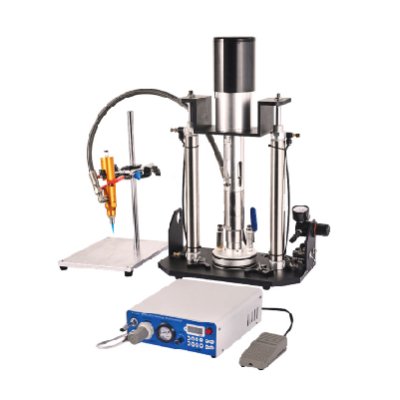
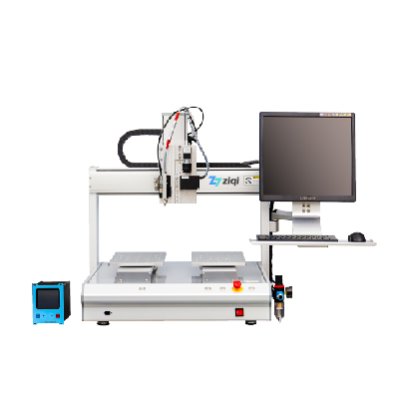
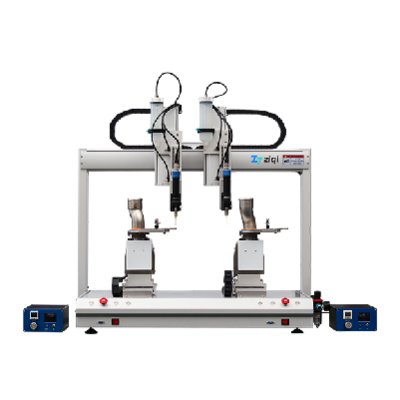
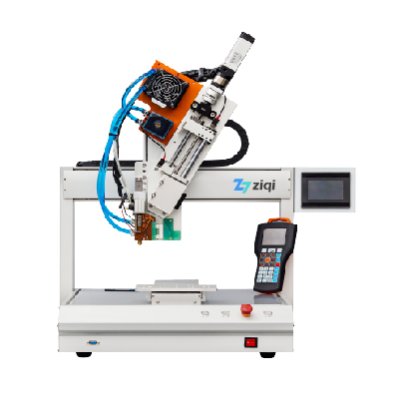
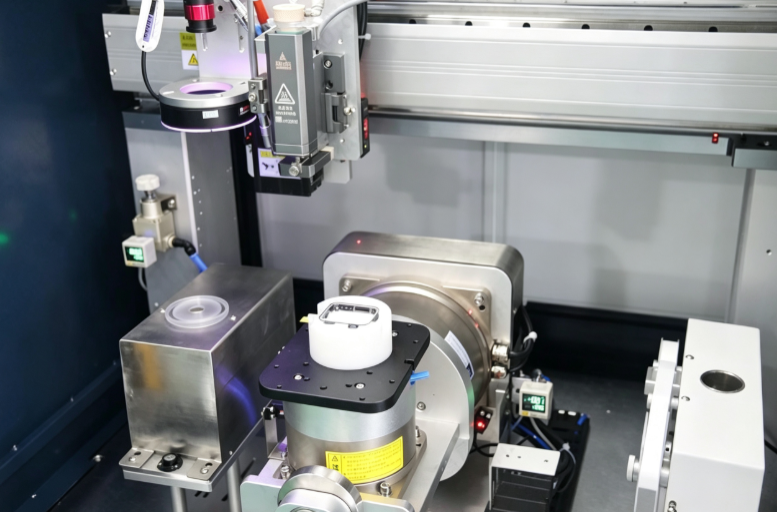
What Is a 5-Axis Vision Dispensing Machine?
A 5-axis vision dispensing machine is an automated precision dispensing system designed for adhesive application on complex three-dimensional workpieces. It combines three linear motion axes (X, Y, and Z) with two rotary axes, commonly designated as A and C, allowing the dispensing valve or workpiece to change orientation during operation.
Compared with conventional 3-axis dispensing machines, a 5-axis system provides greater flexibility for dispensing on curved surfaces, inclined areas, side surfaces, and irregular product structures.
By integrating five-axis motion control, machine vision positioning, and precision dispensing technology, the system can identify workpiece positions, compensate for positioning deviations, and execute programmed dispensing paths. It is particularly suitable for electronic components and precision products requiring multi-angle adhesive application.
How Does a 5-Axis Vision Dispensing Machine Work?
A 5-axis vision dispensing machine combines visual positioning, coordinate calibration, and coordinated motion control to perform automated dispensing operations.
First, an industrial camera captures images of the workpiece and identifies predefined features, reference marks, or target positions. The vision system processes the detected information and converts the feature positions into machine coordinates through a calibrated coordinate relationship.
The motion controller then applies the necessary positional compensation and coordinates the X, Y, and Z linear axes with the two rotary axes. This allows the dispensing valve or workpiece to adjust its relative position and orientation according to the programmed dispensing path.
Finally, the dispensing system controls adhesive output while the machine follows the programmed trajectory to complete the application process.
This combination of vision positioning and five-axis movement helps improve positioning consistency and supports more flexible dispensing on complex three-dimensional structures. Actual positioning, calibration, and path-following capabilities depend on the machine configuration and vision system.
Key Technologies and Features
Five-Axis Motion Control
The machine integrates three linear axes and two rotary axes to support coordinated multi-axis movement. This configuration allows the dispensing valve or workpiece to change orientation according to the product geometry and process requirements.
Five-axis motion control is particularly useful for applications involving curved surfaces, inclined sections, side surfaces, and complex three-dimensional dispensing paths. By adjusting the relative angle between the dispensing valve and the workpiece, the system can access areas that may be difficult to reach with conventional three-axis equipment.
Vision Positioning System
An industrial camera and image processing software identify product features, reference marks, or target dispensing positions. The system compares detected positions with programmed coordinates to compensate for workpiece positioning deviations.
A 2D vision system can support feature recognition and coordinate correction, while optional 3D vision technology can provide additional surface or height information for applications requiring three-dimensional path guidance.
The appropriate vision configuration depends on the product structure and dispensing requirements. Standard vision positioning should not be confused with full 3D surface scanning or automatic three-dimensional path generation.
Precision Dispensing System
The dispensing system can be configured with different dispensing valves according to adhesive properties and process requirements. Options may include pneumatic dispensing valves, screw valves, and jet valves.
The appropriate dispensing method depends on factors such as adhesive viscosity, dispensing volume, application position, and production speed. Selecting a suitable dispensing valve helps maintain stable material output and consistent dispensing performance.
Intelligent Software and Programming
The control software allows operators to configure dispensing paths, motion parameters, valve operation, and vision positioning settings. Programmable processing parameters make it easier to adjust dispensing processes for different products.
Combined with vision positioning and multi-axis motion control, the system helps simplify product changeovers and supports flexible automated production.
5-Axis vs. 3-Axis Dispensing Machines
Both 3-axis and 5-axis dispensing machines are used in automated adhesive application, but they are designed for different process requirements.
A conventional 3-axis dispensing machine moves along the X, Y, and Z directions. It is generally suitable for flat surfaces, regular workpieces, and standard dispensing paths.
A 5-axis dispensing machine adds two rotary axes, providing additional control over the relative orientation of the dispensing valve and workpiece. This allows the equipment to handle multi-angle dispensing, including applications involving inclined surfaces, curved structures, side areas, and complex three-dimensional components.
For products with relatively simple structures and conventional dispensing paths, a 3-axis system may be sufficient. For applications requiring greater angular flexibility or access to complex dispensing positions, a 5-axis system may offer a more suitable solution.
The choice between the two systems should be based on the actual product geometry, dispensing path, and production requirements rather than the number of motion axes alone.
Main Applications of 5-Axis Vision Dispensing Machines
5-axis vision dispensing machines are suitable for precision manufacturing processes involving complex product structures and multi-angle adhesive application.
3C Electronics Manufacturing
Typical applications include smartphone components, camera modules, smartwatches, TWS earbuds, and other electronic products. The equipment can support adhesive dispensing, component bonding, and sealing processes on products with complex structures and limited dispensing access.
Smart Wearable Devices
Smart rings, VR/AR headsets, and other wearable electronic products often feature compact structures and curved surfaces. Five-axis motion control helps the dispensing system adapt to different surface angles and programmed application paths.
Optical and Electronic Components
Optical modules, electronic connectors, and selected PCB-related components may require precise adhesive application in confined or irregular areas. Vision positioning and multi-axis movement help improve process adaptability and dispensing consistency.
Selected Semiconductor and Electronic Packaging Processes
Depending on the machine configuration and process requirements, five-axis dispensing equipment may also be suitable for selected component bonding, encapsulation, and protective material dispensing applications.
These processes require careful evaluation of material properties, dispensing volume, positioning requirements, and equipment capabilities before selecting a suitable system.
Advantages of 5-Axis Vision Dispensing Technology
Compared with conventional 3-axis dispensing systems, 5-axis vision dispensing machines offer several advantages for complex manufacturing applications.
Greater Multi-Angle Flexibility: Two additional rotary axes allow the dispensing valve or workpiece to change orientation, supporting adhesive application on different surface angles and complex product structures.
Improved Positioning Adaptability: Vision positioning helps identify workpiece features and compensate for placement deviations, reducing the impact of inconsistent product positioning.
Better Adaptability to Complex Paths: Coordinated multi-axis movement supports programmed dispensing along curved, inclined, and irregular surfaces, depending on the machine configuration.
More Flexible Automated Production: Programmable dispensing paths and vision-based positioning help manufacturers adapt to different product designs and improve production process consistency.
How to Choose the Right 5-Axis Dispensing Machine?
Selecting a suitable 5-axis dispensing machine requires evaluating the product structure and actual manufacturing process.
Important considerations include product dimensions, dispensing positions, surface geometry, adhesive viscosity, required dispensing volume, and production cycle time.
The dispensing valve, vision system, rotary axis configuration, and programming functions should be selected according to the specific application. For products requiring surface height measurement or complex three-dimensional path guidance, additional 3D vision capabilities may also need to be considered.
Before selecting equipment, it is recommended to evaluate actual workpieces and adhesive materials through process testing. This helps determine the appropriate machine configuration and ensures that the proposed solution matches the production requirements.
Frequently Asked Questions
Can a 5-Axis Dispensing Machine Apply Adhesive to Curved Surfaces?
Yes. A 5-axis dispensing machine can support adhesive application on curved surfaces by coordinating its linear and rotary axes to adjust the relative angle between the dispensing valve and the workpiece. Actual capabilities depend on the machine structure, motion range, and programmed dispensing path.
Does a 5-Axis Vision Dispensing Machine Require a 3D Camera?
Not necessarily. A 2D vision system can identify product features and compensate for positioning deviations. A 3D vision system may be required when the application involves surface height measurement, contour recognition, or three-dimensional path guidance.
Is a 5-Axis Dispensing Machine Better Than a 3-Axis Dispensing Machine?
Not in every application. A 3-axis dispensing machine is generally sufficient for regular workpieces and standard dispensing paths. A 5-axis system offers greater flexibility for multi-angle dispensing and complex three-dimensional structures. The appropriate choice depends on the product design and process requirements.
5-Axis Vision Dispensing Solutions by Shenzhen Ziqi Technology Co., Ltd.
Shenzhen Ziqi Technology Co., Ltd. focuses on industrial automation and precision dispensing solutions, providing equipment options for manufacturers seeking flexible adhesive application and automated production processes.
From electronic components to products with curved surfaces and complex dispensing positions, selecting the right equipment configuration is essential for achieving stable and consistent production.
Contact Shenzhen Ziqi Technology Co., Ltd. with your product details, dispensing requirements, and application images. Our team can help evaluate your process and discuss a suitable automated dispensing solution.