
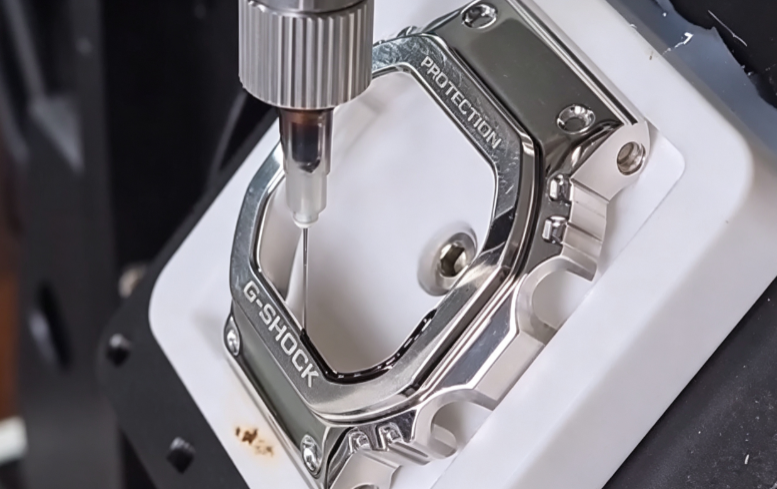
Smartwatches require reliable sealing to protect internal electronic components from water and moisture. However, their frames often feature curved edges, rounded corners, and irregular contours, making precise adhesive application challenging.
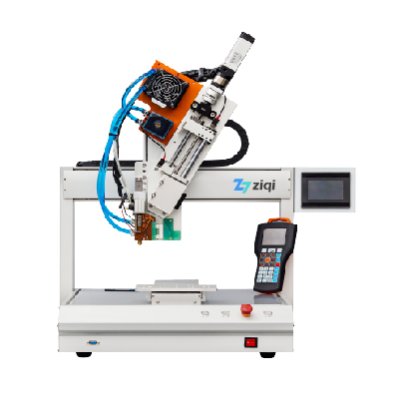
A 5-axis dispensing machine improves the flexibility of adhesive application by adjusting the dispensing head orientation and following complex frame contours. When combined with accurate dispensing control, it helps manufacturers achieve more consistent adhesive beads and improve the sealing process.
Flexible Dispensing for Complex Frame Contours
Smartwatch frames may include curved edges, inclined surfaces, and narrow sealing areas that require precise dispensing paths and different tool orientations.
A typical 5-axis dispensing machine combines three linear axes (X, Y, and Z) with two rotary axes, commonly designated as A and C, depending on the machine configuration.
This multi-axis movement allows the dispensing head to adjust its angle while following complex three-dimensional contours. Compared with conventional three-axis dispensing, it provides greater flexibility for applying adhesive to curved and multi-angle sealing areas.
Consistent Adhesive Bead Application
Consistent adhesive bead width, height, and continuity are essential for reliable sealing. Gaps, interruptions, or excessive adhesive may affect assembly quality and increase the risk of sealing defects.
When combined with a suitable dispensing valve or pump and properly adjusted process parameters, a 5-axis dispensing machine can coordinate adhesive output with the movement path. This helps improve bead consistency and reduce common defects such as missing adhesive, uneven application, and overflow.
Improved Production Efficiency and Automation
A 5-axis dispensing machine can automate complex adhesive application paths, reducing manual operations and improving process repeatability.
Depending on production requirements and system configuration, it can also be integrated with automatic loading, positioning, curing, and other manufacturing processes. This helps streamline production workflows and maintain consistent dispensing results across different batches.
Reduced Adhesive Waste and Production Costs
Accurate dispensing path planning and controlled adhesive output help minimize unnecessary adhesive application, overflow, and material waste.
For manufacturers using high-cost sealing adhesives, reducing excess material and rework can improve material utilization and help optimize overall production costs.
Dispensing Program Management and Process Traceability
A 5-axis dispensing system can be equipped with software for storing dispensing programs and process parameters.
These functions allow manufacturers to reproduce established dispensing paths, manage different product recipes, and trace process settings when quality issues occur. Additional monitoring functions can also be integrated according to production requirements.
Conclusion
A 5-axis dispensing machine provides greater motion flexibility and controlled adhesive application for complex smartwatch frame sealing. By following curved and multi-angle contours, it helps manufacturers improve adhesive bead consistency, reduce dispensing defects, and support automated production.
However, the final water-resistance performance of a smartwatch also depends on its sealing design, adhesive properties, surface preparation, assembly conditions, curing process, and product testing. Precision dispensing is an important part of achieving reliable sealing in wearable electronics manufacturing.
Frequently Asked Questions
Why use a 5-axis dispensing machine for smartwatch frames?
A 5-axis dispensing machine provides additional rotary motion, allowing the dispensing head to follow curved and inclined surfaces more flexibly. This helps improve adhesive application along complex frame contours.
How does precision dispensing improve smartwatch sealing?
Controlled adhesive output and consistent dispensing paths help reduce gaps, interruptions, and excessive adhesive application, supporting more reliable sealing processes.
Can a 5-axis dispensing machine guarantee smartwatch waterproof performance?
No. The machine helps improve adhesive application, but the final water-resistance performance depends on product design, sealing materials, assembly conditions, curing, and waterproof testing.
What factors affect the quality of smartwatch frame sealing?
Key factors include adhesive properties, bead width and height, dispensing path accuracy, surface preparation, assembly conditions, and curing parameters. These factors must work together to achieve reliable sealing.