
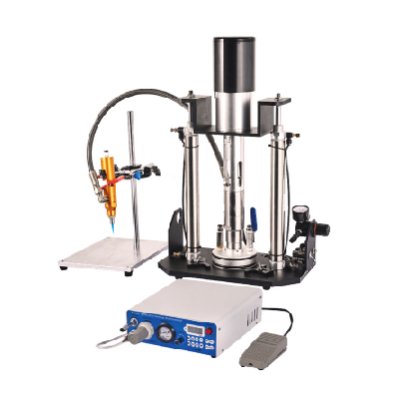
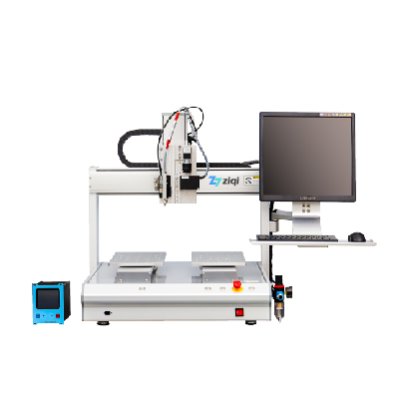
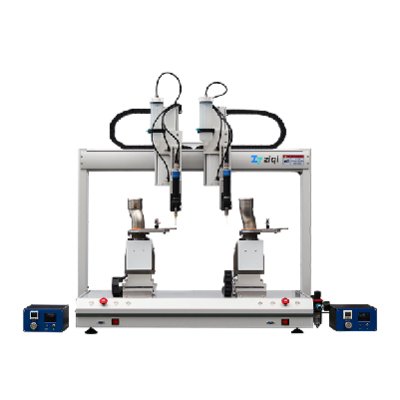
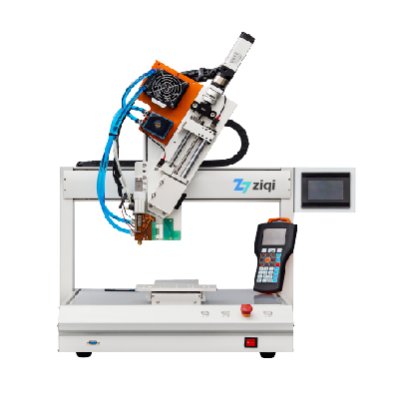

Smart glasses frames may feature curved contours, compact structures, and limited dispensing space, making precise adhesive application challenging. Depending on the product design, adhesive may need to be applied along selected frame sections or other designated bonding areas while maintaining a controlled dispensing path.
A 5-axis dispensing machine combines three linear axes (X, Y, and Z) with two rotational axes to provide greater flexibility when following complex three-dimensional paths. By coordinating machine motion with adhesive output, the system can help maintain a suitable nozzle position and orientation relative to the workpiece.
The appropriate solution depends on the frame geometry, adhesive properties, required bead dimensions, and assembly requirements. For simpler dispensing paths, a 3-axis system may be sufficient.
Why Is Adhesive Dispensing on Smart Glasses Frames Challenging?
Smart glasses frames can include curved surfaces, narrow sections, and changes in surface orientation. These features can make it difficult to maintain a suitable nozzle-to-surface relationship throughout the dispensing process.
Several factors need to be considered.
Curved dispensing paths
When adhesive must follow a curved contour, the dispensing nozzle needs to travel along the programmed path without unnecessary deviations. Complex three-dimensional geometries may also require coordinated changes in nozzle or workpiece orientation.
Limited working space
Compact frame structures can restrict nozzle access, particularly around narrow sections and recessed areas. The machine configuration must provide sufficient clearance to reach the intended dispensing locations without interfering with the workpiece or fixture.
Consistent adhesive bead geometry
The required bead width, height, and continuity depend on the application. Dispensing speed, material flow, nozzle size, and adhesive properties must be appropriately matched to achieve the specified result.
Repeatable workpiece positioning
The frame must be located securely in a suitable fixture. Positioning variations can affect the dispensing path and cause adhesive to be deposited outside the intended area.
Different frame designs
Smart glasses frames may vary in shape, dimensions, materials, and assembly requirements. Different products may therefore require different fixtures, dispensing paths, and process parameters.
Before selecting a machine, manufacturers should identify the actual adhesive application areas and determine whether the process requires three-dimensional motion or changes in nozzle orientation.
How Does a 5-Axis Dispensing Machine Apply Adhesive?
A 5-axis dispensing machine uses three linear axes and two rotational axes to coordinate the relative movement between the dispensing nozzle and the workpiece. Depending on the machine design, rotational motion may be provided by the dispensing head, the workpiece fixture, or a combination of both.
For smart glasses frame applications, the process generally involves five stages.
Position the Frame in a Dedicated Fixture
The frame is placed in a fixture designed to provide stable and repeatable positioning. The fixture establishes the workpiece reference position and helps prevent unwanted movement during dispensing.
Fixture design should account for the frame's shape, accessible dispensing areas, and the need to avoid obstructing the nozzle path.
Program the Dispensing Trajectory
The dispensing path is defined according to the intended adhesive application area and the geometry of the frame.
The programmed trajectory should account for curved sections, changes in surface direction, nozzle clearance, and the required start and end points. For products with different geometries, the dispensing program and fixture may need to be adjusted accordingly.
Coordinate Linear and Rotational Motion
During dispensing, the machine coordinates its linear and rotational movements to follow the programmed trajectory.
When the dispensing path changes direction or the surface orientation varies, rotational motion can help maintain a suitable nozzle-to-surface relationship. The actual benefit depends on the machine's axis configuration, working envelope, calibration, and motion programming.
Synchronize Adhesive Output With Movement
Adhesive output must be matched to the dispensing speed and the required bead geometry.
Depending on the material and dispensing method, process parameters may include flow rate, dispensing pressure or pump settings, nozzle size, and material temperature where applicable.
Coordinating adhesive delivery with machine movement can help reduce variations in deposited material, particularly during changes in travel speed.
The appropriate settings must be established through testing with the actual adhesive and workpiece.
Inspect and Validate the Dispensing Result
After dispensing, the workpiece should be inspected against the application requirements.
Relevant quality criteria may include:
·Adhesive bead position and continuity
·Bead width and height, where specified
·Coverage of the intended application area
·Excess adhesive or unwanted material deposits
·Repeatability across multiple workpieces
The inspection method should reflect the actual assembly function. Adhesive application on a smart glasses frame should not automatically be assumed to be for sealing, waterproofing, or structural bonding without confirmation of the product design.
When Is a 5-Axis Dispensing Machine Better Than a 3-Axis System?
The main difference between 3-axis and 5-axis dispensing is the available motion flexibility, not simply the number of axes.
A 3-axis dispensing machine uses X, Y, and Z linear movement. It can be suitable when the workpiece is presented in a fixed orientation and the required dispensing path can be reached without additional rotational movement.
A 5-axis dispensing machine adds two rotational axes, which can help the system follow more complex three-dimensional trajectories and accommodate changes in surface orientation.
A 5-axis configuration may be worth considering when:
·The dispensing path follows complex three-dimensional contours.
·Different sections of the frame require different nozzle orientations.
·A fixed nozzle orientation limits access to the intended dispensing area.
·Multiple dispensing locations require coordinated rotational movement.
However, a 5-axis system is not automatically more accurate or more productive than a 3-axis machine. Actual performance depends on mechanical repeatability, calibration, fixture stability, trajectory planning, dispensing control, and cycle-time requirements.
The best configuration is the one that meets the application's technical requirements without unnecessary mechanical complexity.
How Should Manufacturers Select a Dispensing Machine for Smart Glasses Frames?
Selecting suitable dispensing equipment requires evaluating the complete application rather than choosing a machine based on its axis count alone.
Workpiece Geometry and Dispensing Area
Assess the frame dimensions, curvature, accessible surfaces, and intended adhesive application locations. Determine whether the required path can be completed with linear motion or whether rotational movement is necessary.
Adhesive Properties and Dispensing Requirements
Identify the adhesive type, viscosity, required bead dimensions, dispensing volume, and curing requirements. These factors help determine the appropriate dispensing valve, material supply system, and process settings.
No single valve or supply method is suitable for every adhesive. The final configuration should be based on material compatibility and application testing.
Motion System and Fixture Design
Evaluate the machine's working envelope, rotational range, nozzle clearance, and fixture arrangement. The system must be able to reach the required dispensing locations while maintaining stable workpiece positioning.
Positioning and Inspection Requirements
If frame recognition or position compensation is required, a vision system may be considered. Vision positioning is a separate capability from five-axis motion and requires appropriate imaging, lighting, calibration, and control integration.
Inspection requirements should also be defined before production. Depending on the application, manufacturers may need to verify bead position, dimensions, continuity, or other product-specific acceptance criteria.
Process Validation Before Production
Before finalizing the equipment configuration, test representative workpieces using the intended adhesive and dispensing conditions.
The evaluation should consider dispensing quality, repeatability, cycle time, material consumption, and any application-specific acceptance criteria. Testing helps determine whether a 3-axis system is sufficient or whether the additional flexibility of a 5-axis configuration is justified.
ZiQi Precision Dispensing Solutions for Smart Glasses Components
Shenzhen ZiQi Technology Co., Ltd. develops industrial automation equipment and customized dispensing solutions for precision manufacturing applications.
For smart glasses frame dispensing, equipment configuration can be evaluated according to the component geometry, intended adhesive application area, material properties, required dispensing path, and production objectives.
Depending on the application requirements, the assessment may cover the motion configuration, dispensing valve, material supply method, workpiece fixture, path programming, and positioning requirements.
The final solution should be determined through engineering evaluation and application testing to confirm that the equipment meets the actual manufacturing requirements. Where the application does not require complex rotational motion, a simpler dispensing configuration may also be appropriate.
Frequently Asked Questions
Can a 5-axis dispensing machine apply adhesive to curved smart glasses frames?
Yes. A suitably configured 5-axis dispensing machine can coordinate linear and rotational movement to follow curved or complex three-dimensional dispensing paths. Suitability depends on frame geometry, nozzle access, machine configuration, and adhesive requirements.
Is a 5-axis dispensing machine always necessary for smart glasses production?
No. If the required dispensing path can be completed with the workpiece held in a fixed orientation, a 3-axis dispensing machine may be sufficient. Five-axis motion becomes more useful when additional rotational freedom is needed to reach the intended dispensing areas or follow complex contours.
What types of adhesive can be used for smart glasses frame assembly?
The appropriate adhesive depends on the frame materials, bonding requirements, environmental conditions, and curing process. Manufacturers should confirm material compatibility and validate the selected adhesive with the actual components before production.
Can vision positioning be integrated into a dispensing machine?
Yes, when the machine design supports vision integration. A vision system can help identify workpiece features or compensate for positioning variations, but its performance depends on imaging conditions, calibration, recognition methods, and mechanical setup.
How can manufacturers verify adhesive dispensing quality?
Manufacturers should establish application-specific acceptance criteria and test representative workpieces. Inspection may include bead position, continuity, dimensions, coverage, excess adhesive, and repeatability across multiple parts.
Conclusion
Applying adhesive to smart glasses frames requires suitable workpiece positioning, controlled dispensing trajectories, and coordination between machine movement and adhesive output.
A 5-axis dispensing machine can provide additional flexibility when the application involves complex three-dimensional paths or changes in surface orientation. However, equipment selection should be based on the actual frame geometry, adhesive requirements, and production objectives rather than axis count alone.
For manufacturers evaluating an automated dispensing solution, testing the intended workpiece and adhesive is an essential step toward establishing a suitable and repeatable process.