
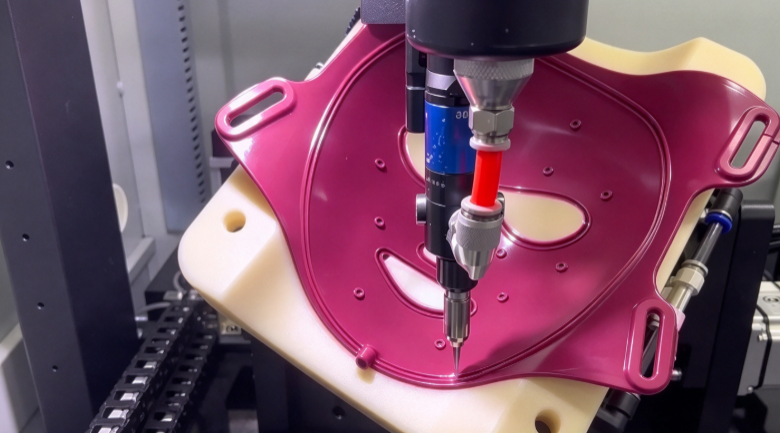
LED light therapy beauty masks feature three-dimensional contours and internal structures that may require adhesive application during assembly. Depending on the product design, dispensing may involve selected areas along the mask structure or other designated locations.
For manufacturers, the challenge is to apply adhesive along the required path while maintaining suitable nozzle positioning, material delivery, and clearance from surrounding components. A 5-axis dispensing machine provides additional motion flexibility by coordinating linear and rotary movements, making it a potential solution for dispensing applications involving curved paths and changing approach angles.
The appropriate configuration depends on the actual mask geometry, adhesive requirements, and production process.
Why Is Adhesive Dispensing on LED Beauty Masks Challenging?
Unlike flat components, LED beauty masks can have curved surfaces, varying contours, and restricted access to certain areas.
These characteristics can make automated dispensing more demanding, particularly when the nozzle must approach the workpiece from different directions.
Several factors influence the dispensing process:
Curved dispensing paths: The nozzle may need to follow contours and transitions rather than straight-line paths.
Multiple dispensing locations: Different areas may require separate paths, positioning movements, or dispensing settings.
Positioning accuracy: The workpiece must be held securely and located consistently to help maintain the programmed dispensing position.
Adhesive control: Material viscosity, dispensing pressure, nozzle characteristics, and travel speed influence the deposited adhesive.
Component clearance: The dispensing trajectory must account for nearby structures to help prevent unintended contact or adhesive overflow.
These challenges make motion planning, fixture design, and process validation essential when developing an automated dispensing solution.
How Does a 5-Axis Dispensing Machine Work?
A 5-axis dispensing machine combines linear and rotary motion to control the relative position and orientation of the dispensing nozzle and workpiece. Depending on the machine design, rotary axes may adjust the nozzle angle, reposition the workpiece, or perform a combination of movements.
For LED beauty mask applications, the dispensing process generally involves five stages.
Position the Mask in a Dedicated Fixture
The mask is placed in a fixture designed to support its shape and maintain a repeatable reference position during dispensing.
The fixture must provide sufficient stability while leaving the required dispensing areas accessible. Its design should also account for component clearances and the movement range of the dispensing head.
Consistent positioning helps the machine follow the programmed path relative to the actual workpiece.
Define the Dispensing Path
The dispensing program is developed according to the product geometry and the locations requiring adhesive application.
Depending on the application, the programmed path may include straight sections, curved contours, or multiple separate dispensing locations. The path must be coordinated with the machine's available motion range and nozzle access.
Before production, the dispensing trajectory should be checked for potential interference and tested using the actual workpiece.
Coordinate Nozzle Position and Orientation
During operation, the machine follows the programmed trajectory while controlling the relative movement between the nozzle and the mask.
Five-axis motion can provide additional flexibility when the dispensing path requires changes in nozzle orientation or access to areas that are difficult to reach using fixed-angle motion.
The actual movement configuration depends on the machine's mechanical design. Some systems rotate the dispensing head, while others move the workpiece or coordinate both.
Importantly, five-axis capability does not automatically mean that all five axes move simultaneously throughout the entire dispensing process. The achievable motion depends on the machine configuration and control system.
Dispense Adhesive Along the Required Path
The dispensing system delivers adhesive according to the programmed path and process settings.
To achieve the required deposit, material delivery must be matched to travel speed, nozzle characteristics, adhesive properties, and the geometry of the target area. Changes in speed or direction may require appropriate adjustments to the dispensing sequence.
The adhesive pattern and application method must be determined by the actual assembly requirements. The presence of an LED circuit board or a curved mask structure alone does not establish whether the adhesive is intended for bonding, sealing, component fixation, or another purpose.
Verify the Dispensing Result
After dispensing, the workpiece should be inspected against defined process requirements.
Depending on the application, relevant checks may include:
·Adhesive placement relative to the target area
·Deposited volume or bead dimensions
·Bead continuity, where a continuous path is required
·Unwanted overflow or contact with surrounding components
·Repeatability across multiple workpieces
If machine vision is required to compensate for variations in workpiece position, it can be considered as part of the system configuration. Its suitability depends on the positioning requirements, camera setup, calibration, lighting, and software capabilities.
Process validation using the intended adhesive and actual workpieces is necessary before production release.
Is a 5-Axis Dispensing Machine Better Than a 3-Axis System?
A 5-axis dispensing machine is not necessarily the best choice for every LED beauty mask.
A conventional 3-axis system may be sufficient when the dispensing paths are accessible from a fixed nozzle orientation and the workpiece can be positioned appropriately.
A 5-axis system may be worth evaluating when the process involves:
·Curved paths with changing surface orientations
·Dispensing locations that require different nozzle approach angles
·Restricted access that cannot be adequately addressed through three-axis movement alone
·More complex positioning requirements within the available working envelope
The key difference is motion flexibility, not an automatic guarantee of better dispensing quality.
Before selecting the equipment, manufacturers should determine whether additional rotary movement is genuinely needed to execute the required path. The decision should also consider cycle time, fixture complexity, adhesive behavior, maintenance requirements, and overall production cost.
What Should Manufacturers Consider When Selecting a Dispensing Machine?
Selecting a suitable dispensing system begins with the product and process rather than the number of axes.
Workpiece geometry: Review the mask's contours, target dispensing areas, internal structures, and available nozzle access.
Adhesive properties: Confirm the material's viscosity, curing requirements, substrate compatibility, and required deposit volume.
Motion requirements: Determine whether fixed-angle dispensing is sufficient or whether coordinated rotary movement is necessary.
Fixture design: Ensure that the mask can be positioned repeatably without obstructing the dispensing path or damaging sensitive components.
Production requirements: Define the required cycle time, loading method, process consistency, and quality acceptance criteria.
Testing and validation: Evaluate the proposed configuration using actual workpieces and the intended adhesive. Verify dispensing placement, material delivery, repeatability, and cycle time before finalizing the solution.
A suitable dispensing machine should meet the demonstrated process requirements. Selecting equipment based on axis count alone may lead to unnecessary complexity or an unsuitable configuration.
ZiQi's Approach to Automated Dispensing Solutions
Shenzhen ZiQi Technology Co., Ltd. provides industrial dispensing equipment and customized automation solutions for manufacturing applications.
For LED beauty mask dispensing, equipment planning should begin with an assessment of the workpiece geometry, target dispensing locations, adhesive characteristics, and production requirements.
Based on this assessment, the proposed solution can be evaluated in terms of motion configuration, fixture design, dispensing control, and any additional positioning or vision functions required by the process.
Actual equipment capabilities and application suitability should be confirmed through technical review and sample testing rather than assumed from the product category.
Manufacturers considering an automated dispensing solution can provide product drawings or samples, adhesive specifications, target dispensing locations, and production requirements to support a more accurate technical evaluation.
Frequently Asked Questions
What is a 5-axis dispensing machine?
A 5-axis dispensing machine combines linear and rotary motion to control the relative position and orientation of the dispensing nozzle and workpiece. The exact movement configuration depends on the machine's mechanical design and control system.
Why use a 5-axis dispensing machine for LED beauty masks?
Five-axis motion may help when dispensing paths involve curved contours, changing approach angles, or areas that are difficult to access with fixed-angle movement. Whether it is necessary depends on the actual product geometry and dispensing requirements.
Can a 3-axis dispensing machine handle LED beauty masks?
Yes, potentially. A 3-axis system may be suitable when the required dispensing paths are accessible without additional rotary movement. The decision should be based on the workpiece, fixture, nozzle access, and process requirements.
Does LED beauty mask dispensing require machine vision?
Not always. A well-designed fixture may provide sufficient positioning repeatability for some applications. Machine vision may be useful when feature recognition or compensation for workpiece-position variation is necessary.
How can dispensing quality be evaluated?
Quality can be assessed using predefined acceptance criteria for adhesive placement, deposit volume, bead dimensions where applicable, unwanted overflow, repeatability, and cycle time. Testing should use the actual workpiece and intended adhesive.
Conclusion
Automated adhesive dispensing for LED light therapy beauty masks requires appropriate coordination of workpiece positioning, dispensing paths, nozzle movement, and material delivery.
A 5-axis dispensing machine may offer greater flexibility when curved paths or changing nozzle orientations make the process difficult for a conventional three-axis system.
However, the most suitable solution depends on the actual product geometry, adhesive requirements, and production targets. Evaluating the dispensing process with real workpieces and the intended adhesive is the most reliable way to determine the required machine configuration.