
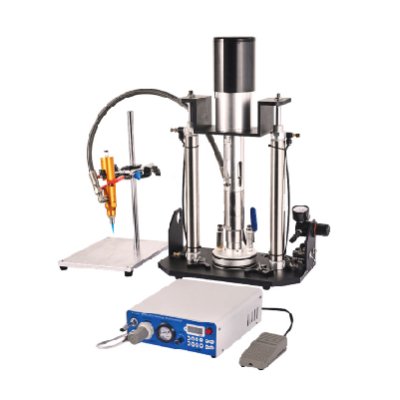
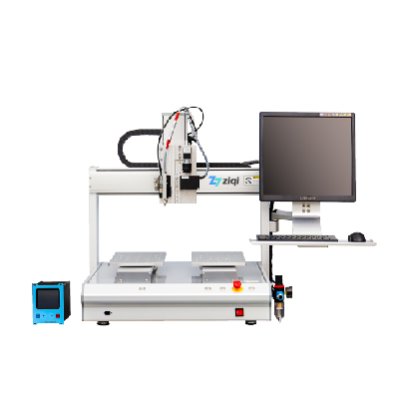
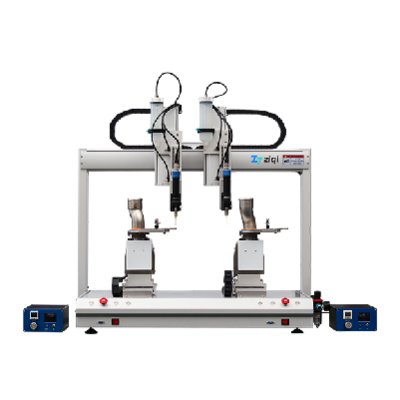
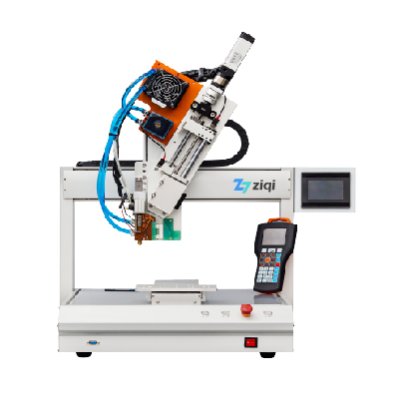
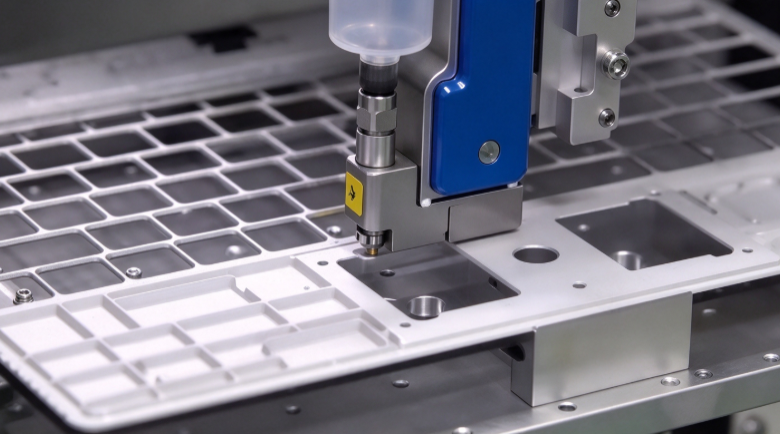
Laptop housing assembly may require adhesive to be applied along curved edges, recessed features, angled surfaces, or other three-dimensional contours. These geometries can make it challenging to maintain a consistent dispensing path, nozzle orientation, and adhesive bead.
A 5-axis dispensing machine may provide greater flexibility when an application requires coordinated linear and rotary motion to reach different surfaces or follow complex dispensing paths. For flat surfaces and relatively simple paths, a conventional 3-axis dispensing machine may remain a practical solution.
The right equipment depends on the housing geometry, adhesive properties, required bead dimensions, positioning tolerances, and production targets. Five-axis motion can expand dispensing capabilities, but it does not automatically guarantee higher dispensing accuracy, faster production, or a specific sealing performance.
In this guide, Shenzhen Ziqi Technology Co., Ltd. explains the key considerations for evaluating a 5-axis dispensing machine for laptop housing applications, including motion flexibility, vision positioning, adhesive process control, and equipment selection.
Why Is Adhesive Dispensing on Laptop Housings Challenging?
Laptop housings can incorporate different surface profiles, narrow bonding areas, recessed features, and curved edges. Depending on the product design, adhesive may be required for bonding, component assembly, or enclosure sealing.
Several factors can affect the dispensing process.
Complex three-dimensional geometry
Curved contours, angled surfaces, and recessed areas can make it difficult to maintain the required nozzle position throughout a dispensing path. Some areas may be difficult to access without changing the nozzle or workpiece orientation.
Nozzle orientation and working distance
The nozzle must approach the workpiece at a suitable angle and maintain an appropriate distance from the dispensing surface. Changes in surface geometry may require coordinated adjustments to the nozzle orientation or workpiece position.
Workpiece positioning and dimensional variation
Variations in fixture positioning, workpiece dimensions, or assembly tolerances can cause the actual dispensing location to differ from the programmed path. Vision-assisted positioning may help compensate for certain positional deviations when the equipment supports the required functions.
Adhesive properties and process parameters
Adhesive viscosity, dispensing pressure, nozzle diameter, material temperature, travel speed, and start-stop control can influence bead width, height, continuity, and material accumulation.
Bonding and sealing requirements
For bonding applications, manufacturers must evaluate adhesive coverage and the resulting bond performance. For sealing applications, the process must also support the required sealing design and final product validation.
The objective is not simply to move the nozzle along a programmed path. It is to establish a repeatable dispensing process that meets the application's material, geometric, and quality requirements.
How Does a 5-Axis Dispensing Machine Work on Complex Laptop Housings?
A typical 5-axis dispensing machine combines three linear axes—X, Y, and Z—with two rotary axes. The rotary axes are often designated A and B, although the actual configuration depends on the machine design.
The linear axes provide movement along three spatial directions, while the rotary axes provide additional angular movement. Depending on the machine's kinematics, the rotary motion may change the nozzle orientation, the workpiece orientation, or a combination of both.
For suitable laptop housing applications, this additional motion flexibility can provide several potential advantages.
Access to Complex Dispensing Paths
A five-axis system may help reach selected angled surfaces, curved sections, and other areas that are difficult to access with a fixed nozzle orientation.
Its suitability depends on the required path, available rotary-axis travel, fixture design, nozzle clearance, and the machine's motion capabilities.
More Flexible Nozzle Orientation
Coordinated linear and rotary movement can help maintain a suitable nozzle angle and working distance as the dispensing path changes direction or surface orientation.
However, achieving the required bead geometry also depends on the adhesive properties, dispensing parameters, nozzle design, and process calibration.
Integration with Vision Positioning
When equipped with a compatible vision system, a dispensing machine may identify selected workpiece features and correct certain positioning deviations.
The available functions depend on the camera configuration, calibration method, software, and control system. Vision positioning should not be assumed to provide automatic three-dimensional path compensation unless the equipment specifically supports it.
Potentially Fewer Repositioning Operations
For suitable applications, five-axis motion may reduce the need to reposition a workpiece or perform separate dispensing operations from different orientations.
Whether this improves cycle time or production efficiency depends on the complete process, including loading, unloading, inspection, dispensing, and any required curing operations.
For Shenzhen Ziqi Technology Co., Ltd., the appropriate equipment configuration should be evaluated against the actual laptop housing geometry, dispensing path, and process specifications rather than selected solely by the number of axes.
Which Technical Parameters Should You Evaluate When Selecting a 5-Axis Dispensing Machine?
Selecting a dispensing machine requires more than checking the number of axes or the maximum travel speed. Manufacturers should evaluate the following parameters against the actual application.
Positioning Accuracy and Repeatability
Positioning accuracy describes how closely a machine reaches a specified target position. Repeatability describes how consistently it returns to the same position under defined conditions.
These specifications are important for precision dispensing, but they do not directly establish the accuracy of the final adhesive bead.
Actual dispensing results can also be affected by calibration, workpiece tolerances, fixture stability, nozzle condition, motion control, and adhesive behavior.
Ask the equipment supplier for the relevant specifications, measurement methods, and test conditions. Where tight tolerances are required, validate the complete dispensing process using representative workpieces.
Rotary-Axis Travel and Nozzle Accessibility
Check whether the available rotary-axis range can reach the required dispensing surfaces and maintain an appropriate nozzle orientation throughout the path.
Important considerations include:
·Required angular movement and path complexity
·Nozzle clearance and potential mechanical interference
·Fixture dimensions and workpiece orientation
·Accessibility of recessed or angled areas
·Motion coordination and programming capabilities
A machine may have five axes but still be unsuitable for a particular application if its motion range or mechanical configuration cannot reach the required dispensing locations.
Vision Positioning and Calibration
A compatible vision system may help identify workpiece features and compensate for certain positioning variations.
Before selecting a vision-assisted dispensing solution, confirm:
·Whether the system supports the required feature recognition
·Whether calibration between the camera and dispensing coordinates is available
·Whether the system supports the necessary positional correction
·Whether three-dimensional path compensation is required and supported
·How the system performs under actual lighting and workpiece conditions
Vision positioning can improve alignment when correctly configured, but the achievable result must be established through testing.
Adhesive Compatibility and Dispensing Control
The dispensing system must be compatible with the specific adhesive and application process.
Key factors include adhesive viscosity, material stability, dispensing pressure, flow control, nozzle diameter, required bead dimensions, and start-stop behavior.
Different adhesive types may require different handling and curing arrangements.
For example, UV-curable adhesives require suitable curing conditions based on the material formulation and light-source requirements. Polyurethane reactive (PUR) adhesives may require specific temperature control, moisture management, or other material-handling measures, depending on the formulation.
Manufacturers should confirm the material specifications and process requirements before finalizing the dispensing system configuration.
Cycle Time and Production Integration
Evaluate the complete production cycle rather than motion speed alone.
The assessment should include workpiece loading and unloading, positioning, vision inspection, dispensing, any required curing, and integration with upstream and downstream processes.
A representative production trial can help establish whether the proposed equipment meets the required cycle time, quality criteria, and production volume.
Programming, Maintenance, and Process Validation
Complex dispensing paths may require more advanced programming and calibration.Manufacturers should consider how dispensing programs are created, adjusted, stored, and validated when product designs or process requirements change.
Also evaluate maintenance access, consumable replacement, operator training, and the availability of technical support.
These factors influence the long-term practicality of an automated dispensing solution.
Can a 5-Axis Dispensing Machine Guarantee IPX5-Rated Sealing Performance?
No. A five-axis dispensing machine can help control adhesive application on complex surfaces, but five-axis motion alone cannot guarantee a specific ingress protection rating.
For products targeting an IPX5 rating under IEC 60529, the completed enclosure must be validated against the applicable water-jet test requirements.
The final sealing performance depends on multiple factors, including:
·Enclosure and sealing design
·Adhesive compatibility with the housing materials
·Adhesive bead continuity, placement, and dimensions
·Bonding conditions and curing quality
·Assembly tolerances and process consistency
·Product-level inspection and validation
Even a well-controlled adhesive dispensing process cannot compensate for every potential weakness in enclosure design, material compatibility, or assembly.
Manufacturers should therefore distinguish between dispensing process capability and the final product's verified sealing performance.
The dispensing machine is one part of the manufacturing process. Any claimed IP rating must be supported by the applicable validation of the completed product.
Is a 5-Axis Dispensing Machine Suitable for Every Laptop Housing Application?
Not necessarily. The appropriate solution depends on the geometry of the housing, the required dispensing path, adhesive specifications, and production targets.
A five-axis dispensing machine is worth evaluating when the application requires changing nozzle orientations, access to angled surfaces, or coordinated motion along complex three-dimensional contours.
A conventional three-axis dispensing machine may remain the more practical option for flat surfaces, straightforward paths, and applications that do not require additional rotary movement.
Before selecting equipment, manufacturers should consider:
·Workpiece dimensions, geometry, and material
·Number and complexity of dispensing paths
·Required bead width, height, and continuity
·Positioning and dispensing tolerances
·Adhesive properties and process requirements
·Required cycle time and production volume
·Equipment investment and integration requirements
The objective is to select the simplest equipment configuration that reliably meets the application's technical and production requirements.
Where the best configuration is uncertain, a feasibility assessment and dispensing trial can help compare possible solutions before equipmen investment.
What Trends Are Relevant to Automated Dispensing in Electronics Manufacturing?
Electronics manufacturing increasingly requires dispensing systems that can accommodate compact product structures, varied geometries, and demanding process requirements.
Several technologies are relevant to these applications.
·Multi-axis motion control: Additional rotary movement can help equipment access selected surfaces and follow more complex dispensing paths.
·Machine vision: Vision-assisted positioning may help identify workpiece features and compensate for supported positional deviations.
·Process monitoring: Monitoring dispensing parameters and evaluating process results can help manufacturers identify variation and improve process control.
·Production-line integration: Automated dispensing can be integrated with workpiece handling, inspection, and other manufacturing operations when the application and production layout permit.
·Advanced path planning and optimization: More advanced software may help simplify the programming of complex paths or support process optimization, depending on the system's actual capabilities.
These technologies should be assessed according to measurable manufacturing needs rather than assumed benefits. Their practical value depends on the equipment configuration, process design, and results obtained under actual production conditions.
Conclusion: How Should You Choose a Dispensing Machine for Laptop Housings?
A 5-axis dispensing machine can provide additional motion flexibility for selected laptop housing assembly and sealing applications. It may be particularly useful when dispensing requires changing nozzle orientations, access to angled surfaces, or coordinated movement along complex three-dimensional paths.
However, the right solution depends on the actual workpiece geometry, adhesive properties, required bead dimensions, positioning tolerances, and production targets. Neither five-axis motion nor vision positioning alone guarantees a particular dispensing accuracy, yield improvement, cycle time, or sealing rating.
Shenzhen Ziqi Technology Co., Ltd. provides automated dispensing equipment for industrial adhesive applications. Equipment suitability should be assessed against the specific workpiece, material, dispensing path, and process requirements.
Request an Application Assessment
To evaluate a dispensing solution for your laptop housing project, prepare the following information:
·Workpiece drawings, dimensions, or representative samples
·Housing material and surface characteristics
·Adhesive type and material specifications
·Required dispensing path and bead dimensions
·Target positioning tolerance and production cycle time
·Applicable bonding, sealing, or inspection requirements
With these details, the equipment configuration and dispensing process can be evaluated more accurately before production implementation.
Contact Shenzhen Ziqi Technology Co., Ltd. to discuss your automated dispensing requirements and determine whether a 3-axis or 5-axis solution is appropriate for your application.
Frequently Asked Questions
What is a 5-axis dispensing machine?
A 5-axis dispensing machine typically combines three linear axes and two rotary axes to provide additional flexibility for dispensing along complex paths and angled surfaces. Its actual capabilities depend on the machine's motion configuration.
What is the difference between a 3-axis and a 5-axis dispensing machine?
A 3-axis system provides linear movement along the X, Y, and Z axes. A 5-axis system adds two rotary axes, allowing greater flexibility in nozzle or workpiece orientation, depending on the machine design.
Can a 5-axis dispensing machine be used for laptop housing adhesive application?
It may be suitable for laptop housing applications involving complex contours, angled surfaces, or changing nozzle orientations. The final equipment choice should be confirmed through workpiece evaluation and process testing.
Does vision positioning improve dispensing accuracy?
Vision positioning can help identify workpiece features and compensate for supported positional deviations. Actual dispensing accuracy also depends on calibration, mechanical performance, motion control, nozzle condition, and adhesive behavior.
What information is needed to select an automated dispensing machine?
Manufacturers should provide workpiece geometry, adhesive specifications, dispensing path requirements, target tolerances, cycle time, and applicable quality requirements. These details help determine the appropriate machine configuration.
About Shenzhen Ziqi Technology Co., Ltd.
Shenzhen Ziqi Technology Co., Ltd. provides automated dispensing equipment for industrial adhesive application. Equipment selection should be based on the specific workpiece, material, process requirements, and validated application performance.